

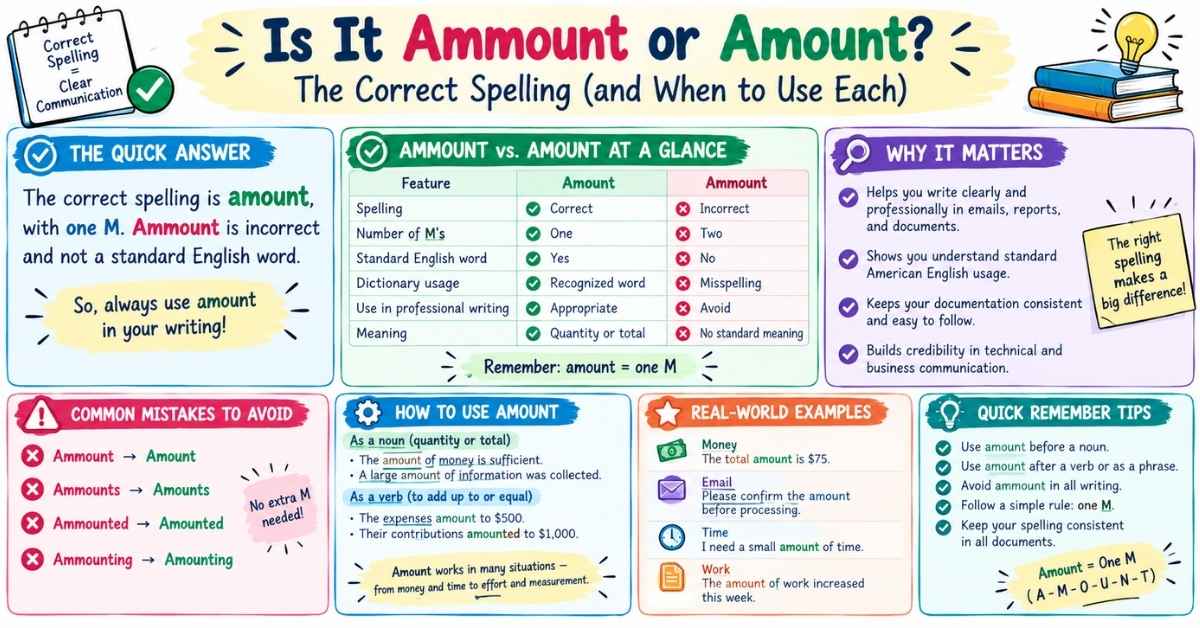
Is it ammount or amount? The correct spelling is amount, with only one M. The spelling “ammount” is incorrect and is not accepted in standard English. Although the extra letter may seem natural when typing quickly, there is no double-M version of this word. Whether you are writing an email, completing a school assignment, preparing an invoice, or discussing money, always use amount.
In this guide, you will learn what amount means, why ammount is incorrect, how to use the word in different sentences, and how to remember its spelling. We will also explain the difference between amount, number, and quantity so you can avoid common grammar mistakes.
Is It Ammount or Amount? The Correct Spelling
Amount is the correct spelling. It contains six letters: A-M-O-U-N-T. The word “ammount,” which contains an extra M, is a spelling mistake.
Here is a quick comparison:
| Word | Correct or Incorrect | Explanation |
|---|---|---|
| Amount | Correct | Standard English spelling |
| Ammount | Incorrect | Contains an unnecessary extra M |
For example:
- Correct: The total amount of the bill is $75.
- Incorrect: The total ammount of the bill is $75.
The correct spelling remains the same in casual conversations, academic writing, business documents, and professional communication.
If you are ever unsure, remember that amount has one M, not two.
What Does Amount Mean?
The word amount refers to the total quantity, value, or extent of something. It is commonly used when discussing things that can be measured or considered as a whole.
For example, amount can describe:
- Money paid for a product or service.
- Water or another liquid in a container.
- Time needed to complete a task.
- Effort invested in a project.
- Food or ingredients used in a recipe.
- Information collected for a report.
Consider these examples:
- The amount of money in my savings account increased this month.
- We need a small amount of water to prepare the mixture.
- She spent a considerable amount of time studying.
- The amount of effort he put into the project was impressive.
In each sentence, amount describes a quantity, measurement, or degree.
Amount as a Noun
Most commonly, amount functions as a noun. It identifies the quantity or total of something.
Examples:
- The amount of sugar in this recipe is too high.
- Please check the amount on your receipt.
- A large amount of information was collected.
- The company received a significant amount of financial support.
The noun can also be pluralized as amounts when discussing multiple quantities.
For example:
- Different amounts of money were deposited into the accounts.
- Small amounts of salt can improve the flavor of food.
Notice that the word still contains only one M when it becomes plural.
Amount as a Verb
Amount can also function as a verb. In this form, it means to add up to a particular total or to have a particular significance.
Examples:
- The monthly expenses amount to $2,000.
- Their combined contributions amounted to $500.
- His achievements amount to much more than a simple award.
The common verb forms are:
| Verb form | Example |
|---|---|
| Amount | The expenses amount to $500. |
| Amounts | The total amounts to $750. |
| Amounted | The expenses amounted to $1,200. |
| Amounting | The damages are amounting to thousands of dollars. |
Every form keeps the same single-M spelling.
Why Is Ammount Incorrect?
The spelling ammount is incorrect because the standard English word is written with one M. Adding another M does not create a different meaning, grammatical form, or regional variation.
There are several reasons people make this mistake.
1. Typing too quickly
When people write quickly, they sometimes repeat a letter accidentally. This commonly happens in emails, text messages, online forms, and other everyday communication.
2. Confusion with double-letter words
English contains many familiar words with double consonants, such as common, summer, and comment. This can make writers assume that amount might follow the same pattern.
However, amount has its own established spelling.
3. Pronunciation confusion
The way a word sounds does not always reveal how many times a particular consonant should appear in writing. Amount is pronounced with a single written M, regardless of how quickly someone says it.
4. Lack of proofreading
An extra letter can easily go unnoticed when someone is focused on the meaning of a sentence rather than its spelling.
The solution is simple: remember the standard spelling and proofread important documents before sending or submitting them.
Amount vs. Ammount: Key Differences
The main difference between amount and ammount is that one is a correct English word and the other is a misspelling.
| Feature | Amount | Ammount |
|---|---|---|
| Spelling | Correct | Incorrect |
| Number of M’s | One | Two |
| Standard English word | Yes | No |
| Dictionary usage | Recognized word | Misspelling |
| Professional writing | Appropriate | Avoid |
| Academic writing | Appropriate | Incorrect |
| Meaning | Quantity or total | No standard meaning |
Here are additional examples:
Example 1: Money
- Correct: What is the total amount of money required?
- Incorrect: What is the total ammount of money required?
Example 2: Time
- Correct: The amount of time available is limited.
- Incorrect: The ammount of time available is limited.
and Example 3: Shopping
- Correct: I checked the amount before paying.
- Incorrect: I checked the ammount before paying.
There is no situation in standard English where the double-M spelling should replace amount.
How to Use Amount Correctly in a Sentence
Understanding the definition is useful, but seeing the word in different situations makes it easier to use correctly.
Here are some practical examples from everyday American English.
Amount in Everyday Writing
| Situation | Example sentence |
|---|---|
| Shopping | The amount on the receipt does not match the price tag. |
| Cooking | Add a small amount of butter to the pan. |
| Education | The amount of homework was manageable. |
| Time | I need a reasonable amount of time to finish. |
| Savings | She saved a considerable amount of money. |
| Work | The amount of work increased this week. |
Amount in Professional Writing
The word is also common in business and formal communication.
In an email:
Please confirm the amount before processing the payment.
In a financial report:
The total amount received during the reporting period was $15,000.
On an invoice:
Please review the outstanding amount and complete the payment by the due date.
In an academic assignment:
The amount of evidence collected supports the research findings.
These examples demonstrate why using the correct spelling matters. A small typing error may not change the intended meaning, but it can make an otherwise professional document look less polished.
Amount vs. Number vs. Quantity: What Is the Difference?
Although these words are related, they are not always interchangeable. Choosing the right one can improve your English grammar and make your sentences more precise.
When to Use Amount
Use amount when discussing something that is generally uncountable or measured as a whole.
Examples:
- A large amount of water.
- A small amount of sugar.
- A considerable amount of time.
- A significant amount of information.
When to Use Number
Use number when referring to individual things that can be counted.
Examples:
- A large number of students.
- A small number of books.
- The number of employees increased.
- A considerable number of customers attended.
For example:
- Correct: A large amount of money was spent.
- Correct: A large number of people attended the event.
Using “amount of people” in ordinary formal writing is generally less appropriate than using “number of people.”
When to Use Quantity
Quantity refers to how much or how many of something exists. It can work with both countable and uncountable nouns, although the sentence structure must still be grammatically correct.
Examples:
- The quantity of rice needed for the recipe is small.
- We ordered a large quantity of notebooks.
- The store received a limited quantity of products.
Here is a quick comparison:
| Word | Best used for | Example |
|---|---|---|
| Amount | Uncountable quantities | Amount of water |
| Number | Countable items | Number of books |
| Quantity | General measured or counted supply | Quantity of products |
Remembering this distinction helps you avoid grammar mistakes beyond the original amount-versus-ammount question.
read more >>> Is it visiter or visitor
Does American or British English Change the Spelling?
No. There is no American-versus-British spelling difference for this word.
Both American English and British English use the spelling amount.
| English variation | Correct spelling |
|---|---|
| American English | Amount |
| British English | Amount |
| Canadian English | Amount |
| Australian English | Amount |
Some English words have different regional spellings, but amount is not one of them.
For example, American English generally uses “color,” while British English uses “colour.” However, both use amount with one M.
Therefore, whether you are writing for a US audience, a UK audience, or international readers, you should always choose amount.
How to Remember the Correct Spelling
If you frequently confuse amount and ammount, a simple memory technique can help.
Remember the one-M rule: Amount = One M.
You can also break the spelling into individual letters:
A – M – O – U – N – T
Say each letter as you write it. This is especially useful when completing important documents, assignments, or professional emails.
Another helpful technique is to associate amount with a total.
For example:
- One amount of money.
- One M in amount.
The goal is to build a quick spelling habit so you no longer need to stop and reconsider the word whenever you type it.
Common Spelling Mistakes Related to Amount
The word amount has several grammatical forms. Writers sometimes add an unnecessary letter when changing its form.
Here are the correct versions:
| Incorrect spelling | Correct spelling |
|---|---|
| Ammount | Amount |
| Ammounts | Amounts |
| Ammounted | Amounted |
| Ammounting | Amounting |
Remember that changing the tense or making the word plural does not introduce another M.
For additional accuracy, use a spellchecker and review the complete sentence rather than relying entirely on automatic corrections.
Frequently Asked Questions
1. Is it ammount or amount?
Amount is correct. Ammount is an incorrect spelling containing an extra M. Always write amount in standard English.
2. Is ammount a real English word?
No. Ammount is not a standard English word. It is a common misspelling of amount and should not be used in formal or informal writing.
3. How do you spell amount correctly?
The correct spelling is A-M-O-U-N-T. It contains six letters and only one M.
4. Why is amount spelled with one M?
Amount follows its established English spelling. There is no second M in the standard word, and no spelling rule requires adding one.
5. What does amount mean?
Amount means the total quantity, value, or extent of something. It can refer to money, time, effort, substances, or other measurable things.
6. Is amount a noun or a verb?
Amount can function as both. As a noun, it means a quantity or total. As a verb, it means to add up to a particular figure or have a particular significance.
7. Is amount spelled the same in American and British English?
Yes. Both American English and British English use amount with one M. There is no regional spelling variation.
8. Can amount be plural?
Yes. The plural form is amounts. For example: Different amounts of money were deposited into the accounts.
9. What is the difference between amount and number?
Amount generally describes uncountable quantities, such as money, water, and time. Number describes countable things, such as people, books, and cars.
10. Is amounting spelled with one M or two?
The correct spelling is amounting, with one M. The same spelling rule applies to amounts and amounted.
Final Verdict: Amount or Ammount?
When deciding whether to write amount or ammount, always choose amount. It is the only correct spelling in standard English, and it contains just one M.
The word describes a quantity, total, or measurement and can function as both a noun and a verb. Its spelling remains unchanged in American and British English.
Remember the simple rule: one M in amount. Whether you are writing an email, preparing an invoice, completing an assignment, or communicating professionally, using the correct spelling will help keep your writing clear, accurate, and polished.
