

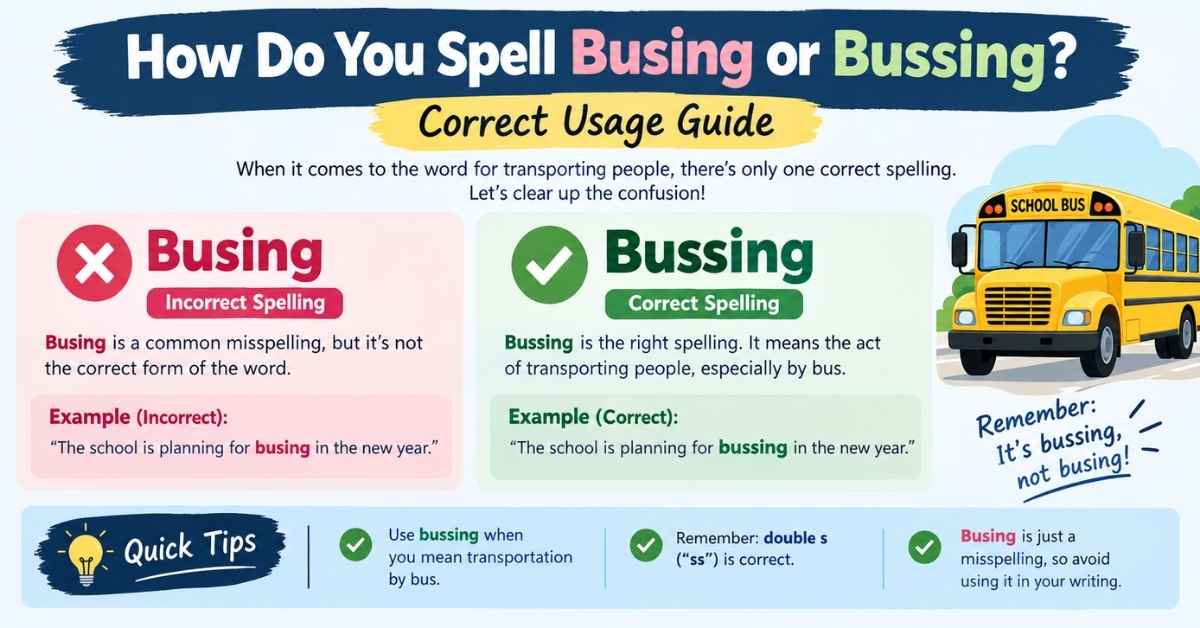
How do you spell busing or bussing? In American English, busing is the preferred spelling when you mean transporting people by bus.
Bussing is also recognized as a variant, but it can create confusion because it may refer to clearing restaurant tables or come from the word buss, meaning “to kiss.” For clear U.S. writing, use busing for transportation.
Busing or Bussing: The Short Answer
Both words exist, but the best choice depends on context.
| Context | Recommended spelling | Example |
|---|---|---|
| Transportation by bus | Busing | The district is busing students to another school. |
| Formal U.S. writing | Busing | Busing will begin Monday morning. |
| Clearing restaurant tables | Bussing is common | Her duties include bussing tables. |
| The verb buss, meaning “kiss” | Bussing | The couple was bussing beneath the mistletoe. |
| British transportation usage | Bussing may appear | The company is bussing workers to the site. |
The safest answer for most American writers is simple: write “busing” when a bus is transporting someone.
What Is the Difference Between Busing and Bussing?
The difference involves meaning, regional convention and editorial style. The words can occasionally overlap, but they are not equally clear in every situation.
Busing for Transportation
Busing is the present participle of bus when the verb means transporting people in a bus.
Examples:
- The school is busing children from rural neighborhoods.
- The resort is busing visitors to the ski area.
- The airline began busing passengers to the terminal.
- Organizers are busing volunteers to the event.
This is the preferred spelling in standard American transportation contexts.
Busing can also function as a noun:
- Student busing has become more expensive.
- The district changed its busing schedule.
- The proposal includes free busing for eligible students.
Merriam-Webster identifies busing as the main form and bussing as a less common variant. That distinction matters: both may be recognized, but “busing” is the clearer default for U.S. readers.
Bussing as an Accepted Transportation Variant
Bussing may also mean transporting people by bus. It is not automatically a spelling error.
You might encounter sentences such as:
- The company is bussing employees to the new facility.
- Fans were bussing into the city for the championship.
- Students are being bussed to a temporary campus.
This spelling is more likely to appear under regional or house-style conventions that double the final “s.” Nevertheless, American writers can avoid ambiguity by using busing and bused for transportation.
Bussing Tables in a Restaurant
In the U.S. restaurant industry, bussing tables commonly means removing used dishes, wiping the table and preparing it for the next customers.
Examples:
- The server needs help bussing tables.
- His first restaurant job involved bussing and washing dishes.
- The manager assigned two employees to bus the patio tables.
The worker performing this job is normally called a busser. Because busser contains a doubled “s,” writers often naturally use bussing in this context.
Some dictionaries and publications also allow busing tables, but bussing tables is familiar and immediately understandable in American restaurant usage.
Bussing When “Buss” Means to Kiss
Buss is an old-fashioned or humorous verb meaning to kiss. Its present participle is always bussing.
- The actor joked about bussing his costar on the cheek.
- The newlyweds were bussing for the camera.
This meaning is uncommon in everyday conversation, but it explains why editors sometimes reserve the double-s form for something other than transportation.
Which Spelling Should You Use in American English?
Use busing when writing about buses carrying students, passengers, workers, tourists or event attendees.
This recommendation is especially useful for:
- School notices
- Academic assignments
- News reports
- Government documents
- Transportation policies
- Business communication
- Travel information
- Website content
The Associated Press recommends bus, buses, bused and busing when referring to vehicles. That makes busing the strongest choice for American news-style and professional writing.
School and Student Transportation
Write school busing or student busing:
- The district expanded its school busing program.
- Winter weather disrupted student busing.
- Parents received an update about busing schedules.
The noun has an additional historical meaning in the United States. Desegregation busing refers to transporting students to schools outside their immediate neighborhoods to promote racial integration.
Because this is an established historical and legal term, busing is the expected spelling:
- The court approved desegregation busing.
- The debate over school busing intensified during the 1970s.
Writers should not assume that every mention of school busing refers to desegregation. In modern school communication, it may simply mean routine student transportation.
Professional, Academic and News Writing
If you are wondering, “Is it spelled busing or bussing in my assignment?”, choose busing for transportation unless your instructor or organization requires a different style.
An editor would normally prefer:
- The district is busing students.
Instead of:
- The district is bussing students.
The second form can be legitimate, but the first is more consistent with mainstream U.S. editorial practice and less likely to distract the reader.
British English and Regional Variation
British sources may use bussing more readily because British English is generally more willing to double final consonants in certain inflected forms.
However, regional variation is not absolute. Both spellings appear in multiple English-speaking countries, and dictionary policies differ. If you are writing for a specific publisher, follow its house style consistently.
Why Does Busing Have Only One “S”?
The confusion is understandable. Bus ends in a vowel followed by a single consonant, so writers may expect the final consonant to double before adding -ing.
That familiar pattern appears in:
- run → running
- sit → sitting
- stop → stopping
English spelling, however, contains conventional exceptions and competing forms. The transportation verb developed both busing and bussing, while modern American editorial usage increasingly favored the shorter form.
Think of it as an established spelling convention rather than a rule you must recalculate every time:
Bus transportation = busing in standard U.S. writing.
Busing, Bussing and Their Related Forms
Understanding the complete word family makes the choice easier.
| Base word | Preferred U.S. transportation form | Recognized variant |
|---|---|---|
| Bus | bus | — |
| Third-person singular | buses | busses is rare |
| Past tense | bused | bussed |
| Present participle | busing | bussing |
| Transportation noun | busing | bussing |
| Restaurant worker | busser | — |
| Kiss | buss | — |
| Kissing | bussing | — |
Bused or Bussed
For transportation in American English, bused is generally preferred:
- The hotel bused us to the airport.
- Students were bused to another campus.
- The organizers bused volunteers to the starting point.
Bussed is accepted as a variant and is more common under some British or regional conventions.
Buses or Busses
The standard plural of the vehicle is buses:
- Three buses arrived.
- The city purchased electric buses.
Busses is a recognized but uncommon plural variant. In most American writing, use buses.
Busser and Bussing Tables
A busser is a restaurant employee who clears and resets tables. Notice the doubled “s”:
- busser
- bussing tables
This restaurant spelling helps distinguish table service from passenger transportation, even though real-world usage sometimes overlaps.
Correct Examples of Busing and Bussing
Transportation Examples
- The city is busing residents to the emergency shelter.
- Our hotel provides busing between the airport and resort.
- The district stopped busing students during the storm.
- The production company is busing the crew to the location.
- Additional busing services will be available after the concert.
Restaurant Examples
- Mia spent the evening bussing tables.
- The restaurant hired another busser for weekends.
- Please bus the table after the guests leave.
- His duties include seating customers and bussing the dining area.
Kissing Examples
- The old novel described the couple bussing affectionately.
- He bussed her on the cheek.
Because this use sounds dated, kiss is normally clearer in modern writing.
Common Spelling Mistakes to Avoid
Treating One Form as Universally Wrong
It is inaccurate to say that bussing can never refer to transportation. Major dictionaries recognize it as a variant.
A more precise explanation is:
- Busing is preferred for transportation in American English.
- Bussing is an accepted variant and has additional meanings.
Assuming Every Dictionary Makes the Same Recommendation
A dictionary may record a word because people use it. That does not mean every editor or style guide gives it equal preference.
Always distinguish between:
- Recognized
- Grammatically possible
- Preferred in a particular style
Confusing Busing With Buses
Busing is a verb form or noun:
- The district is busing students.
Buses is normally the plural vehicle or a third-person verb:
- The district owns 20 buses.
- The company buses workers into town.
Using Bussing Without Enough Context
“The company is bussing people” may be understood, but the double “s” can briefly suggest another meaning. Busing eliminates that distraction for American readers.
A Simple Rule for Remembering the Difference
Use this editorial shortcut:
One “s” for transportation; two “s’s” for tables or kisses.
The rule is deliberately practical rather than absolute. Bussing can still be an accepted transportation variant, but busing remains the safest U.S. choice.
Before publishing, ask:
- Am I referring to transportation by bus?
- Is my audience primarily American?
- Does my organization follow AP or a similar U.S. style?
- Could the double-s spelling create ambiguity?
If the answers point toward U.S. transportation, write busing.
Frequently Asked Questions
Is It Spelled Busing or Bussing?
For transportation in American English, it is preferably spelled busing. Bussing is also an accepted variant, but it is less suitable when you want maximum clarity.
Are Both Spellings Correct?
Yes. Busing and bussing can both refer to transportation. However, busing is generally preferred in standard U.S. writing.
Is It School Busing or School Bussing?
Use school busing for an American audience:
- School busing was canceled because of snow.
- The board reviewed its student busing policy.
Is It Busing or Bussing Tables?
Bussing tables is the common restaurant-industry spelling. It means clearing dirty dishes and preparing tables for new customers.
Does Bussing Mean Kissing?
It can. Bussing is the present participle of the old-fashioned verb buss, meaning “to kiss.” Context normally makes the intended meaning clear.
What Is the Past Tense of Bus?
For transportation, bused is the preferred American spelling:
- The organization bused attendees to the conference.
Bussed is a recognized variant.
Why Isn’t Busing Spelled With Two S’s?
Both forms developed in English, but modern American convention generally favors busing for transportation. It is best treated as an established spelling rather than applying the consonant-doubling rule mechanically.
Final Verdict
If you are still asking, “Is it spelled busing or bussing?”, use busing when writing about transportation for a U.S. audience. Use bussing when discussing restaurant table clearing or the old-fashioned verb meaning “to kiss.”
Both spellings can be valid, but they are not equally clear in every context. For school transportation, passenger shuttles, news writing and professional American English, busing is the safest and most widely recommended choice.
