

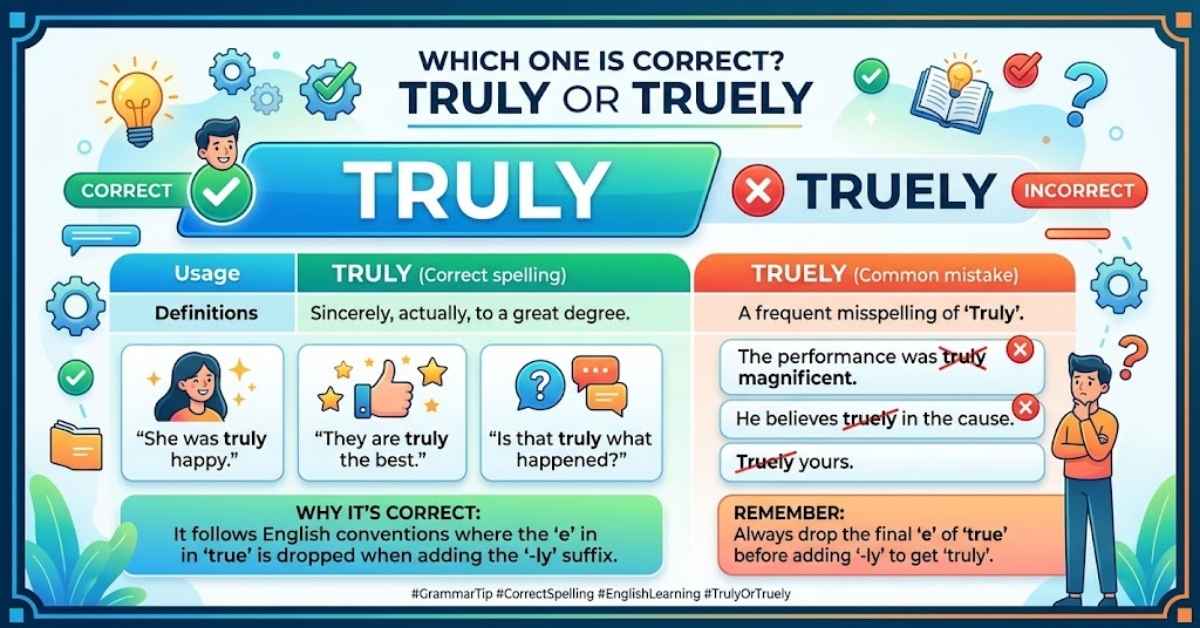
Truely or truly—which is correct? Truly is the correct spelling in modern standard English. Truely is a common misspelling that occurs because people naturally want to keep the final e in true.
The word truly is an adverb meaning sincerely, genuinely, truthfully, or really, depending on the context. Once you understand the simple spelling change from true to truly, it becomes much easier to remember the correct form.
Truely or Truly: Which Is Correct?
The correct spelling is truly, with no e between the u and l. Truely is not the standard spelling for contemporary English writing.
| Spelling | Correct? | Explanation |
|---|---|---|
| Truly | Yes | Standard modern English adverb |
| Truely | No, in standard modern usage | Common misspelling; also encountered in historical texts and proper names |
Examples:
- Incorrect: I am truely grateful for your help.
- Correct: I am truly grateful for your help.
- Incorrect: She truely believes in her team.
- Correct: She truly believes in her team.
- Incorrect: It was a truely remarkable experience.
- Correct: It was a truly remarkable experience.
The answer to “which is correct, truely or truly?” is the same in American and British English: truly.
What Does Truly Mean?
Truly is an adverb formed from the adjective true. It can describe the truthfulness or sincerity of an action, or emphasize how strongly something is the case.
Its meaning depends on the sentence.
1. Truly means sincerely or honestly
When truly describes someone’s words, feelings, or intentions, it can mean sincerely, genuinely, or truthfully.
Examples:
- I truly appreciate everything you have done for me.
- She truly believes that honesty matters.
- He was truly sorry for his mistake.
- We are truly grateful for your support.
In these examples, truly emphasizes that the feeling or statement is genuine.
2. Truly means really or genuinely
The word can also emphasize that something is real or deserves the description being given.
Examples:
- That was a truly unforgettable experience.
- She is a truly talented musician.
- It is truly remarkable how quickly the team improved.
- This is a truly beautiful place.
Here, truly strengthens the adjective that follows it. It tells the reader that the quality is genuine or especially noticeable.
3. Truly means in a truthful way
In some contexts, truly describes how accurately or honestly someone speaks or acts.
Example:
“She spoke truly about what had happened.”
This means she spoke truthfully. Although this use is less common in everyday conversation than really or genuinely, it is still useful to recognize.
Why Is It Truly Instead of Truely?
The spelling becomes confusing because the adjective true ends in e. It seems logical to keep that letter and simply add -ly:
True + ly = truely.
However, standard English uses truly, dropping the final e.
The correct transformation is:
TRUE → TRULY
This is an established spelling convention for this word. It should not be treated as a universal rule that every adjective ending in e must lose that letter before -ly is added. For example, nice becomes nicely, retaining the e.
The important point is to remember the established spelling of truly rather than trying to apply one suffix rule to every word.
An easy memory trick
Think of the word as:
TRUE − E + LY = TRULY
Remove the final e from true, then add ly. The result is truly.
This simple formula is especially helpful when proofreading emails, essays, assignments, and professional documents.
Truely or Truly Examples in Everyday English
If you are learning how to spell truely or truly, comparing correct and incorrect sentences is one of the easiest ways to remember the difference.
| Incorrect spelling | Correct spelling |
|---|---|
| I truely love this song. | I truly love this song. |
| We are truely thankful. | We are truly thankful. |
| He truely cares about his family. | He truly cares about his family. |
| It was a truely special day. | It was a truly special day. |
| I truely hope you feel better soon. | I truly hope you feel better soon. |
| She was truely surprised by the news. | She was truly surprised by the news. |
In each case, only the spelling changes. The intended meaning remains the same.
Examples of truly in different situations
In a personal message:
“I truly appreciate you being there when I needed help.”
In school writing:
“The experiment was truly useful because it helped us understand the concept.”
In professional communication:
“We truly value your feedback and will consider your suggestions.”
In everyday conversation:
“That was truly the best meal I’ve had in a long time.”
These examples show that truly works in casual, academic, and professional English.
Truly vs. True: What Is the Difference?
Although true and truly are closely related, they have different grammatical functions.
True is generally an adjective. It describes a person, statement, fact, or situation.
Truly is an adverb. It modifies a verb, an adjective, another adverb, or sometimes an entire statement.
Compare these sentences:
- The statement is true.
- I truly believe the statement.
- She is a true friend.
- She truly cares about her friends.
- It was a true story.
- It was a truly remarkable story.
A useful test is to ask what the word is doing in the sentence. If you are describing something as accurate or genuine, true may fit. If you are explaining how sincerely, genuinely, or strongly something is felt or done, truly may be the right choice.
Truly vs. Truthfully: Are They the Same?
Truly and truthfully overlap in meaning, but they are not interchangeable in every sentence.
- Truly can mean sincerely, genuinely, really, or in a truthful way.
- Truthfully more directly emphasizes honesty or accuracy.
For example:
“I truly admire her work” means the admiration is genuine.
“I answered truthfully” means I answered honestly.
The words can sometimes be substituted for one another, but the natural choice depends on the intended meaning.
Other related words include:
- True: accurate or genuine.
- Truth: the quality or state of being true.
- Truthful: honest or accurate.
- Truthfully: in an honest or truthful manner.
- Truly: sincerely, genuinely, or really.
Learning these related forms can help you choose the right word and improve your vocabulary.
Is “Yours Truly” or “Yours Truely” Correct?
The correct expression is “Yours truly,” not “Yours truely.”
This expression has two common uses.
As a letter or email closing
“Yours truly” is a conventional closing used in correspondence, particularly in some formal or traditional styles.
Example:
Yours truly,
Michael
Other closings, such as Sincerely and Best regards, may be more suitable depending on the relationship and tone of the message.
As an informal reference to yourself
People also use yours truly humorously or casually to refer to themselves.
Example:
“The person who baked all those cookies was yours truly.”
In both uses, the spelling remains truly.
Common Spelling Mistakes to Avoid
When writing this word, watch for three common errors.
1. Writing truely
This is the main mistake. Remember that the standard spelling is truly.
2. Writing trully
This version adds an unnecessary second l. The correct form contains one l: truly.
3. Writing truley
This form rearranges the letters incorrectly. The standard spelling is T-R-U-L-Y.
A quick proofreading tip: search your document for truely, trully, and truley. Replace them with truly when you intend the standard adverb. If the spelling appears in a quotation, historical source, or proper name, check the context before changing it.
LEARN MORE: Finalized or Finalised
Is Truely Ever Used in English?
Although truly is the standard modern spelling, truely has appeared in historical English and is also used as a proper name.
Dictionary.com discusses the historical development of the spelling and notes that truely was once used before truly became the standard form. It may also appear in modern names, titles, or informal writing.
That historical or name-related use does not make truely the correct spelling for the ordinary adverb in contemporary formal English.
If you are writing a school essay, website article, business email, or professional report, choose truly.
Frequently Asked Questions
Which is correct, truely or truly?
Truly is correct in modern standard English. Truely is a common misspelling of the adverb.
How do you spell truly?
The correct spelling is T-R-U-L-Y. Remember that true drops its final e before the spelling -ly is added in this word.
What is the meaning of truly?
Truly is an adverb that can mean sincerely, genuinely, truthfully, or really, depending on the context.
Is truely a word in the dictionary?
You may encounter truely in historical references, discussions of misspellings, or proper names. However, it is not the standard modern spelling of the ordinary adverb; use truly in contemporary writing.
Is truly spelled differently in American and British English?
No. Truly is the standard spelling in both American and British English. There is no regional spelling difference for this word.
Is truly an adjective or an adverb?
Truly is an adverb. The related adjective is true. For example, “The statement is true” uses the adjective, while “I truly believe it” uses the adverb.
Is “Yours truly” correct?
Yes. Yours truly is the standard spelling. “Yours truely” is incorrect for this conventional expression.
What is the difference between truly and truthfully?
Truly can express sincerity, genuineness, or emphasis. Truthfully more directly emphasizes honesty or accuracy. The best choice depends on the sentence.
Conclusion
When deciding between truely or truly, choose truly. It is the standard modern spelling in American and British English and can mean sincerely, genuinely, truthfully, or really.
The confusion comes from the adjective true, which appears to invite the spelling truely. Instead, remember the established transformation: true → truly.
Use truly in your everyday writing, essays, emails, and professional communication. With this simple spelling rule in mind, you can avoid a common mistake and write with greater confidence.
