

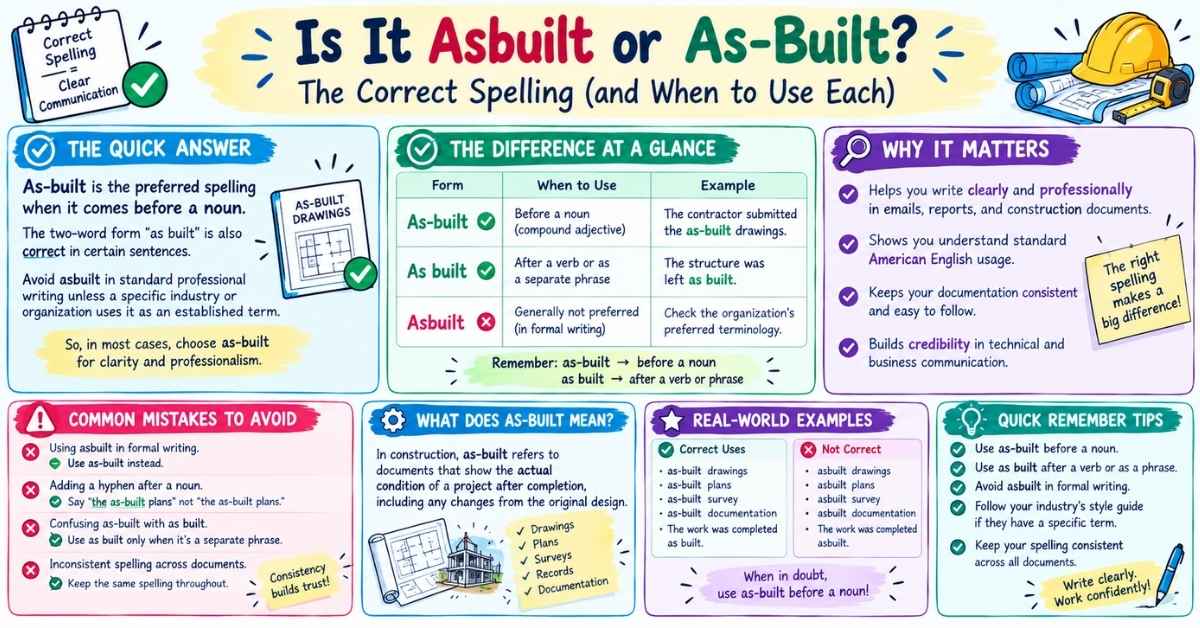
Is it asbuilt or as-built? “As-built” is the preferred spelling when the term comes before a noun, as in “as-built drawings” or “as-built plans.” The two-word form “as built” is also correct in certain sentences, while “asbuilt” is generally best avoided in standard professional writing unless a specific industry or organization uses it as an established term.
Although these spellings look similar, their usage depends on grammar, context, and established writing conventions. Understanding the difference helps you write clearly in emails, reports, construction documents, and everyday American English.
Is It Asbuilt or As-Built?
The preferred form for most formal and technical writing is as-built, particularly when describing drawings, plans, surveys, or records that show the actual state of completed work.
For example, write “The contractor submitted the as-built drawings” rather than “The contractor submitted the asbuilt drawings.”
The hyphen connects the two words into a compound modifier, making their relationship clear. Technical documentation guidance, including NASA’s style guide, uses this construction before a noun.
However, the hyphen is not required in every sentence. When the words function as a phrase after a verb, as built can be appropriate.
As-Built vs. As Built vs. Asbuilt
These three forms are not equally suitable for every situation.
| Form | Typical usage | Example |
|---|---|---|
| As-built | Compound adjective before a noun | We reviewed the as-built plans. |
| As built | Phrase describing how something was constructed | The structure remains as built. |
| Asbuilt | Nonstandard in general professional prose; may occur in specialized terminology or naming conventions | Check the organization’s preferred terminology. |
The simplest rule is to use as-built before a noun when it describes the noun, and use as built when the sentence calls for the separate phrase.
Avoid automatically treating “asbuilt” as the standard spelling in formal writing. If your industry, client, or project specification explicitly uses that spelling, follow the applicable convention where required.
When Should You Use As-Built?
Use as-built when it describes a noun and identifies the actual condition or configuration of something after construction or installation.
This is particularly common in architecture, engineering, and construction, where the term helps distinguish completed work from the original design.
Examples include:
- As-built drawings: Documents showing the actual construction and recorded changes.
- As-built plans: Plans reflecting the completed project.
- As-built survey: A survey documenting relevant site conditions or installed features.
- As-built documentation: Records describing the completed work.
- As-built model: A digital representation of the constructed or installed condition.
Examples in everyday professional writing
Correct: Please send the as-built drawings before the project handover.
Correct: The engineer reviewed the as-built documentation.
and
Correct: We need an updated as-built survey for the site.
In each example, “as-built” comes before a noun and acts as a compound modifier.
Why the hyphen matters
A hyphen helps readers understand that “as” and “built” work together to describe the following noun. It also makes technical documents easier to scan and keeps terminology consistent across reports, plans, and emails.
For professional writing, consistency is especially important when the same term appears in multiple files or project deliverables.
When Is As Built Correct?
As built, written as two words, can be correct when it functions as a phrase rather than a compound adjective placed before a noun.
For example:
“The structure was left as built.”
Here, the phrase describes the condition in which the structure was left. The words are not directly modifying a noun that immediately follows them.
Compare these examples:
Before a noun: The team prepared the as-built drawings.
After a verb: The records show how the system was built.
Describing a condition: The building remains as built, without subsequent modifications.
The precise wording can depend on the sentence’s intended meaning. If a sentence sounds awkward, rewriting it can be clearer than trying to force a particular hyphenation rule.
For example, “The building remains in its original condition” may be more natural than “The building remains as built” when the goal is to emphasize that no changes have occurred.
What Does As-Built Mean in Construction?
In construction, as-built generally describes records that reflect how a project was actually constructed, including documented differences from the original design.
During a project, field conditions, approved changes, installation requirements, or unexpected obstacles may lead to differences between the original plans and the completed work.
As-built records help capture those differences.
What information can as-built drawings contain?
Depending on the project and documentation requirements, they may show changes to dimensions, equipment locations, utility routes, structural details, or installed systems.
For example, an original plan might show a pipe running along one route, but a field change may require it to follow a different path. The relevant as-built documentation should reflect the actual route, provided that information was properly recorded and verified.
These records can support maintenance, troubleshooting, renovations, and future construction planning.
Are as-built drawings the same as record drawings?
The terms are often used similarly, but their exact meaning can depend on the contract, project specifications, and documentation process.
An as-built drawing generally aims to represent the completed work and its documented changes. “Record drawing” may refer to a related set of project records, including drawings updated during construction.
Do not assume that a drawing is fully verified simply because its title includes “as-built.” Its accuracy depends on how changes were recorded, reviewed, and confirmed.
Is Asbuilt Ever Acceptable?
Although asbuilt is generally not the preferred spelling in standard professional prose, the form does appear in some specialized terminology, industry references, and established naming conventions.
For example, an organization might use “asbuilt” in an internal database field, software label, legacy file name, or project-specific document standard.
That does not mean the closed form is the best choice for every sentence.
Use this practical approach:
- For general writing: Prefer “as-built” before a noun and “as built” where the sentence calls for the two-word phrase.
- For technical documentation: Follow the project’s specifications and the organization’s established style guide.
- For existing file names or system labels: Preserve the official spelling when changing it could break references or create inconsistencies.
- For edited public-facing content: Use the preferred spelling consistently unless there is a clear reason to retain a specialized variant.
The key distinction is between following a documented naming convention and assuming that every spelling variant is interchangeable.
read more >>> Is It Presenter or Presentor?
Common As-Built Spelling Mistakes to Avoid
One frequent mistake is writing “asbuilt drawings” in a formal report without checking the organization’s terminology standard. In general professional writing, “as-built drawings” is the safer choice.
Another mistake is adding a hyphen automatically every time the words appear together. The phrase “as built” can be appropriate when it functions separately in a sentence.
Writers can also confuse the meaning of as-built records with the original design documents. Original design drawings communicate what is intended; as-built documentation records the completed condition and relevant changes. These documents serve related but different purposes.
Finally, avoid inconsistent spelling across headings, filenames, emails, and reports. Even when a variation is understandable, inconsistent terminology can make technical documentation look less carefully edited.
Frequently Asked Questions
Is as-built one word or two?
As-built is hyphenated when used as a compound adjective before a noun, such as “as-built drawings.” The phrase “as built” is also correct in certain grammatical contexts.
Is asbuilt grammatically correct?
“Asbuilt” is generally not the preferred form in standard professional writing. Some specialized references or organizations may use it as a variant, so follow the relevant terminology standard when one applies.
Should as-built have a hyphen?
Yes, in common constructions such as as-built plans, as-built drawings, and as-built documentation. The hyphen joins the words into a compound modifier.
What is the difference between as built and as-built?
“As-built” typically modifies a noun, as in “as-built drawings.” “As built” can function as a separate phrase, as in “The structure remains as built.”
Is as-built correct in American English?
Yes. “As-built drawings” is an established construction and engineering expression in American professional writing.
What are as-built drawings?
As-built drawings are construction records intended to reflect the completed work and relevant changes from the original design. Their accuracy depends on the quality of the records and verification process.
Are as-built and record drawings the same?
They can overlap in meaning, but the exact distinction depends on the project and its documentation requirements. Check the contract or applicable project standard before treating them as identical.
Final Verdict
If you are deciding whether to write asbuilt or as-built, choose as-built for standard professional expressions such as “as-built drawings,” “as-built plans,” and “as-built documentation.”
Use as built when the words function as a separate phrase in the sentence. Avoid “asbuilt” in general formal writing unless an established technical or organizational convention specifically calls for it.
This simple distinction will help you produce clearer, more consistent writing in American English and professional construction documentation.
