

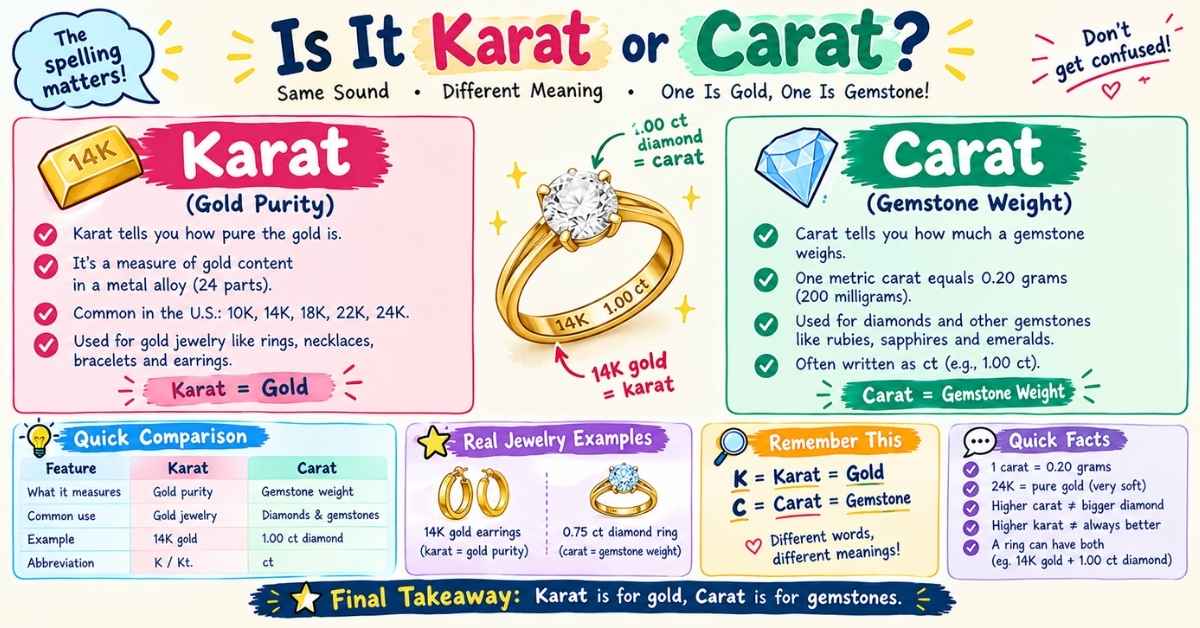
If you’re wondering is it karat or carat, the answer depends on what you’re describing. In U.S. jewelry terminology, karat refers to the purity of gold, while carat refers to the weight of a diamond or other gemstone. The two words sound almost identical, which is why they are so easy to mix up.
A simple example makes the difference clear: 14K gold tells you how much gold is in the metal, while a 1.00-carat diamond tells you how much the diamond weighs. A single ring can have both measurements.
Once you understand that one word describes gold purity and the other describes gemstone weight, the confusion becomes much easier to avoid.
Is It Karat or Carat?
Both karat and carat are real words, but they are not interchangeable in standard U.S. jewelry terminology.
- Karat (K or Kt.) = gold purity
- Carat (ct) = gemstone weight
- 24K gold = very high-purity gold
- 1.00 ct diamond = a diamond weighing one metric carat
So if you’re talking about the purity of a gold ring, necklace, bracelet, or other gold jewelry in the United States, karat is the spelling you will normally see.
If you’re talking about the weight of a diamond, ruby, sapphire, emerald, or another gemstone, carat is the appropriate term.
The easiest memory trick
Think:
K = karat = gold
C = carat = crystal/gemstone
It isn’t the historical reason for the spelling, but it is an easy way to remember the difference when shopping.
What Does Carat Mean?
A carat is a unit of weight used for diamonds and other gemstones.
One metric carat equals 0.20 grams, or 200 milligrams. A carat is divided into 100 points, so a 0.50-carat diamond is also described as a 50-point diamond.
For example:
- 0.25 ct = one-quarter carat
- 0.50 ct = half a carat
- 0.75 ct = three-quarters of a carat
- 1.00 ct = one carat
- 1.50 ct = one and a half carats
The carat system is internationally standardized. The Gemological Institute of America explains that the modern metric carat was adopted in the United States in 1913 and equals exactly 0.2 grams.
Carat does not mean exactly “size”
This is one of the most important details people miss.
Carat measures weight, not the exact visible dimensions of a gemstone.
Two diamonds can have the same carat weight but look somewhat different in size because their shapes, proportions, depth and cutting styles differ.
For example, a 1-carat round diamond and a 1-carat elongated diamond may have the same weight while presenting different visual dimensions.
That’s why a diamond’s carat weight should not be considered by itself. Diamond quality is also evaluated using the other members of the 4Cs: cut, color and clarity.
What Does Karat Mean?
A karat measures the purity or fineness of gold.
The karat system is based on 24 parts. The number tells you how many of those 24 parts are gold.
For example:
- 10K = 10 parts gold out of 24
- 14K = 14 parts gold out of 24
- 18K = 18 parts gold out of 24
- 22K = 22 parts gold out of 24
- 24K = 24 parts gold out of 24
The remaining portion consists of other metals used to create a gold alloy.
Pure gold is relatively soft, which is why jewelry is commonly alloyed with other metals to improve properties such as hardness and durability.
Karat vs. Carat: The Difference at a Glance
| Term | What it measures | Common use | Example |
|---|---|---|---|
| Carat | Gemstone weight | Diamonds and gemstones | 1.00 ct diamond |
| Karat | Gold purity | Gold jewelry | 14K gold |
| ct | Carat abbreviation | Gemstone weight | 0.75 ct |
| K / Kt. | Karat abbreviation | Gold purity | 18K |
| ctw | Carat total weight | Total gemstone weight | 1.50 ctw |
The distinction is simple:
Carat tells you how much a gemstone weighs. Karat tells you how much of a gold alloy is gold.
Can a Piece of Jewelry Have Both a Carat and a Karat?
Absolutely.
In fact, this is where the difference becomes particularly useful.
Imagine a ring described as:
14K yellow gold with a 1.00 ct diamond
There are two separate measurements:
- 14K → the purity of the gold
- 1.00 ct → the weight of the diamond
They are measuring two completely different properties of the same piece of jewelry.
You might also see something such as:
18K white gold, 0.75 ct center diamond, 1.20 ctw
That means:
- 18K = gold purity
- 0.75 ct = weight of the center diamond
- 1.20 ctw = combined weight of the diamonds in the piece
Once you see the distinction this way, jewelry descriptions become much easier to understand.
What Do 10K, 14K, 18K and 24K Gold Mean?
The common U.S. gold karats can be understood using a simple calculation:
Karat ÷ 24 × 100 = approximate percentage of gold
Here is the basic breakdown:
| Gold | Approximate gold content | Meaning |
|---|---|---|
| 10K | 41.7% | 10 parts gold out of 24 |
| 14K | 58.3% | 14 parts gold out of 24 |
| 18K | 75% | 18 parts gold out of 24 |
| 22K | 91.7% | 22 parts gold out of 24 |
| 24K | Very high purity | 24 parts gold out of 24 |
A higher karat number means a greater proportion of gold in the alloy. It does not automatically mean that a piece is better for every purpose.
For example, higher-purity gold tends to be softer, while additional alloy metals can increase durability.
Does Higher Karat Mean Better Gold?
Not necessarily.
It means higher gold purity.
That is different from saying that the jewelry is automatically better.
A person looking for a daily-wear ring may care heavily about durability. Another buyer may place greater importance on gold content and color.
This is why 10K, 14K, 18K and 24K gold exist for different purposes.
A higher karat can mean:
- more gold content
- a richer gold appearance
- less alloy
A lower karat can mean:
- more alloy metal
- greater hardness in some formulations
- potentially lower material cost
The right choice depends on the jewelry design, intended use, personal preference and budget.
Does Higher Carat Mean a Bigger Diamond?
Not necessarily.
A higher carat weight means more weight, but it doesn’t provide a perfect measurement of the diamond’s visible face-up size.
Diamond shape matters.
For instance, an elongated oval or emerald-cut diamond may appear larger or longer than a round diamond of the same carat weight because the stones distribute their weight differently.
Cut quality also matters because proportions influence how a diamond handles light and how large or lively it appears.
So when comparing diamonds, don’t look at the carat number alone. Check the stone’s:
- carat weight
- measurements
- cut
- color
- clarity
- shape
What Do K, Kt., Ct. and Ctw. Mean?
Jewelry listings often become confusing because several abbreviations appear together.
K or Kt.
These abbreviations refer to karat, the gold-purity measurement.
Examples:
- 10K
- 14K
- 18K
- 24K
Ct.
Ct means carat and generally describes the weight of a gemstone.
Example:
1.25 ct diamond
means the diamond weighs 1.25 metric carats.
Ctw.
Ctw generally means carat total weight.
This is especially useful when a piece contains multiple diamonds or gemstones.
For example, an engagement ring might contain a 0.70 ct center diamond plus several smaller accent diamonds, producing a total carat weight greater than the center stone alone.
Always check the specific jewelry description to see whether a listed carat figure refers to one stone or the total weight of multiple stones.
read more >>> Is It Kindergarten or Kindergarden?
How to Read a Real Jewelry Description
Suppose an online listing says:
14K White Gold Halo Ring — 0.75 ct Center Diamond — 1.10 ctw
Here’s how to read it:
14K White Gold
The metal is gold with a karat purity designation of 14K.
0.75 ct Center Diamond
The center diamond weighs 0.75 carat.
1.10 ctw
All the diamonds together have a combined weight of 1.10 carats.
Notice how karat and carat are not competing measurements.
They describe different components of the same ring.
What Should You Look for on Gold Jewelry in the U.S.?
If you’re buying gold jewelry in the United States, don’t stop at the number.
The Federal Trade Commission advises consumers to look for the karat quality mark and, near that mark, the name or U.S.-registered trademark of the company responsible for the mark.
For example, you might see a marking such as:
14K
or
18K
The FTC also distinguishes solid gold from gold-plated, gold-filled and gold-overlay products. These terms matter because a piece can contain gold without being made entirely from a gold alloy.
That distinction can be financially important.
A listing that says 14K gold is not the same thing as a product described as 14K gold plated.
The FTC specifically recommends understanding these markings before purchasing precious-metal jewelry.
Is “14 Carat Gold” Wrong?
This is where geography matters.
In U.S. usage, 14-karat gold or 14K gold is the conventional spelling for gold purity.
In some other countries, particularly the UK and some Commonwealth contexts, carat can also be used for gold purity.
So if you are writing for a U.S. audience, use:
14K gold
rather than:
14 carat gold
For gemstones, use:
1-carat diamond
The distinction is therefore not simply about pronunciation. It is also about what the measurement describes and, in some cases, where the terminology is being used.
Why Are Karat and Carat So Easy to Confuse?
There is a good reason.
The two words have a shared historical background associated with the ancient use of carob seeds as a reference for weighing precious materials.
Over time, the terminology developed differently in different languages and regions.
Modern jewelry terminology separates the concepts clearly in U.S. usage:
Carat → gemstone weight
Karat → gold purity
The similar pronunciation is what keeps the confusion alive.
Karat vs. Carat: A Real-World Example
Imagine you’re comparing two engagement rings.
Ring A
14K gold + 1.00 ct diamond
This tells you:
- The ring’s gold is 14K.
- The main diamond weighs 1.00 carat.
Ring B
18K gold + 0.75 ct diamond
This tells you:
- The ring’s gold is 18K.
- The main diamond weighs 0.75 carat.
You cannot conclude that Ring A has “more karats” of diamond or that Ring B has “more carats” of gold.
The measurements belong to different materials.
That’s the key idea to remember.
The Quickest Way to Remember Karat vs. Carat
If you forget everything else, remember this:
Karat = gold purity.
Carat = gemstone weight.
So:
18K gold → How pure is the gold?
1.00 ct diamond → How much does the diamond weigh?
And:
18K gold + 1.00 ct diamond → One piece of jewelry containing both measurements.
Frequently Asked Questions
Is it karat or carat for gold?
For U.S. jewelry terminology, use karat when referring to gold purity. For example, 14K gold or 18K gold.
Is it carat or karat for diamonds?
Use carat for diamond weight. For example, a 1-carat diamond or a 0.50 ct diamond.
Is 24 karat or 24 carat gold correct?
In standard U.S. usage, 24-karat gold or 24K gold is the conventional form. Some other countries use “carat” for gold purity as well.
Are karat and carat pronounced the same?
They are generally pronounced the same in English, which is one major reason the two words are frequently confused.
Is a carat a measurement of diamond size?
Not exactly. Carat measures weight, not the diamond’s exact physical dimensions. Shape and cutting proportions can affect how large a diamond appears.
Is 14K gold the same as 14 carat gold?
In a U.S. context, 14K gold is the standard terminology for gold purity. “14 carat gold” may appear in other English-speaking markets where carat is also used for gold purity.
What is the difference between 14K and 18K gold?
14K contains about 58.3% gold, while 18K contains about 75% gold. The remaining material consists of alloy metals.
What does 1 carat mean?
One metric carat equals 0.20 grams, or 200 milligrams. A gemstone weighing 1.00 carat weighs 200 milligrams.
Can a ring have both karat and carat measurements?
Yes. A ring can be made from 14K gold and contain a 1.00 ct diamond. The first describes gold purity; the second describes gemstone weight.
What does CTW mean in jewelry?
CTW generally means carat total weight, referring to the combined weight of multiple gemstones or diamonds in a piece.
Final Answer: Karat or Carat?
If you’re talking about gold purity, use karat in U.S. jewelry terminology.
If you’re talking about the weight of a diamond or gemstone, use carat.
So the easiest rule is:
14K gold = karat
1.00 ct diamond = carat
Once you separate gold purity from gemstone weight, the spelling becomes much easier to remember—and jewelry descriptions become much easier to read.
