

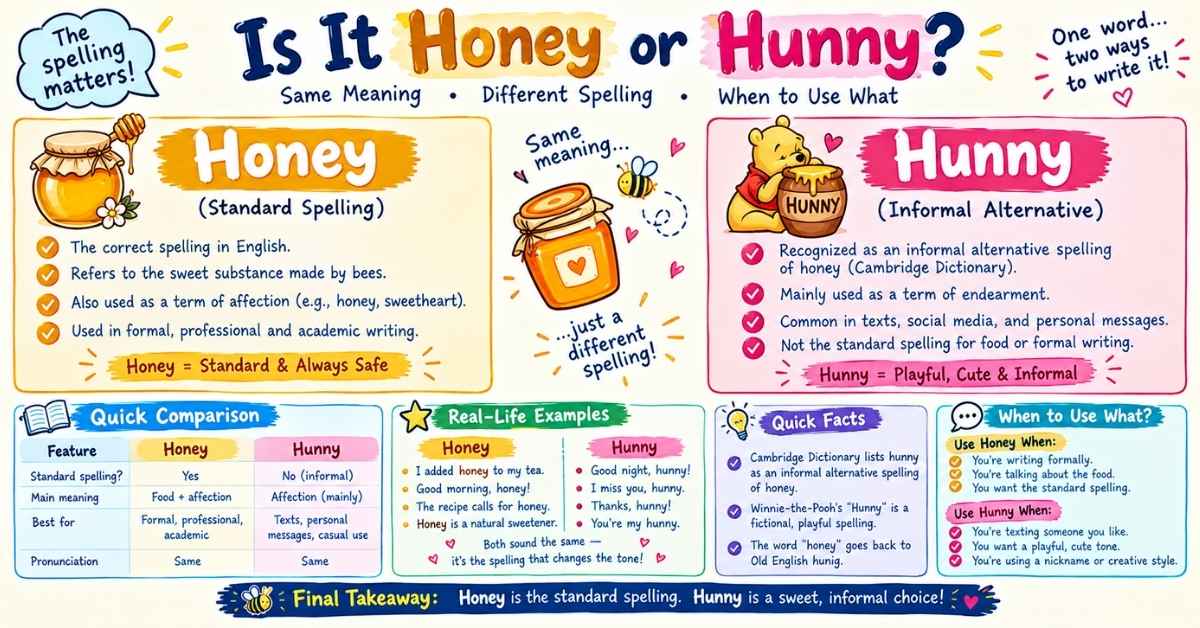
If you’re wondering is it honey or hunny, the standard English spelling is honey. It is the correct spelling for the sweet substance made by bees and for the familiar term of affection. Hunny is also seen in English, but it has a much narrower, informal use: Cambridge Dictionary recognizes it as an alternative spelling of honey when addressing someone affectionately.
So, if you’re writing an email, school assignment, article, recipe, or other standard English text, use honey. If someone writes hunny in a personal text or playful message, however, they may be using the spelling deliberately rather than simply making a mistake.
Honey vs. Hunny: What’s the Difference?
The easiest way to understand the difference is to separate standard spelling from informal style.
| Word | Standard English? | Common meaning | Typical use |
|---|---|---|---|
| honey | Yes | Bee-produced food; term of affection | Everyday, formal, professional, and personal writing |
| hunny | Informal alternative | Mainly an affectionate form of address | Texts, nicknames, playful messages, creative contexts |
Honey is the standard choice. Hunny can appear intentionally when someone wants a message to sound cute, playful, or highly casual.
The distinction matters because saying that hunny “doesn’t exist” is too broad. Cambridge lists hunny as an informal alternative spelling of honey specifically in affectionate address.
What Does “Honey” Mean?
The word honey has two especially common meanings.
1. Honey is a food
Honey is the sweet substance bees make from flower nectar and store in their hives. Oxford defines it as a sweet, sticky substance made by bees, while Collins likewise gives the bee-produced substance as its primary meaning.
Examples:
- I put honey in my tea.
- The recipe calls for two tablespoons of honey.
- Bees produce honey from nectar.
- She bought a jar of local honey.
In these sentences, honey is the normal spelling. You would not normally replace it with hunny.
2. Honey is a term of affection
In American English, honey can also be used as an affectionate or familiar way to address someone.
For example:
- Good morning, honey.
- Are you okay, honey?
- Thanks for helping me, honey.
- I love you, honey.
Oxford lists this affectionate use as an informal way of addressing someone you like or love. Collins also recognizes honey as a term of affectionate address.
The same spelling works for both meanings.
What Does “Hunny” Mean?
Hunny is an informal alternative spelling of honey, particularly when it is used as a term of endearment.
For example:
Good night, hunny.
The writer normally intends essentially the same affectionate meaning as:
Good night, honey.
The unusual spelling adds a different tone. It can make the message feel more playful, cute, personal, or deliberately casual.
Cambridge Dictionary specifically records hunny as an informal alternative spelling of honey used when speaking to someone you like or love.
That is an important distinction: hunny is recognized in this limited informal context, but it is not the standard spelling of the word used for honey as a food.
Is “Hunny” a Real Word?
Yes—but the answer needs a little nuance.
It would be misleading to say that hunny is simply a completely incorrect word. Cambridge Dictionary has an entry for it and labels it an informal alternative spelling of honey in affectionate address.
At the same time, dictionary recognition does not mean that hunny is interchangeable with honey in every sentence.
Compare:
Standard:
I added honey to my tea.
Informal affectionate spelling:
Thanks, hunny!
The first sentence is about food. The second uses the word as a term of affection.
So the practical rule is:
Use honey as the standard spelling. Use hunny when you intentionally want an informal, playful spelling in an affectionate context.
Why Do People Spell Honey as “Hunny”?
There are a few reasons.
Pronunciation makes the spelling tempting
Honey is pronounced roughly /ˈhʌni/. The first sound can make the spelling hun- feel intuitive, especially to someone writing informally.
English spelling is not always a direct representation of pronunciation, so spelling a word according to how it sounds can produce a nonstandard form.
Informal communication encourages creative spelling
People regularly alter familiar words in texts and social media.
For example:
- honey → hunny
- love → luv
- you → ya
These changes can communicate personality or emotion rather than a new dictionary meaning.
People may want the message to feel cuter
Compare:
Good morning, honey!
with:
Good morning, hunny! ❤️
The second spelling can feel more playful or deliberately affectionate. The difference is primarily style and tone, not pronunciation.
Honey vs. Hunny in Texting
Texting is probably where you’re most likely to encounter hunny.
If someone writes:
Hey hunny, how was your day?
they probably aren’t trying to refer to a jar of bee-produced honey. They are using hunny as a casual term of affection.
In a text, hunny may communicate:
- affection
- playfulness
- cuteness
- familiarity
- informality
- personal style
However, honey is still completely natural in the same situation:
Hey honey, how was your day?
In fact, honey is the conventional spelling.
The choice between the two is therefore often about how the message should feel, rather than what the writer literally means.
Is Honey or Hunny Better for Formal Writing?
For formal, academic, professional, or edited writing, use honey.
Examples:
- The recipe contains raw honey.
- Honey is commonly used as a natural sweetener.
- The study examined consumer preferences for honey products.
Writing hunny in these sentences would look unusual because the informal spelling does not fit the context.
The exception is when you’re deliberately reproducing someone’s wording.
For example:
Her text said, “Good night, hunny.”
Here, keeping hunny is appropriate because you’re quoting the original spelling.
Likewise, if Hunny is part of a brand name, username, character name, or other intentionally stylized name, you would normally preserve the original spelling.
Can You Call Your Boyfriend or Girlfriend “Hunny”?
Yes. In an informal personal message, hunny can be used as a playful spelling of honey.
For example:
I miss you, hunny.
The standard version is:
I miss you, honey.
Both can express affection. The first simply has a more casual or stylized appearance.
Neither honey nor hunny is restricted to one gender. Depending on the relationship and context, either can be used when addressing a boyfriend, girlfriend, husband, wife, partner, family member, or another person affectionately.
Can You Call Your Husband or Wife “Honey”?
Yes.
Examples:
- How was your day, honey?
- Thanks for dinner, honey.
- Good night, honey.
- I love you, honey.
If you intentionally prefer a playful spelling in a private message, you may see:
- Good night, hunny.
- Love you, hunny.
- See you later, hunny.
The standard spelling remains honey.
Why Does Winnie-the-Pooh Spell It “Hunny”?
One reason many people recognize Hunny is its strong association with Winnie-the-Pooh.
The spelling appears as part of Pooh’s fictional world, particularly on his honey pots. Modern Disney merchandise continues to use “Hunny” in Winnie-the-Pooh products, reinforcing the association between the spelling and the character.
This is important because Pooh’s “Hunny” is a playful fictional spelling. It should not be taken as evidence that hunny is the standard spelling of the food.
In other words:
Pooh’s “Hunny” is intentional character language. Standard English uses “honey.”
Are Honey and Hunny Pronounced the Same?
Usually, yes, when hunny is being used as an informal spelling of honey.
The main difference is written form, not pronunciation.
The standard pronunciation of honey is /ˈhʌni/. Oxford gives this pronunciation for the word, and Cambridge gives the same pronunciation for its hunny entry.
So hearing the word alone generally will not tell you whether the writer intended:
- honey
- hunny
You need the written context.
Honey vs. Hunny: Examples in Real Sentences
Here are some practical examples:
When talking about food
Correct:
I added honey to my coffee.
Not the standard spelling:
I added hunny to my coffee.
When addressing someone affectionately
Standard:
Thanks, honey!
Informal/playful:
Thanks, hunny!
In a professional email
Standard:
The product contains organic honey.
Avoid:
The product contains organic hunny.
In a personal text
Standard:
Good night, honey ❤️
Playful:
Good night, hunny ❤️
In a quotation
If someone actually wrote:
“I miss you, hunny.”
you can preserve hunny when quoting them.
The key is context.
read more >>> Is It Karat or Carat?
Does “Hunny” Mean Something Different From “Honey”?
Usually, not when hunny is being used as an affectionate spelling.
The intended meaning is generally the same as honey.
What changes is the style.
Honey can sound:
- conventional
- warm
- affectionate
- familiar
- standard
Hunny can sound:
- playful
- cute
- casual
- personal
- intentionally stylized
There can also be situations where the spelling is simply part of a name, username, brand, or fictional character. In those cases, the spelling should be understood according to its specific context.
The History Behind “Honey”
The standard word honey has a long history in English.
Etymological sources trace modern honey through Middle English forms to Old English hunig. The word is related to forms found in several Germanic languages.
Interestingly, the affectionate use of honey is also centuries old. Etymonline dates the term-of-endearment sense to at least the mid-14th century.
So the use of honey for both a sweet substance and a loved person isn’t a modern internet invention.
The spelling hunny, by contrast, is best understood in modern usage as an informal or stylized alternative in particular contexts rather than the standard spelling of the food.
How to Remember the Correct Spelling
If you’re unsure, remember:
H-O-N-E-Y = honey
The standard word has:
- one n
- an o after the h
- an e before the final y
So:
Honey ✅
Hunny — informal/stylized affectionate spelling
Honney ❌
Honeyy ❌
For standard English, simply choose honey.
Frequently Asked Questions
Is it honey or hunny?
Honey is the standard English spelling. Hunny is an informal alternative spelling recognized particularly for affectionate address.
Is hunny a correct spelling?
Hunny is not the standard spelling of honey, but it is recognized as an informal alternative spelling when used as a term of affection.
Is “hunny” a real English word?
Yes, in a limited informal sense. Cambridge Dictionary lists hunny as an alternative spelling of honey used as a form of address.
How do you spell honey correctly?
The standard spelling is H-O-N-E-Y.
Can I use “hunny” in a text?
Yes. In a personal or playful text, hunny can intentionally be used as an affectionate spelling of honey.
Should I use “hunny” in an essay?
Generally, no. Use honey in standard academic, professional, and formal writing unless you’re quoting or reproducing an intentionally stylized name.
Can I call my girlfriend “hunny”?
Yes. Hunny can be used as a playful term of affection. Honey is the standard spelling.
Can I call my boyfriend “honey”?
Yes. Honey is a general term of affection and is not restricted to women or men.
Are honey and hunny pronounced differently?
Usually not when hunny is being used as an informal spelling of honey. The distinction is primarily written style.
Why does Winnie-the-Pooh spell honey “hunny”?
“Hunny” is associated with Pooh’s playful fictional spelling and his honey pots. It is not the standard spelling of the word in English. Modern Disney merchandise continues to use the “Hunny” spelling in Winnie-the-Pooh products.
Does hunny mean the same thing as honey?
When used as an affectionate spelling, yes, the intended meaning is generally the same. The main difference is that hunny signals a more informal or playful style.
Is honey better than hunny?
For standard English, use honey. If you intentionally want a cute or playful spelling in an informal affectionate message, hunny can work.
Bottom Line
If you’re asking is it honey or hunny, the answer is honey for standard English.
Use honey when you’re referring to the food made by bees, writing professionally, completing schoolwork, publishing edited content, or simply want the conventional spelling.
Use hunny only when you intentionally want the informal, playful spelling—especially as an affectionate term in texts, captions, personal messages, or creative contexts.
So you don’t need to wonder whether someone who wrote “Hey hunny” necessarily made a spelling mistake. They may have deliberately chosen an informal spelling. But if you’re asking how to spell the word correctly in standard English, write honey.
