

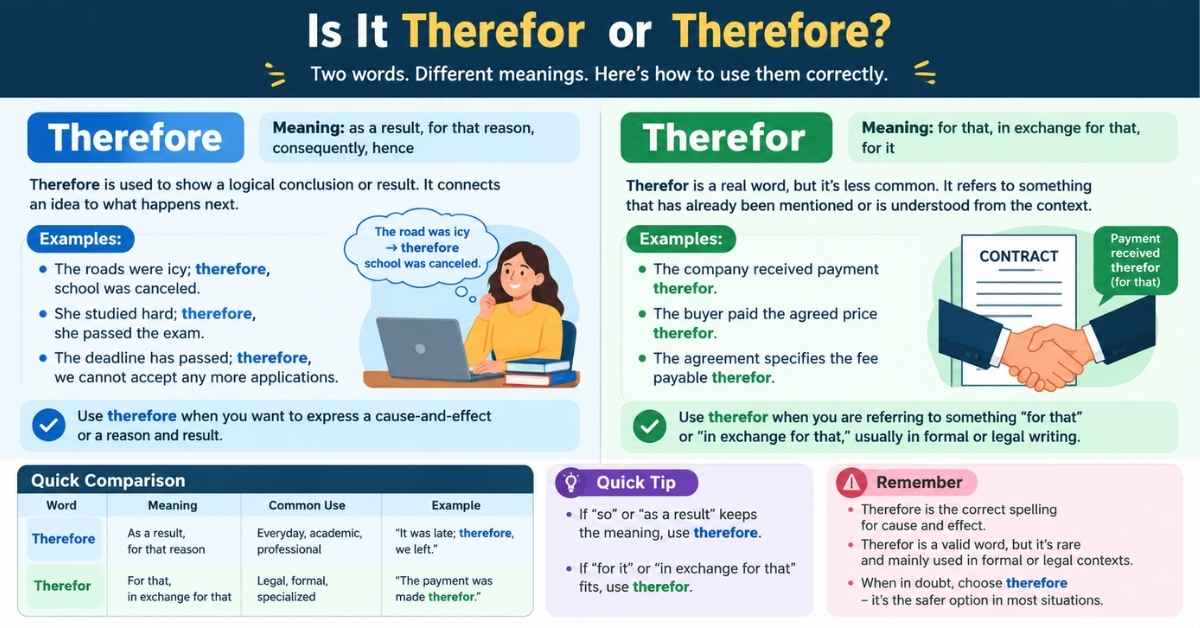
Is it therefor or therefore? The correct word for expressing a reason, result, or conclusion is therefore. For example, “The roads were icy; therefore, school was canceled.” However, therefor is also a real English word that means “for that” or “in exchange for that.” It appears mainly in formal or legal writing. Although the two words look almost identical, their meanings are different, so choosing the right one depends on what you want to say.
Therefor vs. Therefore: What’s the Difference?
The easiest way to understand the difference between therefor and therefore is to look at what each word means.
| Word | Meaning | Example |
|---|---|---|
| Therefore | For that reason; as a result | It was snowing; therefore, we stayed home. |
| Therefor | For that thing; in exchange for it | The company received payment therefor. |
Therefore is the word you will need in almost all everyday writing. It connects an idea to its logical result. Therefor, without the final e, refers to something mentioned earlier and is much less common in modern English. It is most likely to appear in legal documents, contracts, or other formal contexts.
For example:
- Correct: I missed the bus; therefore, I arrived late.
- Incorrect for the intended meaning: I missed the bus; therefor, I arrived late.
The second sentence uses the wrong word because the writer is expressing a consequence, not referring to something in exchange for something else.
What Does Therefore Mean?
Therefore is an adverb that means as a result, consequently, hence, or for that reason. It indicates that a conclusion or outcome follows from the information stated before it.
Writers use therefore to make the relationship between two ideas clear. It is common in academic essays, professional emails, reports, explanations, and everyday communication.
Examples of therefore in sentences
- The store was closed; therefore, we went somewhere else.
- She studied consistently and therefore improved her grades.
- The deadline has passed. Therefore, we cannot accept any more applications.
- The computer battery was empty; therefore, the presentation stopped.
- The evidence was incomplete; therefore, the team requested additional information.
In each example, therefore introduces a result that follows from a reason or situation.
Synonyms for therefore
Depending on the sentence, you can replace therefore with:
- As a result
- Consequently
- Thus
- Hence
- For that reason
- So
For example:
Original: The flight was delayed; therefore, we arrived late.
Alternative: The flight was delayed; as a result, we arrived late.
Both sentences communicate the same basic relationship between the delay and the late arrival.
However, these words are not always interchangeable in tone or sentence structure. Therefore is often suitable for formal explanations, while so is generally more conversational.
What Does Therefor Mean?
Therefor means “for that,” “for it,” or “in exchange for that.” It refers to an item, action, or matter that has already been mentioned or is understood from the context.
Unlike therefore, it does not ordinarily introduce a conclusion. Its use is relatively rare in everyday American English.
Examples of therefor in sentences
- The supplier delivered the equipment and received payment therefor.
- The agreement specifies the fee payable therefor.
- The company sold the materials and issued an invoice therefor.
- The contract requires the buyer to pay the agreed amount and any applicable charges therefor.
In these examples, therefor refers back to the equipment, the relevant matter, or the goods. It essentially means “for that” or “for those things.”
The word is particularly associated with formal and legal language. If you are writing an ordinary email or school assignment, a simpler phrase will usually sound more nature.
For example:
Formal: The contractor received compensation therefor.
Clearer everyday wording: The contractor received compensation for the work.
Both express a similar meaning, but the second is easier for most readers to understand.
When Should You Use Therefore?
Use therefore when you want to explain what follows logically from a fact, reason, decision, or situation.
Here are some common situations.
1. In academic writing
Academic writing often requires you to explain how evidence supports a conclusion.
Example:
“The study found a consistent improvement in test results; therefore, the researchers recommended further investigation.”
Here, therefore connects the reported finding to the recommendation.
2. In professional emails
You can use therefore to explain the outcome of a business decision.
Example:
“The client has not approved the final draft. Therefore, we will postpone publication until approval is received.”
The word makes the relationship between the missing approval and the delay explicit.
3. In everyday communication
Although therefore can sound formal, it is also useful in ordinary explanations.
Example:
“My phone battery is almost dead; therefore, I need to charge it before leaving.”
A more conversational alternative would be, “My phone battery is almost dead, so I need to charge it before leaving.”
4. When drawing a logical conclusion
Use therefore when the second statement follows from the first.
Example:
“All registered participants must check in before entering. Therefore, you need to visit the registration desk first.”
The second sentence states the practical consequence of the rule.
When Is Therefor Correct?
Use therefor only when you mean “for that,” “for it,” or “in exchange for that,” and the context makes the reference clear.
You are most likely to encounter it in:
- Legal contracts and agreements
- Formal business documents
- Statements about payment or compensation
- Traditional legal or administrative language
Consider this example:
“The buyer received the goods and paid the agreed price therefor.”
Here, therefor refers to the goods: the buyer paid the agreed price for them.
In everyday American English, a clearer version would be:
“The buyer received the goods and paid the agreed price for them.”
This is a useful principle: recognize therefor, but prefer simpler wording unless the formal term serves a specific purpose. Some legal drafting guides even recommend avoiding it in favor of clearer alternatives.
Therefore and Therefor: More Sentence Examples
The following examples show how the meaning changes depending on the word you choose.
| Sentence | Correct word | Why |
|---|---|---|
| The weather was dangerous; ___, the event was canceled. | Therefore | It introduces a result. |
| She missed the deadline; ___, her application was rejected. | Therefore | It explains a consequence. |
| The buyer paid for the products and received a receipt ___. | Therefor | It refers to the products. |
| The evidence was insufficient; ___, the claim was dismissed. | Therefore | It introduces a conclusion. |
| The agreement lists the fees payable ___. | Therefor | It refers to the fees or related matter. |
Correcting common mistakes
Incorrect: I was feeling sick, therefor I stayed home.
Correct: I was feeling sick; therefore, I stayed home.
The word therefore is correct because staying home was the result of feeling sick.
Incorrect: The employee received compensation therefore.
Potentially correct: The employee received compensation therefor.
The second version may be appropriate if therefor means compensation for something previously mentioned. However, “The employee received compensation for the work” is clearer in most situations.
Incorrect: The roads were flooded, therefor the school closed.
Correct: The roads were flooded; therefore, the school closed.
The final e matters because it distinguishes the result related word from the much less common word referring to something.
read more >>> Cubical vs Cubicle
How to Use Therefore With Commas and Semicolons
Choosing the correct spelling is only part of writing a correct sentence. Punctuation also matters.
1. Therefore at the beginning of a sentence
When therefore begins a sentence and introduces a conclusion, it is commonly followed by a comma.
Example:
“Therefore, we decided to postpone the meeting.”
This format is useful when the reason has already been explained in the previous sentence.
2. Therefore between two independent clauses
When therefore connects two independent clauses, a semicolon before it and a comma after it are a common choice.
Example:
“The report was incomplete; therefore, the manager requested a revision.”
Both parts can stand as complete sentences:
- The report was incomplete.
- The manager requested a revision.
The semicolon joins the related clauses, while the comma follows the introductory transition word.
3. Therefore within a sentence
When therefore appears in the middle of a sentence, punctuation depends on its placement and function.
Example:
“The proposal was, therefore, rejected.”
Here, commas set off therefore as an interrupting transition.
Another correct example is:
“The proposal was rejected and therefore requires revision.”
In this sentence, commas are not necessary around therefore.
4. Avoid comma splices
A comma alone should not normally join two independent clauses simply because therefore appears between them.
Incorrect: “The deadline passed, therefore we canceled the order.”
Better: “The deadline passed; therefore, we canceled the order.”
Also correct: “The deadline passed, so we canceled the order.”
Understanding these patterns will help you use therefore naturally in formal and everyday writing.
A Simple Trick to Remember the Difference
If you frequently confuse therefor and therefore, try this quick substitution method.
Step 1: Replace the word with “so” or “as a result.”
If the sentence still makes sense, choose therefore.
Example: “It was getting dark; therefore, we returned home.”
Test: “It was getting dark; as a result, we returned home.”
The meaning remains the same, so therefore is correct.
Step 2: Replace the word with “for it” or “in exchange for that.”
If this replacement makes sense, therefor may be correct.
Example: “The company received payment therefor.”
Test: “The company received payment for it.”
The meaning is similar, so therefor fits the context.
Step 3: Consider your audience.
If you are writing a school assignment, a blog post, a report, or a regular business email, you will almost certainly want therefore when expressing a conclusion. If you encounter therefor in a contract, read the surrounding sentence to understand what it refers to.
The substitution test is a practical guide, not an absolute grammatical rule, but it works well for most ordinary examples.
Frequently Asked Questions
Is it therefor or therefore?
Therefore is correct when you mean “as a result” or “for that reason.” Therefor means “for that” or “in exchange for that” and is much less common.
Is therefor a real word?
Yes. Therefor is a legitimate English word, not simply a misspelling. It is used mainly in formal, legal, and specialized contexts.
Does therefore mean the same as therefor?
No. Therefore introduces a result or conclusion, whereas therefor refers to something for which something is given, paid, or done.
How do you spell therefore correctly?
The correct spelling is therefore, with an e at the end. Use it to express a consequence or logical conclusion.
Can I use therefor in an essay?
You can use it when its specific meaning is appropriate, but it is rarely needed in an ordinary essay. Phrases such as “for it,” “for that purpose,” or “in exchange for that” are often clearer.
Do you put a comma after therefore?
Often, yes, when therefore begins a sentence or follows a semicolon. For example: “Therefore, we changed the plan.” Punctuation can differ when the word appears within a sentence.
What are synonyms for therefore?
Common alternatives include consequently, hence, thus, so, and as a result. Choose the synonym that fits the sentence’s tone and structure.
Is therefor an American or British spelling?
The difference is not a standard American-versus-British spelling variation. The two words have different meanings in both varieties of English.
Conclusion
When deciding whether to use therefor or therefore, focus on the meaning rather than the appearance of the word.
Use therefore when expressing a reason, consequence, or logical conclusion. Use therefor when referring to something “for that” or “in exchange for that,” particularly in formal or legal writing.
For everyday American English, therefore is the spelling you will usually need. If you are unsure, replace the word with “as a result.” If the sentence still makes sense, you have probably chosen correctly.
