

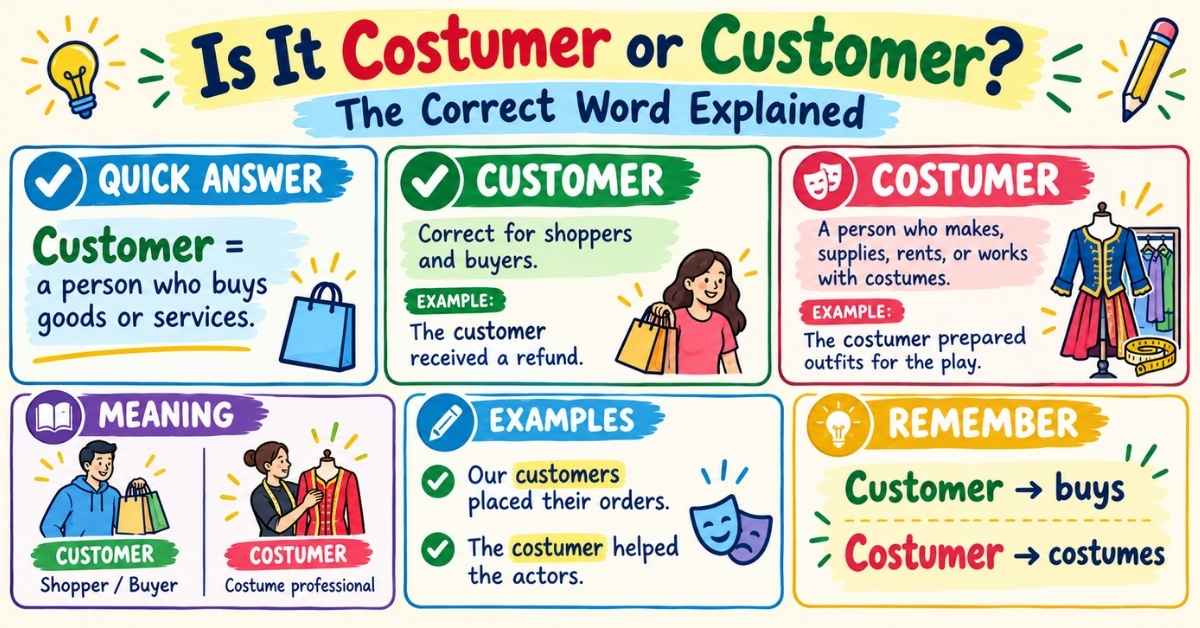
Is it costumer or customer? The correct word for a person who buys goods or services is customer. The word costumer is also correct, but it refers to someone who makes, supplies, rents, or works with costumes, especially in theater and film. Although these words look similar, their meanings are different. Knowing when to use each one will help you avoid spelling mistakes in business emails, school assignments, professional documents, and everyday writing.
Costumer vs. Customer: Quick Answer
| Word | Meaning | Example |
|---|---|---|
| Customer | A person or organization that buys goods or services | The customer received a refund. |
| Costumer | A person or company that makes or supplies costumes | The theater hired an experienced costumer. |
Remember: A customer buys products or services. A costumer works with costumes.
Both words are valid English words. Neither is simply an alternative spelling of the other.
What Does Customer Mean?
A customer is a person or organization that purchases goods or services from a business, seller, or service provider. It is the standard word used in retail, restaurants, banking, online shopping, and many other commercial settings.
For example, when someone purchases a pair of shoes from a store, that person is a customer. Someone who pays a plumber to repair a leaking pipe is also a customer.
Examples of customer in a sentence
- The customer asked whether the store offered free delivery.
- Every customer received a confirmation email after placing an order.
- Our business values every customer and welcomes feedback.
- The restaurant offered a discount to its regular customers.
- The company improved its customer service to resolve complaints faster.
- A new customer signed up for the monthly subscription.
In each sentence, the word refers to someone buying something or receiving a commercial service.
Common phrases using customer
You will often encounter customer in these expressions:
- Customer service: Help and support provided to customers.
- Customer support: Assistance with questions, problems, or products.
- Customer satisfaction: How satisfied customers are with their experience.
- Customer experience: The overall experience someone has when interacting with a business.
- Customer feedback: Opinions and comments shared by customers.
- Customer loyalty: The tendency of customers to continue choosing a business.
These phrases are common in American business writing, marketing, and professional communication.
What Does Costumer Mean?
A costumer is a person or business that makes, supplies, rents, or works with costumes. The word is particularly associated with theater, film production, television, and performance.
Costumers may help select clothing for actors, coordinate wardrobe pieces, prepare costumes for performances, or maintain outfits during production. The exact duties depend on the workplace.
Examples of costumer in a sentence
- The film hired a talented costumer to prepare historical outfits.
- The theater’s costumer repaired a damaged costume before opening night.
- An experienced costumer helped the production team organize the wardrobe.
- The production company contacted a local costumer to rent period clothing.
- The costumer made sure every actor had the correct outfit for each scene.
In these sentences, costumer is correct because the subject is related to costumes rather than buying goods or services.
Where might you encounter a costumer?
A costumer may work in:
- Theater and stage productions
- Film and television studios
- Costume rental businesses
- Wardrobe departments
- Historical reenactments
- Performance and entertainment productions
The term is less common in everyday shopping conversations because it belongs to a more specialized professional context.
Costumer vs. Customer: Key Differences
The easiest way to distinguish these words is to focus on what the person does.
| Feature | Customer | Costumer |
|---|---|---|
| Main meaning | Buyer of goods or services | Person or business involved with costumes |
| Common setting | Shops, businesses, online stores | Theater, film, wardrobe departments |
| Related word | Purchase or commerce | Costume |
| Example | The customer bought a jacket. | The costumer designed a jacket for the play. |
| Typical phrase | Customer satisfaction | Costume design |
| Correct for a shopper? | Yes | No, unless referring to a different role |
The difference is not a matter of American versus British spelling. The words have different meanings in both varieties of English.
A simple way to remember the difference
Think of the main word associated with each spelling:
- Customer → buying: A customer purchases something.
- Costumer → costume: A costumer works with costumes.
This memory trick is more reliable than trying to remember which word looks right. It connects each spelling to the meaning you want to express.
Correct and Incorrect Examples of Costumer vs. Customer
Sometimes the difference becomes clearer when you compare sentences that use the wrong word with corrected versions.
Example 1: Writing a business email
Incorrect: “Dear Costumer, your order has been shipped.”
Correct: “Dear Customer, your order has been shipped.”
Why? The message is addressed to someone who purchased a product. Therefore, customer is the appropriate word.
Example 2: Describing an online purchase
Incorrect: “The costumer requested a refund for the damaged item.”
Correct: “The customer requested a refund for the damaged item.”
Why? The person bought an item and requested a refund. The sentence concerns a commercial transaction, not costume production.
Example 3: Describing a theater production
Incorrect: “The customer prepared costumes for the actors.”
Correct: “The costumer prepared costumes for the actors.”
Why? The person is working with theatrical clothing, so costumer expresses the intended meaning.
Example 4: Writing a business website
Incorrect: “We appreciate every costumer who shops with us.”
Correct: “We appreciate every customer who shops with us.”
Why? A business thanking its buyers should use customer.
Example 5: Describing a film crew
Incorrect: “The customer worked with the wardrobe department to prepare outfits.”
Correct, if the person is the costume professional: “The costumer worked with the wardrobe department to prepare outfits.”
Why? The corrected sentence identifies someone involved in costume work. If the person is actually a paying client, however, customer could be correct.
These examples demonstrate an important principle: choose the word according to the intended meaning, not merely according to how it looks.
Why Do People Confuse Customer and Costumer?
The confusion is understandable because the words share many letters and have similar pronunciations. The spelling difference is small, but it changes the meaning substantially.
1. The words look almost identical
Both words begin with c and contain a similar sequence of letters. When typing quickly, it is easy to insert an o where a u belongs.
2. Both are legitimate English words
A conventional spellchecker may accept either spelling because both exist in English. It may not recognize that the word is inappropriate for the sentence.
For example, “We value every costumer” may pass a basic spelling check even though the writer intended to refer to buyers.
3. People often type quickly
Business emails, customer service responses, online product descriptions, and social media posts are sometimes written under time pressure. A small spelling mistake can remain unnoticed when the writer focuses on the message rather than the meaning of each word.
4. Pronunciation can make the difference harder to notice
In ordinary speech, the two words can sound similar, particularly when spoken quickly. Context often makes the intended meaning clear when speaking, but written communication requires the correct spelling.
Is It Costumer or Customer in American English?
In American English, customer is the correct spelling for a person who buys goods or services. Costumer refers to someone who works with or supplies costumes. Neither word is an American-versus-British alternative for the other.
For example:
- US retail business: “We appreciate your business as a valued customer.”
- US online store: “Every customer receives an order confirmation.”
- US theater production: “The costumer prepared the actors’ outfits.”
The same basic distinction applies in British English. Oxford notes that costumier is also used in British English for the costume-related occupation.
If you are writing for an American audience, use customer whenever you mean a buyer, shopper, or person purchasing a service.
read more >>> Is It Spicey or Spicy?
Customer vs. Client vs. Consumer vs. Buyer
These words overlap, but they do not always communicate exactly the same thing.
| Word | Meaning and typical use | Example |
|---|---|---|
| Customer | Someone who buys goods or services | A customer bought a laptop. |
| Client | Someone who receives professional or specialized services | A lawyer met with a client. |
| Consumer | Someone who uses or consumes goods or services; often used in market research | Consumers are comparing prices. |
| Buyer | Someone purchasing or intending to purchase something | The buyer negotiated the price. |
| Costumer | Someone who works with or supplies costumes | The costumer prepared the wardrobe. |
A person can be both a customer and a consumer. For example, someone buying a coffee machine for personal use is the customer at the point of purchase and the consumer when using it.
Similarly, a client may be a customer in a broader sense, but client often emphasizes an ongoing or professional relationship. Cambridge Dictionary recognizes this overlap in its definition of client.
These distinctions can make your writing more precise, particularly in business, marketing, and professional communication.
How to Avoid the Costumer vs. Customer Spelling Mistake
Use these practical checks before sending an email, publishing an article, or submitting an assignment.
Step 1: Identify the person’s role.
Ask yourself whether the person is purchasing something or working with costumes.
Step 2: Check the surrounding words.
Words such as order, refund, payment, shopper, and purchase often indicate that customer is the intended choice. Words such as wardrobe, actor, theater, film, and costume may indicate that costumer is appropriate.
Step 3: Read the entire sentence.
Do not rely exclusively on a spellcheck underline. A correctly spelled word can still be the wrong word for a sentence.
Step 4: Replace the word temporarily with its meaning.
If the sentence means “the person who bought the product,” use customer. If it means “the person who prepared the actors’ costumes,” use costumer.
Step 5: Proofread the final text.
This is particularly helpful for business emails, customer support templates, product pages, and marketing content where the same word may appear many times.
Frequently Asked Questions
Is it costumer or customer?
Use customer for someone who buys goods or services. Use costumer for someone who makes, supplies, rents, or works with costumes.
Is costumer a real word?
Yes. Costumer is a legitimate English noun associated with costume work, including theatrical and film production.
Is customer the correct spelling in the United States?
Yes. Customer is the standard American English spelling for a person or organization that buys goods or services.
Why do people spell customer as costumer?
The words look and sound similar, and both are valid. People may accidentally choose costumer when typing quickly or relying on spellcheck.
Can costumer mean a shopper?
No, not in its ordinary meaning. A shopper is a customer when buying goods. A costumer is someone involved with costumes.
What is the plural of customer?
The plural is customers. For example, “The store welcomed hundreds of customers during the sale.”
What is the plural of costumer?
The plural is costumers. For example, “The production hired two costumers to prepare the wardrobe.”
Is customer the same as client?
Not always. A customer typically buys goods or services, while a client often receives professional or specialized services. Their meanings can overlap.
Does spellcheck always catch costumer vs. customer?
No. Basic spellcheckers may accept both words because both are correctly spelled English words. You must also check whether the selected word makes sense in context.
How can I remember customer vs. costumer?
Remember customer = buying and costumer = costume. Connecting each word to its meaning makes it easier to select the right spelling.
Conclusion
The answer to “is it costumer or customer?” depends on the meaning of your sentence. Use customer for someone who buys goods or services, and use costumer for someone who works with or supplies costumes.
For everyday communication, shopping, business writing, customer service, and marketing, customer is usually the word you need. When writing about theater, film, or costume design, costumer may be exactly right.
Before publishing or sending a message, take a moment to check the context. One small spelling difference can change what your sentence communicates.
