

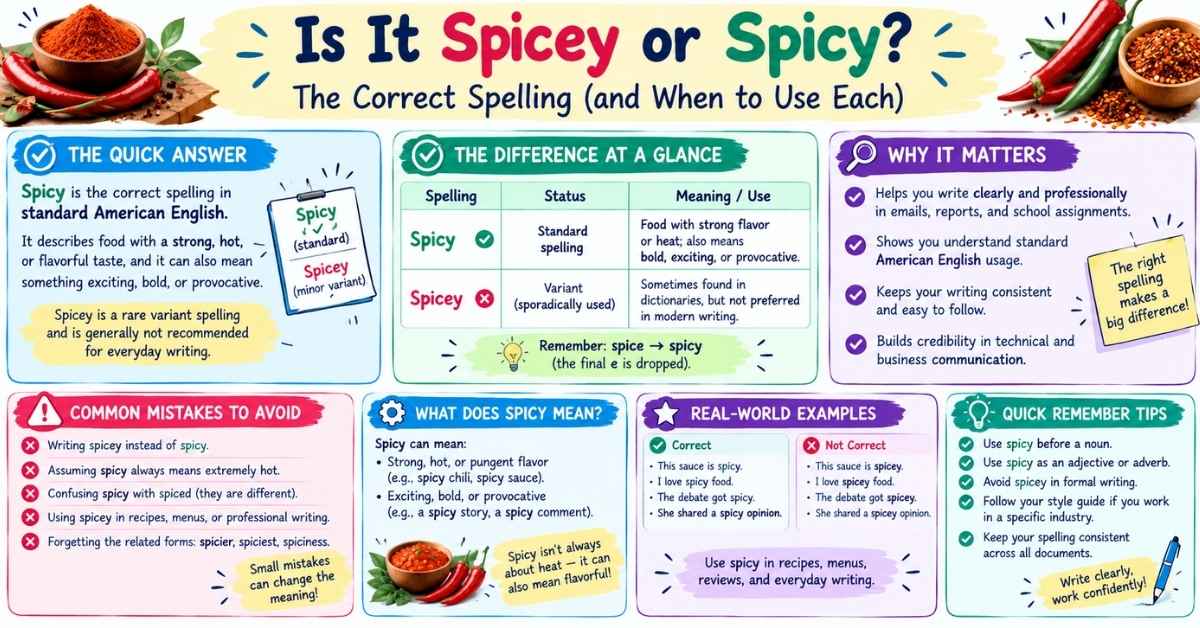
Is it spicey or spicy? The correct spelling to use in standard modern American English is spicy. It describes food with a strong, hot, or flavorful seasoning, and it can also describe something exciting, bold, or provocative. Although spicey appears as a variant spelling in some dictionaries, spicy is the preferred choice for recipes, menus, school assignments, professional writing, and everyday communication.
Is It Spicey or Spicy? The Quick Answer
Spicy is the standard spelling. Spicey is an uncommon variant that most readers will regard as a spelling mistake in ordinary modern writing.
Compare these examples:
- Correct: This chicken curry is too spicy for me.
- Nonpreferred: This chicken curry is too spicey for me.
- Correct: The restaurant serves spicy chicken wings.
- Nonpreferred: The restaurant serves spicey chicken wings.
Both spellings may communicate the intended meaning, but spicy is the safest and most widely accepted choice when you want your writing to look polished and professional.
| Spelling | Status | Example |
|---|---|---|
| Spicy | Standard spelling | The salsa is spicy. |
| Spicey | Uncommon variant | The salsa is spicey. |
One detail is worth knowing: some dictionaries record spicey as a variant of spicy. Therefore, saying it has never existed would be inaccurate. For everyday American English, however, use spicy.
What Does Spicy Mean?
The adjective spicy has several related meanings. Its exact meaning depends on the context in which it appears.
1. Having a strong or hot flavor
The most common meaning describes food that contains spices or has a strong, pungent flavor.
For example:
- The spicy chili warmed us up on a cold evening.
- I ordered a spicy chicken sandwich for lunch.
- This salsa has a spicy kick from fresh jalapeños.
- The soup was flavorful without being too spicy.
Spicy food does not always have to burn your mouth. A dish can be mildly spicy, richly seasoned, or intensely hot. The word can describe a strong flavor as well as noticeable heat.
2. Exciting, provocative, or surprising
Spicy can also be used figuratively to describe something lively, bold, controversial, or slightly shocking.
Examples include:
- The interview revealed some spicy details about the celebrity.
- Their conversation became spicy when they disagreed about politics.
- She shared a spicy opinion about the latest movie.
- The novel contains a few spicy scenes.
In these examples, the word does not necessarily describe food. It adds a sense of excitement, controversy, or boldness.
Cambridge and Oxford both document food-related and figurative meanings of spicy, making it useful to understand both rather than limiting the word to cooking.
Why Is Spicy Spelled Without an E?
The confusion comes from the base word spice. Because it ends in a silent e, it may seem natural to keep that letter when forming the adjective.
However, the established spelling is:
Spice → Spicy
The final e is dropped before the y is added.
A simple way to remember this is to learn the complete word rather than assume that every new word keeps all the letters of its base form.
Consider these related examples:
| Base word | Correct adjective |
|---|---|
| Spice | Spicy |
| Ice | Icy |
| Juice | Juicy |
| Grease | Greasy |
| Noise | Noisy |
| Shine | Shiny |
These examples illustrate a useful spelling pattern, although English has exceptions and does not follow one universal rule in every case.
Why does spicey look reasonable?
The spelling spicey looks plausible because it preserves the original noun.
A writer might reason that adding y to spice should produce spicey. The problem is that English spelling conventions do not always work through simple letter addition.
The conventional adjective has developed as spicy, and that is the form used in standard edited English.
The best memory trick is straightforward: spice loses its final e to become spicy.
Is Spicey Ever Correct?
Yes, in a limited sense. Some dictionaries recognize spicey as a variant spelling of spicy. Dictionary.com identifies it as a variation, and Collins directs readers from spicey to spicy.
That does not mean the two forms are equally advisable in every situation.
For modern standard writing, spicy remains the better choice.
There are also situations in which you should preserve the spelling Spicey exactly as written, such as when it appears in an official brand name, business name, username, title, or historical quotation. In those cases, you are reproducing a specific name or source rather than choosing the ordinary adjective.
For example:
- Recipe: This sauce is spicy.
- Restaurant description: We serve spicy shrimp tacos.
- Historical quotation: Preserve the original spelling if accuracy requires it.
- Brand name: Retain the official spelling of the brand.
The important distinction is between a spelling used as part of a specific name and the spelling you would choose when writing a normal sentence.
read more >>> Is It Cacoon or Cocoon?
Spicy vs. Spicey: Correct Usage Examples
The easiest way to learn the difference is to see the spellings in realistic contexts.
Food and cooking
Correct: I added a little chili powder to make the soup spicy.
Avoid: I added a little chili powder to make the soup spicey.
Correct: The restaurant is famous for its spicy chicken wings.
Avoid: The restaurant is famous for its spicey chicken wings.
Correct: Would you prefer a mild salsa or a spicy one?
Avoid: Would you prefer a mild salsa or a spicey one?
School and professional writing
Correct: The recipe calls for spicy peppers and fresh garlic.
Avoid: The recipe calls for spicey peppers and fresh garlic.
Correct: The product description identifies the sauce as spicy.
Avoid: The product description identifies the sauce as spicey.
Correct: The reviewer described the debate as spicy and entertaining.
Avoid: The reviewer described the debate as spicey and entertaining.
Casual and figurative writing
Correct: That was a spicy comment during the meeting.
Avoid: That was a spicey comment during the meeting.
Correct: The movie includes a spicy storyline.
Avoid: The movie includes a spicey storyline.
Across these contexts, the same principle applies: use spicy for the standard adjective, regardless of whether you are describing food, a conversation, a story, or an opinion.
Is Spicy Different in American and British English?
No. Spicy is the standard spelling in both American and British English.
Some English words have established regional spelling differences. For example, American English uses color, whereas British English commonly uses colour. The spicy-versus-spicey question is different because it is not a comparable regional spelling pair.
| Context | Preferred spelling |
|---|---|
| American English | Spicy |
| British English | Spicy |
| Canadian English | Spicy |
| Australian English | Spicy |
| International English | Spicy |
If you are writing for an American audience, choose spicy. The same choice is appropriate for British and international readers.
There is no need to switch to spicey when adapting an article, recipe, menu, or product description for another English-speaking market.
Related Words: Spicier, Spiciest, and Spiciness
Learning the related forms helps you use the word accurately in different sentences.
Spicier
Spicier is the comparative form of spicy. Use it when comparing two dishes or describing an increase in flavor intensity.
Examples:
- This curry is spicier than the one we had yesterday.
- I prefer the spicier sauce.
- The second batch turned out spicier because I added more chili.
Spiciest
Spiciest is the superlative form. It identifies the item with the greatest degree of spiciness within a group.
Examples:
- That was the spiciest dish on the menu.
- Which of these three sauces is the spiciest?
- The restaurant’s spiciest wings come with an extra-hot sauce.
Spiciness
Spiciness is the noun form. It describes the quality or degree of being spicy.
Examples:
- The spiciness of the sauce increased as it cooked.
- You can adjust the spiciness by adding less chili.
- The recipe balances the spiciness of the peppers with the sweetness of the tomatoes.
These forms are useful in recipes, restaurant reviews, cooking instructions, and product descriptions. Oxford Learner’s Dictionaries also lists spicier and spiciest as the comparative and superlative forms of spicy.
Common Mistakes to Avoid
Even when you know which spelling is standard, a few related mistakes can make writing less precise.
1. Writing spicey instead of spicy
Incorrect: The sauce is spicey.
Correct: The sauce is spicy.
2. Assuming spicy always means extremely hot
A dish can be spicy because of its strong seasoning or pungent flavor without being overwhelmingly hot. Choose words such as mild, medium-hot, or fiery when you need to communicate a more specific heat level.
3. Confusing spicy with spiced
These words are related but are not always interchangeable.
- Spicy describes a strong, pungent, or hot flavor.
- Spiced describes something to which spices have been added.
For example, a spiced cake may contain cinnamon and nutmeg without tasting hot. A spicy chili sauce, by contrast, may have noticeable heat.
4. Treating spicey as a regional alternative
Spicey is not the standard British spelling or a special American spelling. Use spicy in both varieties of English.
5. Overlooking related word forms
Remember that spicier, spiciest, and spiciness are established forms. They can make your writing more precise without repeatedly using the same adjective.
Frequently Asked Questions
Is it spicey or spicy?
Spicy is the standard spelling in modern English. Use it when describing food, flavor, or something figuratively bold or provocative.
Is spicey a real word?
Some dictionaries record spicey as a variant spelling of spicy. It is uncommon in modern standard writing, so spicy is the preferred choice.
Why is spicy not spelled spicey?
The standard adjective drops the final e from spice before adding y. The resulting spelling is spicy.
Does spicy mean hot or flavorful?
It can mean either, depending on context. Spicy commonly describes strong seasoning, pungent flavor, or heat. It can also describe something exciting, bold, or provocative.
Is spicy correct in American English?
Yes. Spicy is the standard spelling in American English. It is also the standard form in British English.
What is the difference between spicy and spiced?
Spicy describes a strong or hot flavor, while spiced means that spices have been added to something. A spiced dessert, for example, may be aromatic without being hot.
What is the comparative form of spicy?
The comparative form is spicier. For example, “This sauce is spicier than the original.”
What is the noun form of spicy?
The noun form is spiciness. For example, “The spiciness of the peppers varies.”
How do you pronounce spicy?
In American English, spicy is pronounced /ˈspaɪ.si/, with two syllables. The first syllable carries the stress.
Should I write spicy or spicey in a recipe?
Write spicy. It is the standard spelling for recipes, ingredient descriptions, restaurant menus, food blogs, and product listings.
Final Verdict: Choose Spicy
When deciding whether to write spicey or spicy, choose spicy for ordinary modern English. It is the standard spelling across American and British English, and it works for both literal and figurative meanings.
Although spicey is recorded as a variant in some dictionaries, it is generally not the best choice for everyday or professional writing.
Remember the simple pattern: spice → spicy. Once you learn that form, you can confidently describe spicy food, a spicier sauce, the spiciest dish, or the spiciness of a recipe without second-guessing your spelling.
