

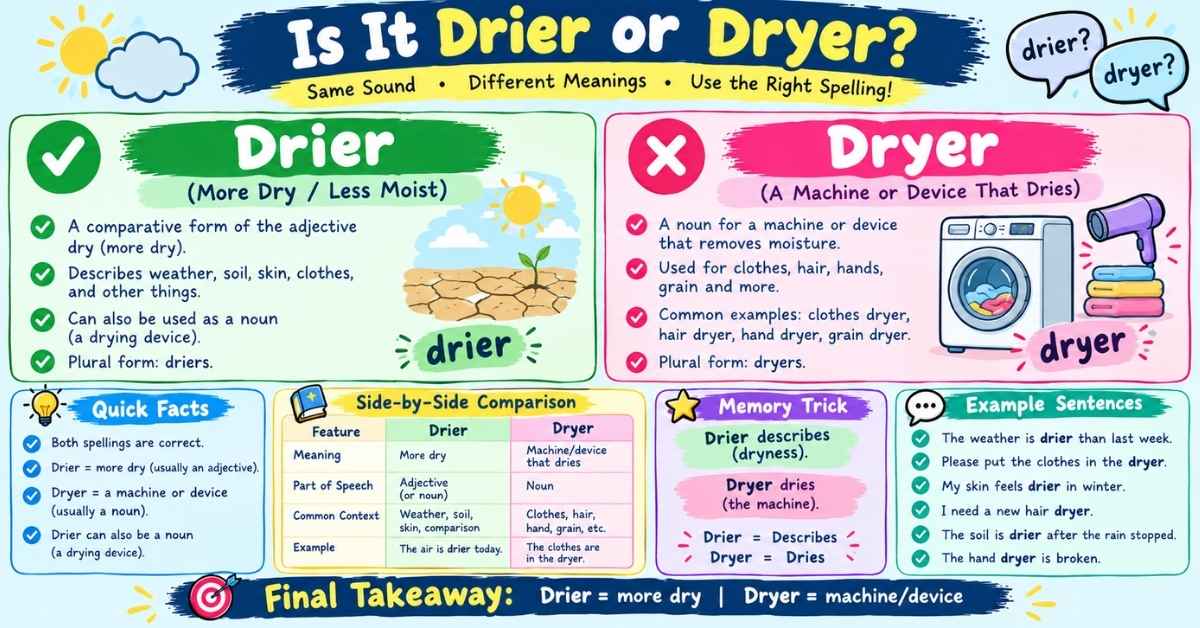
Have you ever wondered, is it drier or dryer? Both spellings are correct, but they are generally used in different contexts. Drier usually means “more dry,” while dryer commonly refers to a machine or device that removes moisture.
For example, you would write “The air is drier today” when describing a change in dryness. But when talking about the appliance used to dry clothes, the correct everyday spelling is “clothes dryer.”
Understanding this simple distinction will help you avoid spelling mistakes in emails, school assignments, professional writing, and everyday conversations.
Drier or Dryer: Quick Answer
Use drier when you mean more dry. Use dryer when you mean a machine or device that dries something.
| Word | Common meaning | Example |
|---|---|---|
| Drier | More dry; containing less moisture | The desert air is drier than coastal air. |
| Dryer | A machine or device that dries something | I put my clothes in the dryer. |
Easy way to remember
Drier describes dryness. Dryer does the drying.
This rule works for most everyday American English writing. However, there is an important dictionary nuance: drier can also be used as a noun meaning a drying machine or device. Therefore, the distinction is a helpful usage guide, not an absolute rule that one spelling is never correct in the other meaning.
What Does Drier Mean?
Drier is most commonly the comparative form of the adjective dry. It means that something has less moisture or is more dry than something else.
The standard comparison pattern is:
Dry → Drier → Driest
Here is how the forms work:
- Dry: The towel is dry.
- Drier: This towel is drier than the other one.
- Driest: This is the driest towel in the basket.
According to Cambridge Dictionary, drier is the comparative form of dry. The word can describe physical moisture as well as other meanings of “dry,” depending on context.
Examples of Drier in Sentences
- The weather is drier this week than last week.
- This towel is drier than the one on the chair.
- The soil becomes drier during the summer.
- My skin feels drier in cold weather.
- The desert has a drier climate than the rainforest.
- The bread became drier after sitting out overnight.
In each example, drier describes a condition or compares levels of dryness.
Drier in Weather and Climate Descriptions
You will often see drier in weather forecasts, climate reports, and environmental discussions.
Examples:
- The region is expected to experience drier weather next month.
- The western part of the state has a drier climate.
- The soil is becoming drier because of limited rainfall.
- Indoor heating can make the air feel drier.
Here, the word describes moisture conditions rather than a machine.
Drier Can Describe More Than Physical Moisture
The word drier can also describe figurative qualities.
For example:
- She has a drier sense of humor than her brother.
- The revised report uses a drier writing style.
In these sentences, drier does not describe water or humidity. It refers to humor or writing that is more restrained, understated, or less emotionally expressive.
The meaning comes from the context.
What Does Dryer Mean?
Dryer is commonly used as a noun for a machine or device that removes moisture from something.
Common examples include:
- Clothes dryer
- Hair dryer
- Hand dryer
- Grain dryer
- Food dryer
Cambridge Dictionary defines dryer as a machine that dries things, including clothes, hair, and other materials. Oxford Learner’s Dictionaries also lists dryer as a machine for drying something.
Examples of Dryer in Sentences
- I put the wet clothes in the dryer.
- My hair dryer stopped working this morning.
- The laundromat has several large dryers.
- The public restroom has an automatic hand dryer.
- We bought a new clothes dryer last month.
- The farmer uses a grain dryer to remove moisture from harvested grain.
In these examples, dryer names an object that performs the drying action.
Drier vs. Dryer: Side-by-Side Comparison
| Feature | Drier | Dryer |
|---|---|---|
| Common meaning | More dry | A machine or device that dries |
| Typical grammatical role | Comparative adjective | Noun |
| Root word | Dry | Dry |
| Main function | Describes a condition | Names a drying device |
| Common phrases | Drier air, drier climate, drier soil | Clothes dryer, hair dryer, hand dryer |
| Example | The air feels drier. | The dryer is running. |
Compare These Two Sentences
1. The clothes are drier now.
Here, drier describes the condition of the clothes. They contain less moisture than before.
2. The clothes are in the dryer.
Here, dryer identifies the appliance holding the clothes.
The surrounding sentence determines which meaning is intended.
Why Does Dry Become Drier Instead of Dryer?
This is where English spelling rules explain the difference.
When forming the comparative of many adjectives ending in a consonant followed by y, the y changes to i before adding -er.
For example:
| Base adjective | Comparative |
|---|---|
| Dry | Drier |
| Happy | Happier |
| Easy | Easier |
| Busy | Busier |
| Lucky | Luckier |
| Noisy | Noisier |
Therefore:
Dry → Drier
Not dryer when you are applying the standard comparative spelling rule.
What About Dryer?
The word dryer developed as a noun for something that dries. It uses the ending -er to identify an agent or device that performs an action.
For example:
- Dry + er → Dryer
This is similar to words such as:
- Teach → Teacher
- Mix → Mixer
- Print → Printer
The spelling difference reflects the word’s grammatical function and meaning.
A Useful Grammar Reminder
The comparative pattern is:
Dry → Drier → Driest
Examples:
- The towel is dry.
- The towel is drier than before.
- This is the driest towel here.
When you mean “more dry,” drier is the standard spelling to use.
Drier or Dryer in American English
For readers in the United States, the everyday distinction is straightforward:
- Drier: More dry or less moist.
- Dryer: A machine used to dry clothes, hair, or other materials.
Examples:
| Context | Correct sentence |
|---|---|
| Weather | The forecast predicts drier conditions. |
| Laundry | The clothes are in the dryer. |
| Skin | My hands feel drier in winter. |
| Hair care | I need a new hair dryer. |
| Agriculture | The soil is drier than it was last month. |
| Public restroom | The hand dryer is broken. |
Is This a British vs. American Spelling Difference?
Not primarily. The basic distinction between drier as a comparative adjective and dryer as a common appliance noun is recognized in both British and American English.
However, British English frequently uses the term tumble dryer for a clothes-drying machine.
For example:
- American English: Put the clothes in the dryer.
- British English: Put the clothes in the tumble dryer.
The comparative form remains:
- The clothes are drier now.
Dictionary references also recognize drier as an alternative noun spelling for a drying device, so actual usage can vary.
read more >>> Is It Caddie or Caddy?
Common Mistakes With Drier and Dryer
Mistake 1: Using Dryer When You Mean More Dry
Incorrect in standard comparative usage:
This towel is dryer than mine.
Preferred:
This towel is drier than mine.
Why? You are comparing the dryness of two towels.
Mistake 2: Using Drier for a Clothes Appliance
Common everyday spelling:
I put my clothes in the dryer.
The word identifies the machine.
A dictionary may recognize drier as an alternative noun spelling, but dryer is the familiar and clearest choice for an American English clothes appliance.
Mistake 3: Assuming the Spelling Must Match the Pronunciation
Drier and dryer are pronounced the same or very similarly in many varieties of English.
That means listening alone may not help you determine the spelling.
For example:
- The air is drier.
- The air is in the dryer.
The surrounding words make the meaning clear when spoken, but writing requires you to choose the appropriate spelling.
Mistake 4: Confusing Drier With Driest
Remember:
- Drier = comparative; more dry.
- Driest = superlative; most dry.
Examples:
- Today is drier than yesterday.
- This is the driest month of the year.
Do not write dryer or dryest when you are following the standard comparative and superlative spelling pattern for dry.
Mistake 5: Treating Every Meaning as an Absolute Rule
It is useful to remember “drier describes, dryer dries,” but dictionaries recognize overlapping noun usage.
Cambridge and Oxford both acknowledge drier as an alternative spelling for a drying device or machine.
Therefore, the best advice is:
Use drier for comparisons and dryer for drying appliances in ordinary American English writing. Recognize that drier can also appear as a noun.
How to Choose the Correct Spelling Every Time
Use this simple three-step test.
Step 1: Identify What You Mean
Ask yourself:
Am I describing how dry something is, or am I naming a machine?
- Describing dryness → Drier
- Naming a drying appliance → Dryer
Step 2: Replace Drier With “More Dry”
Try substituting the phrase more dry.
Example:
The air is drier today.
The air is more dry today.
The meaning is understandable, so drier is appropriate.
Another example:
The clothes are in the dryer.
The clothes are in the more dry.
This does not make sense because the sentence needs the name of an appliance.
Step 3: Check the Word’s Job in the Sentence
| If the word… | Use |
|---|---|
| Compares two levels of dryness | Drier |
| Describes air, soil, weather, or skin | Usually drier |
| Names a clothes appliance | Dryer |
| Names a hair appliance | Dryer |
| Names a hand-drying machine | Dryer |
This quick test solves most everyday spelling questions.
Real-Life Examples: Drier or Dryer?
Example 1: Weather Forecast
Sentence:
The forecast predicts drier conditions next week.
Why drier?
The sentence describes a change in moisture or weather conditions.
Example 2: Laundry Room
Sentence:
Please remove the clothes from the dryer.
Why dryer?
The word refers to the machine used to dry clothing.
Example 3: Skin Care
Sentence:
My skin becomes drier during the winter.
Why drier?
The sentence describes a change in skin moisture.
Example 4: Hair Care
Sentence:
She packed her hair dryer before traveling.
Why dryer?
It names a device used to dry hair.
Example 5: Agriculture
Sentence:
The southern fields are drier than the northern fields.
Why drier?
The sentence compares moisture conditions in two areas.
Example 6: Figurative Writing
Sentence:
His humor became drier as the conversation continued.
Why drier?
Here, the word describes a figurative quality rather than physical moisture.
Is “Drier” Ever Correct for a Machine?
Yes. This is an important nuance that simplified grammar explanations sometimes omit.
Both Cambridge Dictionary and Oxford Learner’s Dictionaries recognize drier as an alternative spelling of the noun dryer, meaning a machine or device that dries something.
However, in everyday American English, dryer is generally the clearest and most familiar spelling for appliances such as:
- Clothes dryer
- Hair dryer
- Hand dryer
For example:
I need to replace my clothes dryer.
This is the standard, familiar choice for most American readers.
The practical takeaway is not that drier is impossible as a noun. It is that dryer is usually the better default when naming a drying appliance.
Drier, Dryer, and Driest: Understand All Three
These words are easy to confuse because they share the same root.
| Word | Meaning | Example |
|---|---|---|
| Dry | Without moisture | The towel is dry. |
| Drier | More dry | This towel is drier. |
| Driest | Most dry | This is the driest towel. |
| Dryer | A drying machine or device | The towel is in the dryer. |
Remember the Pattern
Dry → Drier → Driest
This is the adjective comparison pattern.
Dryer = A thing that dries
This is the common noun usage.
Once you separate these functions, the spelling becomes much easier.
Quick Practice Quiz: Drier or Dryer?
Choose the correct word in each sentence.
Questions
- The desert climate is much _____ than the coastal climate.
- Please put the wet towels in the _____.
- My skin feels _____ during the winter.
- I bought a new hair _____ yesterday.
- The soil is _____ after several weeks without rain.
- This is the _____ summer the region has experienced in years.
- The automatic hand _____ stopped working.
- The bread became _____ after being left uncovered.
Answers
- Drier — compares two climates.
- Dryer — names a machine.
- Drier — describes reduced moisture.
- Dryer — identifies a hair-drying device.
- Drier — describes soil with less moisture.
- Driest — expresses the superlative form of dry.
- Dryer — identifies a device.
- Drier — compares the bread’s dryness with its earlier condition.
How Did You Do?
If you understood the difference between describing dryness and naming a machine, you have learned the central rule.
Frequently Asked Questions
Is it drier or dryer?
Both are correct words, but they commonly have different uses.
Drier means more dry, while dryer usually refers to a machine or device that dries something.
Is drier the correct comparative form of dry?
Yes. The standard comparative form is drier.
The pattern is:
Dry → Drier → Driest
Is “dryer” a real word?
Yes. Dryer is a standard noun for a machine or device that dries something, such as a clothes dryer or hair dryer.
Is “drier” also a correct word for a machine?
Yes. Major dictionaries recognize drier as an alternative noun spelling for a drying machine or device.
Nevertheless, dryer is the familiar everyday spelling for most American English appliance references.
Is it drier weather or dryer weather?
When you mean weather with less moisture, the standard choice is drier weather.
Example:
The region is expected to experience drier weather next month.
Is it a hair drier or hair dryer?
Hair dryer is the familiar and widely used spelling in American English.
Dictionaries recognize drier as an alternative noun spelling, but hair dryer is the clearest everyday choice.
Are drier and dryer pronounced the same?
They are pronounced the same or very similarly in many varieties of English. This is why the distinction can be confusing when spelling from sound alone.
Is it driest or dryest?
The standard modern spelling is driest.
Examples:
- Dry → Drier → Driest
- This is the driest month of the year.
Final Answer: Drier or Dryer?
So, is it drier or dryer?
The answer depends on the meaning.
- Use drier when you mean more dry or less moist.
- Use dryer when you mean a machine or device that dries something.
- Use driest when you mean the most dry.
The easiest memory trick is:
Drier describes. Dryer dries.
For everyday American English writing, this distinction will help you choose the correct spelling in weather reports, school assignments, professional emails, laundry-related sentences, and ordinary conversation.
When in doubt, ask yourself: Am I describing dryness, or am I naming a machine?
