

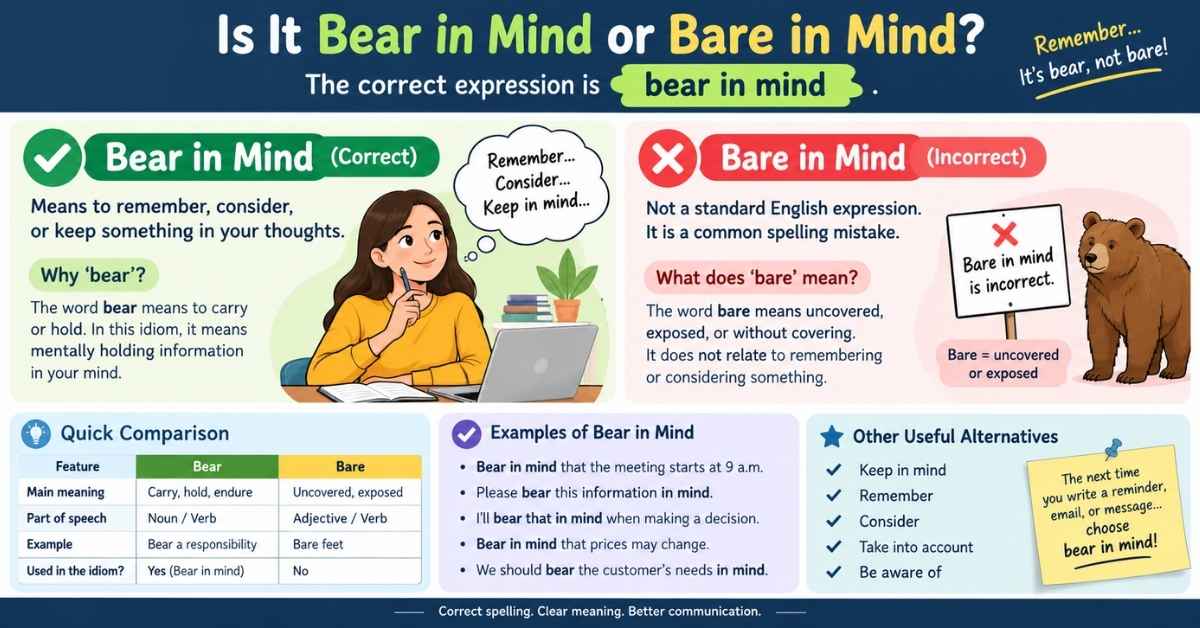
Is it bear in mind or bare in mind? The correct expression is bear in mind, not bare in mind. Both words are pronounced alike in many English accents, which makes them easy to confuse, but they have different meanings and grammatical uses. The expression bear in mind means to remember something, consider important information, or keep a particular fact in your thoughts. For example, you might say, “Please bear in mind that the office closes at 5 p.m.” The word bare means uncovered or exposed, so it does not work in this idiom.
Understanding the difference is easier when you look at what each word means. Once you know why the expression uses bear, you can remember its correct spelling and use it confidently in emails, conversations, academic writing, and professional communication.
Bear in Mind or Bare in Mind: Which Is Correct?
Bear in mind is the correct spelling when you want someone to remember, consider, or pay attention to something. Bare in mind is an incorrect spelling of this established English expression.
Although bear and bare sound similar, they serve different purposes in a sentence.
| Expression | Meaning | Correct usage |
|---|---|---|
| Bear in mind | Remember or consider something | Correct |
| Bare in mind | Not a standard English idiom | Incorrect |
| Keep in mind | Remember or consider something | Correct |
| Bear something in mind | Keep information in your thoughts | Correct |
For example:
- Correct: Bear in mind that the weather may change.
- Incorrect: Bare in mind that the weather may change.
- Correct: Please bear this information in mind.
- Incorrect: Please bare this information in mind.
The easiest way to remember the rule is to connect bear with carrying or holding something. When you bear something in mind, you figuratively hold that information in your thoughts.
What Does Bear in Mind Mean?
The expression bear in mind is an English idiom meaning to remember, consider, or remain aware of something. It tells someone to keep particular information in their thoughts because it may be important when making a decision or understanding a situation.
People commonly use this expression when giving advice, explaining conditions, offering reminders, or discussing something that should not be overlooked.
For example:
“Bear in mind that the final decision depends on your performance.”
This sentence asks someone to remember an important detail while thinking about the situation.
Other examples include:
- Please bear in mind that prices may increase next month.
- Bear in mind that everyone has different learning abilities.
- When planning your vacation, bear in mind the travel expenses.
- We should bear the customer’s needs in mind before making changes.
Why Is Bear Used in This Expression?
The word bear has several meanings in English. It can refer to an animal, but it can also function as a verb meaning to carry, support, endure, or hold.
In the expression bear in mind, the word refers to the figurative idea of carrying or holding information in your thoughts.
Think about carrying a heavy bag. You physically support its weight. Similarly, when you bear something in mind, you mentally hold on to information instead of forgetting it.
This connection makes the spelling easier to remember:
- Bear a responsibility = Carry a responsibility.
- Bear the cost = Take responsibility for a cost.
- Bear in mind = Hold information in your thoughts.
The meaning is figurative rather than literal, but the connection between carrying and remembering explains why the expression uses bear.
What Does Bare Mean?
Bare is a different English word that generally means uncovered, exposed, empty, or without the usual covering.
It can function as both an adjective and a verb.
As an adjective, bare describes something that has no covering or contains very little.
Examples:
- She walked across the cold floor with bare feet.
- The room had bare walls and very little furniture.
- The tree branches were bare during winter.
- He told the story with only the bare facts.
As a verb, bare means to uncover or expose something.
Examples:
- The dog bared its teeth when it felt threatened.
- The investigation helped bare the truth.
- He bared his arms before entering the water.
Notice that none of these meanings communicates remembering or considering information. That is why bare in mind does not work as a replacement for bear in mind.
Bear in Mind vs. Bare in Mind: Key Differences
The most important difference is the meaning of each word. Although they are homophones in many accents, their spelling and grammatical functions are different.
| Feature | Bear | Bare |
|---|---|---|
| Main meaning | Carry, hold, or endure | Uncovered or exposed |
| Part of speech | Noun and verb | Adjective and verb |
| Example | Bear the responsibility | Bare feet |
| Related expression | Bear in mind | Bare minimum |
| Used in the idiom? | Yes | No |
Remember: Use bear when you mean remembering or considering something. Use bare when you mean something is uncovered, exposed, or minimal.
How to Use Bear in Mind in a Sentence
The expression can appear in different sentence structures. Understanding these patterns will help you use it naturally in everyday and professional English.
1. Bear in Mind That
One common structure is:
Bear in mind that + complete clause.
The word that introduces the information someone should remember.
Examples:
- Bear in mind that the application deadline is approaching.
- Please bear in mind that this offer is available for a limited time.
- You should bear in mind that learning a new language takes patience.
- Bear in mind that the final results may vary.
This structure is particularly useful when explaining an important condition or giving someone a reminder.
2. Bear Something in Mind
You can also place a noun or noun phrase between bear and in mind.
The structure is:
Bear + object + in mind.
Examples:
- Bear the additional expenses in mind before booking your flight.
- We must bear customer expectations in mind.
- Please bear the instructions in mind while completing the assignment.
- She always bears her family’s needs in mind.
This structure is useful when you want to identify exactly what information someone should remember.
3. Bear This or That in Mind
The words this, that, and it can also function as objects in the expression.
Examples:
- Bear this in mind before making your decision.
- I will bear that in mind.
- You should bear it in mind when planning your schedule.
- We need to bear this in mind throughout the project.
A useful grammatical distinction is that you should not combine the object pronoun with another unnecessary that-clause.
Correct: Bear that in mind.
Incorrect: Bear that in mind that the deadline is tomorrow.
Instead, write:
Bear in mind that the deadline is tomorrow.
Bear in Mind Examples in Everyday English
Here are some natural examples showing how the expression works in different situations.
| Situation | Example sentence |
|---|---|
| Workplace | Bear in mind that the meeting starts at 9 a.m. |
| Education | Students should bear the examination rules in mind. |
| Travel | Bear in mind that flights can be delayed during bad weather. |
| Shopping | Please bear in mind that discounted products may not be returnable. |
| Health and fitness | Bear in mind that recovery times differ from person to person. |
| Finance | Always bear additional charges in mind when comparing prices. |
| Relationships | Bear in mind that people may have different perspectives. |
| Everyday conversation | I’ll bear that in mind. |
These examples demonstrate that the phrase is flexible. You can use it whenever a particular fact, condition, or consideration needs to remain important.
Different Forms of Bear in Mind
Because bear in mind contains the verb bear, its verb form changes according to the tense of the sentence.
The principal forms of the verb are bear, bore, borne, and bearing.
| Verb form | Usage | Example |
|---|---|---|
| Bear | Present/base form | I bear your advice in mind. |
| Bears | Third-person singular | She bears the instructions in mind. |
| Bearing | Present participle | He is bearing the warning in mind. |
| Bore | Simple past | She bore his advice in mind. |
| Borne | Past participle | We have borne these concerns in mind. |
Bear in Mind in the Past Tense
The simple past form of bear is bore, not beared.
Example:
“She bore the manager’s instructions in mind throughout the project.”
This means she remembered and considered those instructions while working.
Bear in Mind in the Present Tense
Use bear or bears depending on the subject.
Examples:
- I bear the risks in mind.
- They bear the costs in mind.
- He bears the consequences in mind.
Bear in Mind in the Present Continuous
Use bearing with an appropriate form of the verb be.
Example:
“We are bearing the customer’s requirements in mind while designing the product.”
Bear in Mind in the Present Perfect
Use borne as the past participle.
Example:
“We have borne these limitations in mind throughout the planning process.”
The distinction between born and borne is also important. In the sense of carrying or keeping something in mind, the correct past participle is borne.
read more >>> Is It Optimisation or Optimization?
Is Please Bear in Mind Formal or Polite?
Yes. Please bear in mind is a polite and widely accepted expression in professional and everyday communication.
It is often used in business emails, workplace instructions, customer service messages, academic communication, and formal reminders.
Examples:
- Please bear in mind that all applications must be submitted by Friday.
- Please bear in mind that additional charges may apply.
- Please bear in mind that our office will remain closed during the holiday.
Adding please makes the instruction sound more courteous. However, the expression can still sound firm depending on the surrounding sentence.
For a more conversational tone, you can use:
- Just keep in mind that the store closes early.
- Remember that the deadline is tomorrow.
- Don’t forget to bring your identification.
For formal writing, please bear in mind is a suitable option, particularly when reminding readers about important conditions.
Synonyms and Alternatives to Bear in Mind
Several English expressions communicate the same general idea. However, their tone and usage can differ slightly.
| Alternative | Meaning | Example |
|---|---|---|
| Keep in mind | Remember or consider | Keep in mind that prices can change. |
| Remember | Retain information | Remember to submit your application. |
| Consider | Think carefully about something | Consider the additional expenses. |
| Take into account | Include something in a decision | Take the delivery costs into account. |
| Be aware of | Know or recognize something | Be aware of the potential risks. |
| Don’t forget | Make sure to remember | Don’t forget that the meeting is tomorrow. |
| Remain mindful of | Continue to pay attention to something | Remain mindful of your responsibilities. |
Bear in mind and keep in mind are especially close in meaning. In most everyday situations, you can use either expression without changing the main message.
However, consider and take into account can sound more analytical, especially when discussing decisions, calculations, or professional matters.
Common Mistakes to Avoid
Even though the spelling rule is straightforward, a few mistakes frequently appear in everyday writing.
1. Writing bare instead of bear
Incorrect: Please bare in mind that the store closes at 6 p.m.
Correct: Please bear in mind that the store closes at 6 p.m.
2. Using beared instead of bore
Incorrect: She beared the instructions in mind.
Correct: She bore the instructions in mind.
3. Confusing born and borne
Incorrect: We have born the risks in mind.
Correct: We have borne the risks in mind.
4. Repeating that unnecessarily
Incorrect: Bear that in mind that the schedule may change.
Correct: Bear in mind that the schedule may change.
5. Using the expression without a clear purpose
Weak: Bear in mind that I bought a blue notebook yesterday.
Better: Bear in mind that the notebook contains the updated project notes.
The expression is most useful when the information being mentioned has some relevance to a decision, reminder, or future situation.
Frequently Asked Questions
1. Is it bear in mind or bare in mind?
Bear in mind is correct. It means to remember or consider something. Bare in mind is a misspelling of the established expression.
2. What does bear in mind mean?
Bear in mind means to remember, consider, or keep particular information in your thoughts. It is commonly used when giving advice or reminding someone about an important detail.
3. Why is it bear instead of bare?
The verb bear can mean to carry or hold. In this idiom, it figuratively describes holding information in your mind. Bare means uncovered or exposed, which does not express the intended meaning.
4. Is bare in mind ever correct?
No. Bare in mind is not the standard English expression for remembering or considering something. Use bear in mind instead.
5. Is bear in mind the same as keep in mind?
Yes. Both expressions generally mean to remember or consider information. For example, “Bear in mind that the store closes early” and “Keep in mind that the store closes early” communicate essentially the same message.
6. Can I use please bear in mind in a professional email?
Yes. It is a polite and appropriate expression for professional communication. You can use it to remind colleagues, customers, or clients about deadlines, requirements, conditions, or important information.
7. What is the past tense of bear in mind?
The simple past tense uses bore. For example, “She bore the instructions in mind.” The past participle is borne, as in “We have borne the requirements in mind.”
8. Is bear in mind formal or informal?
It works in both formal and informal English. It is particularly common in professional writing, instructions, discussions, and everyday conversations.
9. What is another word for bear in mind?
Common alternatives include keep in mind, remember, consider, recall, be aware of, and take into account. The best choice depends on the context and tone.
10. Is bear in mind grammatically correct in American English?
Yes. Bear in mind is a standard English idiom and is fully acceptable in American English. It means to remember or consider something.
Final Verdict: Bear in Mind Is the Correct Expression
When deciding between bear in mind or bare in mind, always choose bear in mind when you want to express remembering, considering, or keeping information in your thoughts.
The difference comes down to the meanings of the two words: bear means to carry or hold, while bare means uncovered or exposed.
A simple memory trick is to associate bearing something in mind with mentally carrying important information. Once you remember this connection, choosing the correct spelling becomes much easier.
So, the next time you write a reminder, prepare a professional email, or explain an important detail, remember to bear it in mind, not bare it in mind.
