

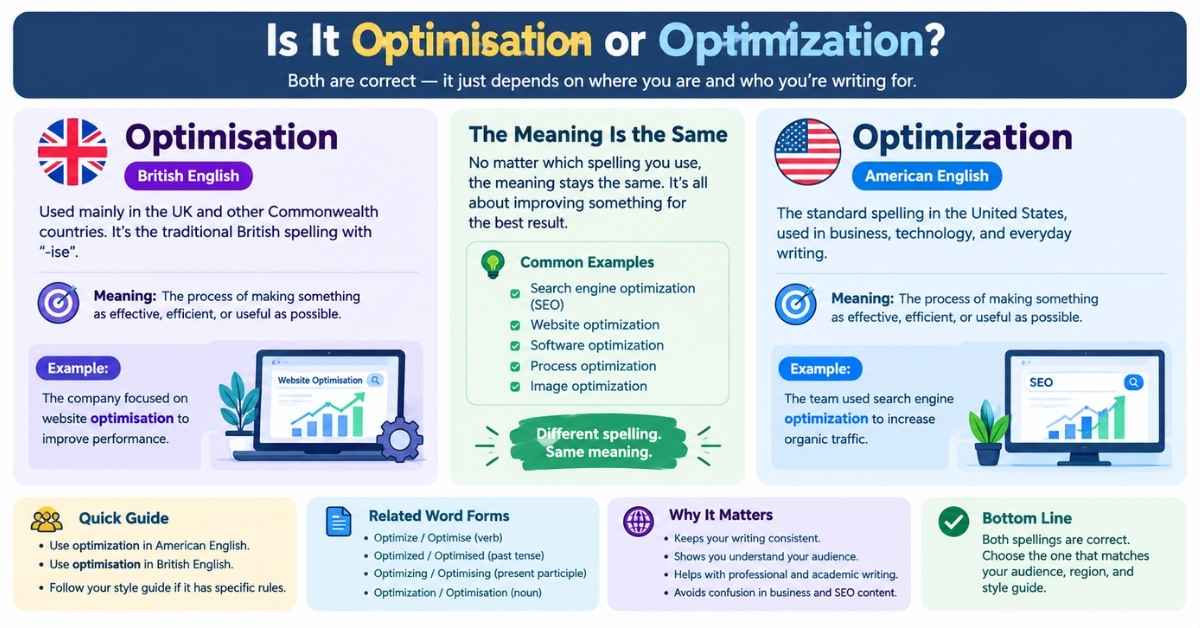
Is it optimisation or optimization? Both spellings are correct, but optimization is the standard spelling in American English, while optimisation is commonly used in British English. Both words have the same meaning: the process of making something as effective, efficient, or useful as possible. If you are writing for a US audience, use optimization in your articles, business documents, academic assignments, and website content.
The difference is primarily regional spelling, not grammar or meaning. However, British English has an important exception: some publishers and style guides, including Oxford’s conventions, prefer -ize spellings. Understanding this distinction helps you choose the right form without second guessing your writing.
Optimisation vs Optimization: Quick Answer
| Feature | Optimization | Optimisation |
|---|---|---|
| Main usage | American English | Common British English |
| Meaning | Making something as effective as possible | Making something as effective as possible |
| Related verb | Optimize | Optimise |
| Past tense | Optimized | Optimised |
| Present participle | Optimizing | Optimising |
| Correct spelling? | Yes | Yes |
The easiest rule to remember is this: use optimization for American English and optimisation when following a British spelling style that prefers -ise endings. If a publisher or organization specifies a style guide, follow that guidance instead.
What Does Optimization Mean?
Optimization is a noun describing the process of improving something to achieve the best possible result for a particular goal. Depending on the context, that goal might be greater efficiency, better performance, lower costs, or more effective use of resources.
For example, a company might improve its delivery routes to reduce fuel consumption. A website owner might compress images to make pages load faster. A software developer might refine an algorithm so that a program uses less processing time.
All these activities involve optimization because they aim to make an existing process or system work better.
Example sentences using optimization:
- The company invested in process optimization to reduce production costs.
- Website optimization helped improve the site’s loading speed.
- The engineering team completed the optimization of its software.
- Search engine optimization helps businesses improve their visibility in search results.
- The airline introduced schedule optimization to use its available resources more efficiently.
In each example, optimization describes an effort to achieve a better result. The precise goal depends on the subject being improved.
Why Do Optimization and Optimisation Have Different Spellings?
The difference comes from regional spelling conventions in English. American English generally favors the spelling -ize in words such as optimize, while British English commonly uses -ise, producing optimise.
This pattern appears in several familiar word pairs:
| American English | Common British English |
|---|---|
| Optimization | Optimisation |
| Organize | Organise |
| Recognize | Recognise |
| Realize | Realise |
| Optimize | Optimise |
These differences do not normally change the meaning of the words. They reflect the spelling convention followed by the writer, publisher, or organization.
There is also an important qualification: not every British style guide prefers -ise. Oxford’s general style guidance favors -ise in its house style, while Oxford’s broader spelling tradition recognizes the -ize convention. Therefore, it is inaccurate to claim that optimization is always wrong in British English.
For everyday writing, the practical solution is to identify your intended audience and follow one consistent spelling system.
Optimization vs Optimisation in American and British English
American English: Optimization
In the United States, optimization is the standard form. It is appropriate for American websites, professional reports, school assignments, marketing materials, and technical documentation.
Examples include:
- The marketing team developed a search engine optimization strategy.
- Our developers are working on website optimization.
- The company improved its inventory management through process optimization.
- Image optimization reduced the size of the website’s media files.
If your target readers are primarily American, this is the spelling to use throughout your content.
British English: Optimisation
Optimisation is common in British English, especially in publications that follow the traditional -ise convention.
For example:
- The marketing team reviewed its search engine optimisation strategy.
- The company invested in website optimisation.
- The engineers completed the optimisation of the production process.
- Image optimisation improved the website’s loading performance.
These sentences communicate the same ideas as their American counterparts. Only the spelling changes.
What About Oxford Spelling?
Oxford’s style conventions are an important exception to the simplified US-versus-UK rule. The University of Oxford’s general house style prefers forms such as organise and authorisation, but Oxford’s broader spelling tradition also recognizes the historical basis for -ize forms.
Consequently, a British publication may use optimization if it follows a style convention that favors -ize. That does not make the publication American or its spelling incorrect.
The most accurate rule is to use the form required by your publication’s style guide. When no specific guide applies, choose the convention that best matches your readers.
Optimization and Optimisation in Real Sentences
Seeing the words in context makes the spelling difference easier to understand.
1. Search Engine Optimization
American English: Search engine optimization helps businesses improve their visibility in search results.
British English: Search engine optimisation helps businesses improve their visibility in search results.
The phrase refers to practices intended to help relevant pages appear more prominently in organic search results. The regional spelling does not change the underlying concept.
2. Website Optimization
American English: Website optimization can improve page performance and user experience.
British English: Website optimisation can improve page performance and user experience.
In this context, the term may refer to improving loading speed, mobile usability, navigation, accessibility, or other aspects of a website.
3. Software Optimization
American English: Software optimization reduced the time required to complete the calculation.
British English: Software optimisation reduced the time required to complete the calculation.
Software optimization involves improving a program’s performance or resource efficiency. Depending on the problem, a developer might reduce memory usage, simplify an algorithm, or eliminate unnecessary operations.
4. Business Process Optimization
American English: The company introduced process optimization to reduce unnecessary delays.
British English: The company introduced process optimisation to reduce unnecessary delays.
The aim is to improve the way work is performed, whether through better scheduling, fewer manual steps, or more efficient resource allocation.
These examples show that the distinction is consistent across different fields. The subject changes, but the regional spelling pattern remains the same.
read more >>> Is It Monkies or Monkeys
Optimize, Optimized, Optimizing, and Optimization
The noun is only one part of the word family. If you want your writing to remain consistent, you should use the corresponding forms as well.
| Word form | American English | Common British -ise style |
|---|---|---|
| Verb | Optimize | Optimise |
| Past tense | Optimized | Optimised |
| Present participle | Optimizing | Optimising |
| Noun | Optimization | Optimisation |
Consider these examples:
American English
- We optimize our website for mobile users.
- The team optimized the checkout process.
- The company is optimizing its delivery network.
- The optimization improved overall efficiency.
British English
- We optimise our website for mobile users.
- The team optimised the checkout process.
- The company is optimising its delivery network.
- The optimisation improved overall efficiency.
A common writing problem is mixing these forms in the same document without a reason. For instance, using optimization in one paragraph and optimising in the next may create an inconsistent style if the document is intended to follow standard American English.
The solution is straightforward: select your English variety and apply it to the complete word family.
Which Spelling Should You Use for SEO?
If you are writing for a US audience, use search engine optimization, not search engine optimisation, as your default phrase.
This recommendation is based on American spelling conventions and the expectations of your target readers. It does not mean that changing a single spelling will automatically improve search rankings.
For a US-focused website, follow these practical guidelines:
- Use American English consistently. Prefer optimization, optimize, optimized, and optimizing.
- Match your audience’s language. A UK-focused publication may appropriately choose optimisation.
- Follow your editorial style guide. A publisher’s requirements take precedence over a generic regional rule.
- Use keywords naturally. Include relevant phrases such as website optimization or search engine optimization where they fit the subject.
- Avoid unnecessary spelling variations. Do not alternate between the two forms simply to increase keyword coverage.
Search engines can encounter both spellings, but the choice of spelling alone is not a guarantee of better rankings. Search intent, content relevance, usefulness, technical accessibility, and overall page quality remain important considerations.
If you publish separate US and UK versions of a website, each version can use the spelling conventions appropriate for its intended readers. The content should still be useful, accurate, and clearly adapted to the relevant audience.
Frequently Asked Questions
Is it optimisation or optimization?
Both are correct spellings. Optimization is standard in American English, while optimisation is commonly used in British English.
Is optimisation British or American English?
Optimisation is primarily associated with British English and other writing styles that prefer the -ise ending. American English normally uses optimization.
Is optimization accepted in British English?
Yes. Some British publishers and style guides use optimization. Oxford-related spelling conventions are a notable example of why the rule is not an absolute division between the United States and the United Kingdom.
Do optimisation and optimization mean the same thing?
Yes. Both words refer to the process of making something as good, effective, or efficient as possible. The difference is spelling rather than meaning.
Which spelling should I use in the United States?
Use optimization for American English. The same convention applies to optimize, optimized, and optimizing.
Is it search engine optimization or search engine optimisation?
Use search engine optimization for American English. Search engine optimisation is common in British English styles that prefer -ise spellings.
Is it optimizing or optimising?
Both forms are correct. Optimizing is the standard American form, while optimising is common in British English that uses -ise.
Does Google prefer optimization or optimisation?
There is no universal rule that one spelling is always preferred for rankings. For a US-focused article, optimization is the natural editorial choice because it matches standard American English and the target audience’s expectations.
Is optimisation a spelling mistake?
No. Optimisation is a recognized spelling. It may be flagged by a spellchecker configured for American English, but that does not make it incorrect in a British English context.
Conclusion
When deciding whether to write optimisation or optimization, choose optimization for American English and optimisation for British English styles that prefer -ise. Both forms have the same meaning, and some British conventions also accept or prefer -ize spellings.
For a US-focused website, use optimization consistently across your content, including related forms such as optimize, optimized, and optimizing. This simple approach keeps your writing clear, professional, and appropriate for your intended readers.
