

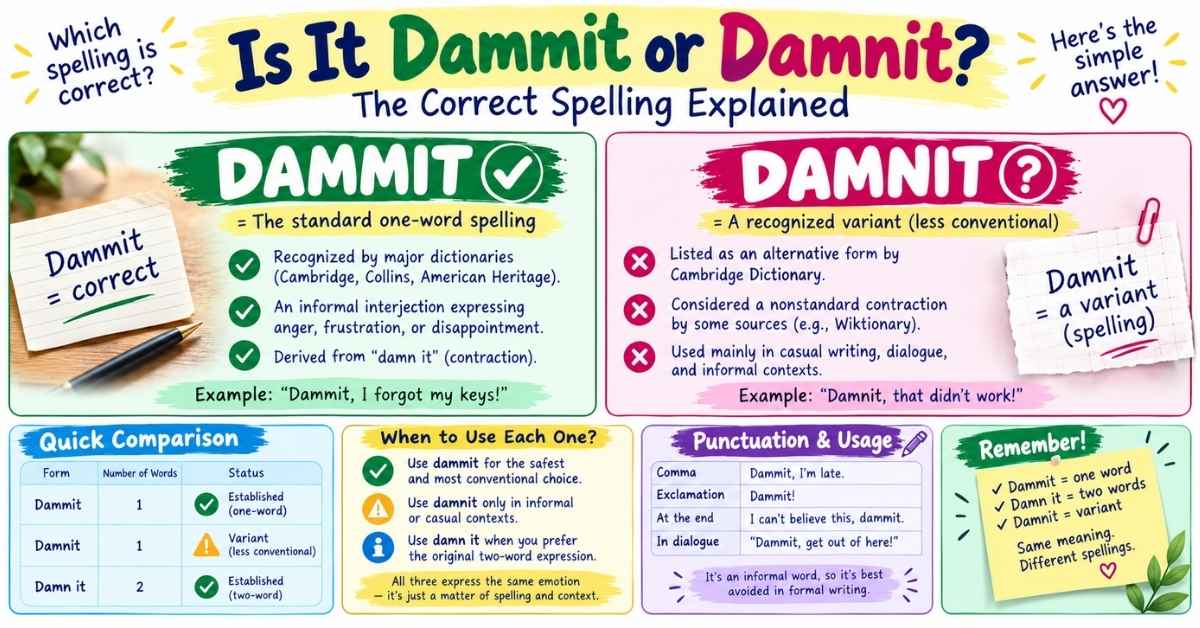
Is it dammit or damnit? If you’re unsure which spelling to use, the safest conventional one word form is dammit. However, the answer is slightly more nuanced than simply calling damnit “wrong.” Cambridge Dictionary lists damnit as an alternative form of dammit, while other references describe it as a nonstandard variant. The original two-word expression, damn it, is also correct.
So, for most edited American English, remember:
dammit = established one-word form
damn it = established two-word form
damnit = recognized variant, but less conventional
Let’s look at the difference, meaning, history, and everyday usage.
Is It Dammit or Damnit?
If you’re choosing between dammit and damnit for standard written English, use dammit.
“Dammit” is an established informal interjection derived from damn it. Dictionaries including Cambridge, Collins, and American Heritage recognize the form.
Damnit is more complicated. It is definitely found in real English usage, and Cambridge explicitly lists it as an alternative form. Wiktionary describes it as a nonstandard contraction of damn + it.
Therefore, saying that damnit “doesn’t exist” would be too absolute.
Quick comparison
| Form | Status | Meaning | Practical choice |
|---|---|---|---|
| dammit | Established informal form | Anger, frustration, irritation, disappointment | Best default one-word form |
| damn it | Established two-word expression | Same basic emotional function | Correct |
| damnit | Variant/nonstandard form depending on reference | Generally the same meaning | Less conventional |
The important difference is therefore not meaning. It is primarily spelling, conventionality, and register.
Is “Dammit” the Standard Spelling?
Yes. Dammit is the established one word spelling.
American Heritage defines dammit as an interjection used to express anger, irritation, contempt, or disappointment and identifies it as an alteration of damn it.
Collins likewise gives dammit as a contracted form of damn it. Its American English entry describes it as an interjection expressing anger, irritation, contempt, or disappointment.
Cambridge labels it very informal and defines it as an expression of anger, while also noting its use for emphasis.
For example:
- Dammit, I forgot my keys.
- Dammit! The computer crashed again.
- I told you to be careful, dammit.
In each example, the word expresses an emotional reaction rather than providing essential factual information.
Is “Damnit” a Word?
This is where many online spelling explanations become too simplistic.
Damnit appears in English and is recognized by some dictionary sources as a variant. Cambridge specifically lists it alongside dammit.
Wiktionary describes damnit as a nonstandard contraction of damn + it and notes its use, particularly in Southern U.S. English.
That means there are two different questions:
Does “damnit” occur as an English form?
Yes.
Is “damnit” the conventional spelling to choose when you want polished, standard-looking English?
Generally, no. Dammit is the safer choice.
This distinction matters because a variant can be real without being the preferred form for every context.
If you’re writing an article, school assignment, professional document, or edited publication, dammit is the more conventional one word choice.
Dammit vs Damnit vs Damn It
There are really three forms worth knowing.
| Form | Number of words | Meaning | Register |
|---|---|---|---|
| dammit | 1 | Frustration, anger, irritation, disappointment | Very informal |
| damnit | 1 | Generally the same | Variant/nonstandard |
| damn it | 2 | Frustration, anger, irritation, disappointment | Informal |
The two-word form is important because damn it is not a spelling mistake.
For example:
Damn it, I left my phone in the car.
And:
Dammit, I left my phone in the car.
Both express frustration.
The major difference is that the first retains the two-word phrase, while the second uses the established contracted form.
Why Is “Dammit” Spelled With Two M’s?
The word developed from the expression damn it.
Over time, the phrase came to be represented as a single informal expression:
damn it → dammit
The spelling reflects the established form of the contracted expression rather than simply copying the first word and removing the space.
Collins dates the first recorded use of dammit to around 1905–1910.
This also explains why spelling it damnit can feel intuitive. Someone hearing the expression spoken quickly may naturally connect the sounds with the spelling of damn and produce damnit.
The pronunciation does not make the spelling distinction obvious.
That’s why this is a particularly persistent spelling question.
What Does “Dammit” Mean?
Dammit is an informal interjection.
It can express:
- anger
- frustration
- irritation
- annoyance
- disappointment
- impatience
- emphasis
Cambridge describes it as an expression of anger and also notes its use for emphasis.
Collins similarly associates dammit with anger, irritation, contempt, and disappointment.
Consider:
Dammit, I missed the train.
The word tells the reader how the speaker feels about missing the train.
Compare that with:
I missed the train.
The factual information is essentially the same, but the emotional tone is different.
How Do You Use “Dammit” in a Sentence?
Dammit can appear at the beginning, middle, or end of a sentence.
At the beginning
Dammit, I forgot the appointment.
Here, the interjection comes before the main statement.
As a standalone exclamation
Dammit!
The entire word functions as the emotional reaction.
At the end
I told you this would happen, dammit.
Here, it adds emphasis to the statement.
In dialogue
“Dammit, we have to leave now!”
This can work naturally in fictional dialogue because the character’s emotional state is part of the scene.
For emphasis
“I need this finished today, dammit.”
In this position, the word adds emotional force to an otherwise ordinary statement.
Is “Dammit” Appropriate in Formal Writing?
Usually, no.
The issue isn’t primarily spelling. It’s register.
Cambridge labels dammit very informal.
That makes it potentially suitable for:
- casual conversation
- text messages
- informal online communication
- fictional dialogue
- personal writing
- character narration
It is generally less suitable for:
- academic essays
- formal reports
- official documents
- professional correspondence
- business proposals
- formal presentations
For example, this may work in dialogue:
“Dammit, we missed the deadline!”
But in a formal report, you could simply write:
Unfortunately, the deadline was missed.
The second version communicates the information without the emotional and mildly profane tone.
Correct spelling does not automatically mean appropriate context.
Is “Damnit” Acceptable in Casual Writing?
You will encounter damnit in casual writing, online conversations, social media, dialogue, and other informal contexts.
Its meaning is generally understood immediately.
However, if your goal is conventional edited English, dammit is the safer choice.
This is one reason a simple “correct vs incorrect” table can be misleading. Cambridge actually records damnit as an alternative form.
So the practical rule is:
Use “dammit” when you want the established one-word form. Recognize “damnit” as a variant you may encounter in informal English.
Dammit vs Damn It: Are They the Same?
In most emotional uses, dammit and damn it communicate essentially the same idea.
For example:
Dammit, I forgot my wallet.
and:
Damn it, I forgot my wallet.
Both express frustration.
The distinction is mainly structural:
- dammit is one word
- damn it is two words
Collins defines dammit as a contracted form of damn it.
Oxford also connects dammit with damn it in its entry for the exclamation damn.
So don’t make the mistake of treating damn it as a misspelling of dammit. It is an established two-word expression.
How Should You Punctuate “Dammit”?
Punctuation depends on how the word functions in the sentence.
Comma after dammit
When it introduces a sentence, a comma is common:
Dammit, I forgot my password.
Exclamation mark
When the expression stands alone or carries strong emphasis:
Dammit!
At the end of a sentence
A comma can separate it from the preceding statement:
I told you not to touch it, dammit.
Inside a sentence
It can be set off according to its role:
I was, dammit, trying to help.
The exact punctuation can vary with sentence structure and intended rhythm, but the key point is that dammit functions as an interjection, not as an ordinary noun or verb.
read more >>> Is It Lily or Lilly?
Is “Dammit” American English?
Dammit is used in American English as well as British English.
Collins provides both American and British English information for the word. Its American English entry describes it as an interjection, while its British English entry describes it as a contracted form of damn it.
Cambridge also provides U.S. pronunciation information for the word.
So it would be too simplistic to say that one spelling belongs exclusively to American English and another belongs exclusively to British English.
The more useful distinction is standard vs variant spelling and informal vs formal register.
Common Mistakes With Dammit and Damnit
Mistake 1: Assuming “dammit” is wrong
It isn’t.
Dammit is an established dictionary word. American Heritage, Collins, and Cambridge all recognize the form.
Mistake 2: Saying “damnit” does not exist
That’s also too absolute.
Cambridge explicitly lists damnit as an alternative form.
Mistake 3: Treating “damn it” as incorrect
Damn it is an established two-word expression.
Mistake 4: Assuming all three forms have different meanings
In their use as emotional exclamations, they generally communicate the same basic idea.
Mistake 5: Using the word in formal writing simply because it is spelled correctly
A word can be correctly spelled and still be inappropriate for the register.
Mistake 6: Inventing a hyphenated form
Damn-it is not the normal spelling of this expression.
Use:
- dammit
- damn it
And recognize damnit as a variant encountered in informal usage.
Which Form Should You Use?
If you simply want the safest practical rule:
For standard one-word spelling
Use dammit.
If you want the original two-word expression
Use damn it.
If you encounter “damnit”
Understand that it is an attested variant, although it is less conventional for edited general English. Cambridge explicitly records it as an alternative form.
For formal writing
Consider avoiding all three because the expression is very informal and emotionally charged.
A neutral alternative may be better.
A Simple Memory Trick
If you’re deciding between dammit and damnit, remember:
The established one-word form is “dammit.”
And if you want to keep the original expression separated:
damn it
So your basic framework is:
dammit = one word
damn it = two words
damnit = variant form
This is more accurate than memorizing a simple “right/wrong” rule because dictionary treatment of damnit is not completely uniform.
Dammit vs Damnit: Examples
| Situation | Example |
|---|---|
| Forgot something | Dammit, I left my wallet at home. |
| Missed an opportunity | Dammit! We were so close. |
| Frustrated with technology | Dammit, the computer froze again. |
| Strong emphasis | I need this finished today, dammit. |
| Fictional dialogue | “Dammit, get out of the way!” |
| Formal report | Prefer a neutral alternative |
| Academic writing | Usually avoid the expression |
These examples show that the spelling question and the usage question are separate.
Frequently Asked Questions
Is it dammit or damnit?
Dammit is the established one-word spelling and the safest choice for conventional edited English. Damnit is also attested as a variant; Cambridge lists it as an alternative form.
Is “damnit” a real word?
Yes, it occurs in English and is recognized as a variant by Cambridge. Other references may describe it as nonstandard.
Is “dammit” one word?
Yes. Dammit is written as one word.
Is “damn it” correct?
Yes. Damn it is the original two-word expression and remains an established form.
What does “dammit” mean?
It is an informal interjection used to express emotions such as anger, irritation, frustration, disappointment, or emphasis.
Why does dammit have two m’s?
The word developed from damn it into an established one-word form, dammit. Dictionary sources describe it as a contraction or alteration of the original expression.
Is damnit a misspelling?
It depends on the reference. Some sources treat it as a nonstandard form, while Cambridge lists it as an alternative form. Therefore, calling it universally “incorrect” is too broad.
Can I use dammit in formal writing?
It is generally better to avoid it in formal, academic, and professional writing because dictionaries classify it as very informal.
Are dammit and damnit pronounced differently?
They are generally pronounced the same or very similarly. Cambridge gives the pronunciation of dammit as /ˈdæm.ɪt/ and lists damnit as an alternative form.
Is dammit a swear word?
It is an informal mild expletive. Collins and Cambridge both associate it with expressions of anger or irritation.
Which is better for American English: dammit or damnit?
For a conventional one-word spelling in American English, dammit is the safer choice. Damnit is nevertheless an attested variant.
Should I write “damn it” or “dammit”?
Both are established forms. Use dammit when you want the contracted one-word form and damn it when you want the two-word expression.
Final Answer: Dammit or Damnit?
If you’re asking “is it dammit or damnit?”, the practical answer is dammit.
Dammit is the established one-word spelling of the informal interjection derived from damn it. Damn it is also correct as two words. Damnit is a recognized variant in some dictionary sources, including Cambridge, although it is less conventional in edited general English.
So, when spelling accuracy matters, use:
✓ dammit
✓ damn it
△ damnit recognized variant, but less conventional
And remember that the bigger issue is often register, not spelling. Because dammit is very informal, a neutral expression may be more appropriate in academic, professional, or official writing.
