

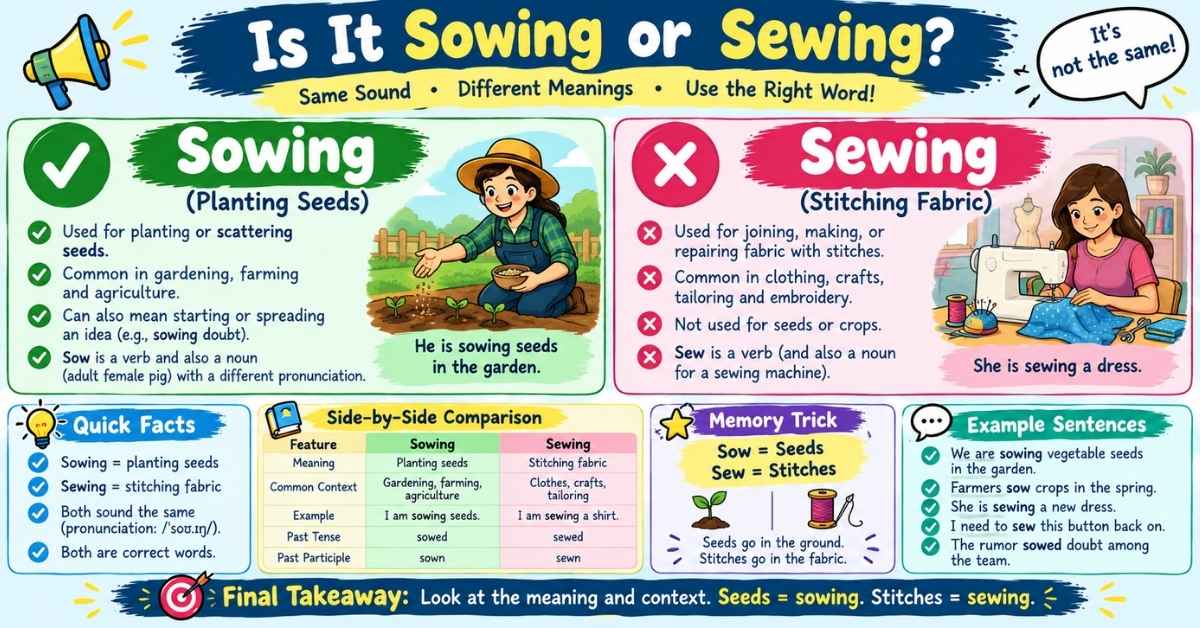
Is it sowing or sewing? Both words are correct, but they have completely different meanings. Use sowing when you are planting or scattering seeds, and use sewing when you are joining, making, or repairing fabric with stitches. The confusion happens because the two words are pronounced the same in standard American English. Cambridge lists the U.S. pronunciation of both as /ˈsoʊ.ɪŋ/.
If you are talking about a garden, farm, seeds, or crops, you want sowing. If you are talking about clothes, fabric, thread, needles, or a sewing machine, you want sewing.
Is It Sowing or Sewing?
The answer depends on what action you mean:
- Sowing = planting or scattering seeds.
- Sewing = joining or repairing fabric with stitches.
For example:
- The farmer is sowing wheat seeds.
- She is sewing a button onto her shirt.
Both spellings are standard English. Neither is simply a “misspelled” version of the other. They are different words that happen to sound alike.
Cambridge defines sow as putting seeds in or on the ground so plants can grow, while sewing refers to making or repairing clothing and other things made from cloth.
Sowing vs. Sewing at a Glance
| Word | Meaning | Common Context | Example |
|---|---|---|---|
| Sowing | Planting or scattering seeds | Gardening, farming, agriculture | Sowing vegetable seeds |
| Sewing | Joining fabric with stitches | Clothing, crafts, tailoring | Sewing a dress |
| Sowed | Past tense of sow | Planting | She sowed the seeds |
| Sewn | Past participle of sew | Fabric/clothing | The dress was sewn |
| Sewed | Past tense of sew | Fabric/clothing | She sewed the patch |
| Sown | Past participle of sow | Seeds/crops | The seeds were sown |
The easiest rule is:
Seeds → sowing. Stitches → sewing.
What Does Sowing Mean?
Sowing is the present participle of sow. It means putting or scattering seeds into or onto soil so they can grow.
You might use sowing when talking about:
- seeds
- crops
- vegetables
- flowers
- gardens
- farms
- fields
- agriculture
- planting seasons
For example:
- We are sowing tomato seeds in the garden.
- Farmers begin sowing crops in the spring.
- She spent the afternoon sowing flower seeds.
- The farmer finished sowing the field before the rain arrived.
Sowing can also have a figurative meaning. English speakers can use sow to describe starting or spreading an emotion, condition, or idea. For example, sow doubt means to cause doubt to begin or grow. Cambridge documents this secondary use of sow.
So these are also correct:
- The rumor sowed doubt among the employees.
- His comments sowed confusion.
- The campaign was accused of sowing fear.
In these examples, nobody is literally putting seeds into soil. The word is being used metaphorically.
What Does Sewing Mean?
Sewing is the present participle of sew. It means joining, making, repairing, or decorating fabric with stitches.
You might use sewing when talking about:
- clothes
- shirts
- dresses
- pants
- fabric
- thread
- needles
- buttons
- seams
- quilts
- tailoring
- embroidery
- sewing machines
For example:
- She is sewing a new dress.
- I spent the afternoon sewing a button onto my jacket.
- My grandmother enjoys sewing quilts.
- He is sewing a torn pocket back together.
Cambridge defines sewing as the skill or activity of making or repairing clothes or other things made from cloth.
That means sewing is not limited to clothes. You can sew bags, curtains, blankets, costumes, cushions, quilts, and many other fabric items.
Why Do Sowing and Sewing Sound the Same?
This is the part that causes the confusion.
Sowing and sewing are homophones: they have different spellings and meanings but the same pronunciation in standard varieties of English.
The U.S. pronunciation listed by Cambridge is /ˈsoʊ.ɪŋ/ for sewing, and the corresponding pronunciation of sowing is the same.
That means you usually cannot identify the spelling just by hearing the word.
You have to use the surrounding context.
For example, if someone says:
“She is ___ a dress.”
The context tells you the answer is sewing.
But:
“The farmer is ___ seeds.”
The answer is sowing.
This is why homophones can be especially tricky in writing. Spell-check software may not always catch the problem because both words are correctly spelled words. The problem is choosing the wrong word for the sentence.
Sowing or Sewing? Use the Context
When you are unsure, look at the noun or activity surrounding the word.
If You See Seeds, Use Sowing
Words such as these strongly suggest sowing:
seeds, soil, crops, fields, plants, garden, vegetables, flowers, farming, agriculture, harvest
Examples:
- Sowing seeds
- Sowing wheat
- Sowing vegetables
- Sowing flowers
- Sowing crops
- Sowing a field
If You See Fabric, Use Sewing
Words such as these strongly suggest sewing:
fabric, clothes, thread, needle, dress, shirt, buttons, stitches, seams, quilt, tailoring
Examples:
- Sewing clothes
- Sewing a button
- Sewing fabric
- Sewing a dress
- Sewing a quilt
- Sewing a torn sleeve
This context-based approach is more reliable than trying to remember how the word sounds.
Common Mistakes With Sowing and Sewing
Mistake 1: “Sowing a Dress”
Incorrect:
She is sowing a dress.
Correct:
She is sewing a dress.
A dress is made from fabric, so the correct verb is sewing.
Mistake 2: “Sewing Seeds”
Incorrect:
The farmer is sewing seeds.
Correct:
The farmer is sowing seeds.
Seeds are planted or scattered, so use sowing.
Mistake 3: “Sowing Machine”
Incorrect:
I bought a new sowing machine for my clothes.
Correct:
I bought a new sewing machine for my clothes.
A sewing machine creates stitches in fabric. It has nothing to do with planting seeds.
Mistake 4: “Sewing Wheat”
Incorrect:
Farmers are sewing wheat in the field.
Correct:
Farmers are sowing wheat in the field.
Wheat is a crop, so the appropriate word is sowing.
Mistake 5: “Sowing the Seeds of Doubt”
This one is different.
Sowing the seeds of doubt is correct because sow is being used metaphorically. The idea is that doubt is being introduced or spread as though it were a seed.
So:
The accusation sowed the seeds of doubt.
is correct.
Using sewing in this expression would change the word and make the phrase incorrect.
Sow vs. Sew: The Related Word Forms
Understanding the complete word families can make the distinction much easier.
Forms of Sow
The verb sow means to plant or scatter seeds.
- Present: sow
- Third person: sows
- Past: sowed
- Past participle: sown or, in some usage, sowed
- Present participle: sowing
Examples:
Farmers sow seeds in prepared soil.
She sowed the seeds last weekend.
The seeds have been sown.
They are sowing vegetables today.
Cambridge lists sowed as the past form and sown or sowed as the past participle.
Forms of Sew
The verb sew means to join or repair material using stitches.
- Present: sew
- Third person: sews
- Past: sewed
- Past participle: sewn or sewed
- Present participle: sewing
Examples:
I sew my own clothes.
She sewed a patch onto her jeans.
The costume was sewn by hand.
They are sewing costumes for the show.
This gives you an easy way to distinguish the two families:
Sow → sowed → sown → sowing
Sew → sewed → sewn → sewing
Sowing and Sewing in Real Sentences
Seeing the words in different contexts makes the distinction easier to remember.
Gardening
Correct:
We are sowing carrot seeds in the garden.
Farming
Correct:
The farmers started sowing corn after preparing the field.
Clothing
Correct:
She is sewing a new skirt.
Repairs
Correct:
I am sewing the tear in my jacket.
Quilting
Correct:
My aunt enjoys sewing quilts.
Flowers
Correct:
We spent Saturday sowing flower seeds.
Embroidery
Correct:
She is sewing an embroidered pattern onto the fabric.
Figurative language
Correct:
The misleading statement was sowing doubt among readers.
Notice how the surrounding subject makes the spelling obvious.
read more >>> Speech or Speach
Is the Spelling Different in American and British English?
No. Sowing and sewing are spelled the same in American and British English.
The meaning also remains the same:
- Sowing → planting/scattering seeds
- Sewing → stitching fabric
The pronunciation may be represented differently in phonetic notation because British and American accents have different vowel conventions, but the words are pronounced as homophones in standard usage. Cambridge gives /ˈsoʊ.ɪŋ/ for U.S. sewing and /ˈsəʊ.ɪŋ/ for U.K. sewing.
So if you are writing for a U.S. audience, do not change the spelling to another regional form. Sowing and sewing are already the standard spellings.
An Easy Memory Trick for Sowing vs. Sewing
Use this simple association:
SOW = SEEDS
Think:
Sow → soil → seeds
SEW = STITCHES
Think:
Sew → stitches → fabric
Another useful visual is:
Sowing: 🌱 seeds + soil
Sewing: 🧵 thread + fabric
If something is going into the ground, think sowing.
If something is going through fabric, think sewing.
This is usually easier to remember than memorizing a complicated grammar rule.
What About “Sew” and “Sow” Without -ing?
The same distinction applies.
Sow means to plant or scatter seeds:
Farmers sow seeds in spring.
Sew means to stitch fabric:
I need to sew this button back on.
Because sow and sew also sound alike, they are another common homophone pair.
One important exception is the noun sow, which can mean an adult female pig. That noun has a different pronunciation from the verb sow meaning “plant.” Cambridge distinguishes these two meanings and pronunciations.
What About “Sewn” and “Sown”?
These are another pair that can cause confusion.
Sewn is associated with sewing:
The buttons were sewn onto the coat.
Sown is associated with sowing:
The seeds were sown in early spring.
They sound alike in standard pronunciation but have different spellings and meanings. Grammar references also identify sewn and sown as homophones.
A quick memory rule:
Sewn → sewing → fabric
Sown → sowing → seeds
Frequently Asked Questions
Is it sowing or sewing?
Both are correct words. Use sowing for planting or scattering seeds and sewing for stitching fabric.
Is sewing for clothes?
Yes. Sewing is used for making, repairing, joining, or decorating clothes and other fabric items.
Is sowing for planting seeds?
Yes. Sowing means planting or scattering seeds so plants can grow.
Are sowing and sewing homophones?
Yes. They have different spellings and meanings but are pronounced alike in standard English.
How do you remember sowing vs. sewing?
Remember sowing = seeds and sewing = stitches.
Is “sowing clothes” correct?
No. If you mean making or repairing clothes with stitches, the correct word is sewing.
Is “sewing seeds” correct?
No, when you mean planting seeds. The correct word is sowing seeds.
Is it a sewing machine or a sowing machine?
It is a sewing machine when you mean a machine used to stitch fabric.
Are seeds sown or sewn?
Seeds are sown, not sewn, because sown is the past participle associated with sowing.
Are clothes sewn or sown?
Clothes are sewn, because they are made or joined with stitches.
What is the difference between sowed and sewed?
Sowed is the past tense of sow, while sewed is the past tense of sew.
What is the difference between sown and sewn?
Sown relates to planting seeds, while sewn relates to stitching fabric.
Final Answer: Sowing or Sewing?
The simplest answer is:
Use “sowing” for seeds, plants, crops, and gardening.
Use “sewing” for fabric, clothes, thread, needles, and stitches.
Both words are correctly spelled, but they cannot normally replace each other because they describe different actions. The reason they are so easy to confuse is that sowing and sewing sound the same in standard English.
When you’re unsure, don’t rely on pronunciation. Look at the meaning and surrounding words.
Seeds → sowing
Stitches → sewing
Once you connect each spelling to its action, this confusing pair becomes much easier to use correctly.
