

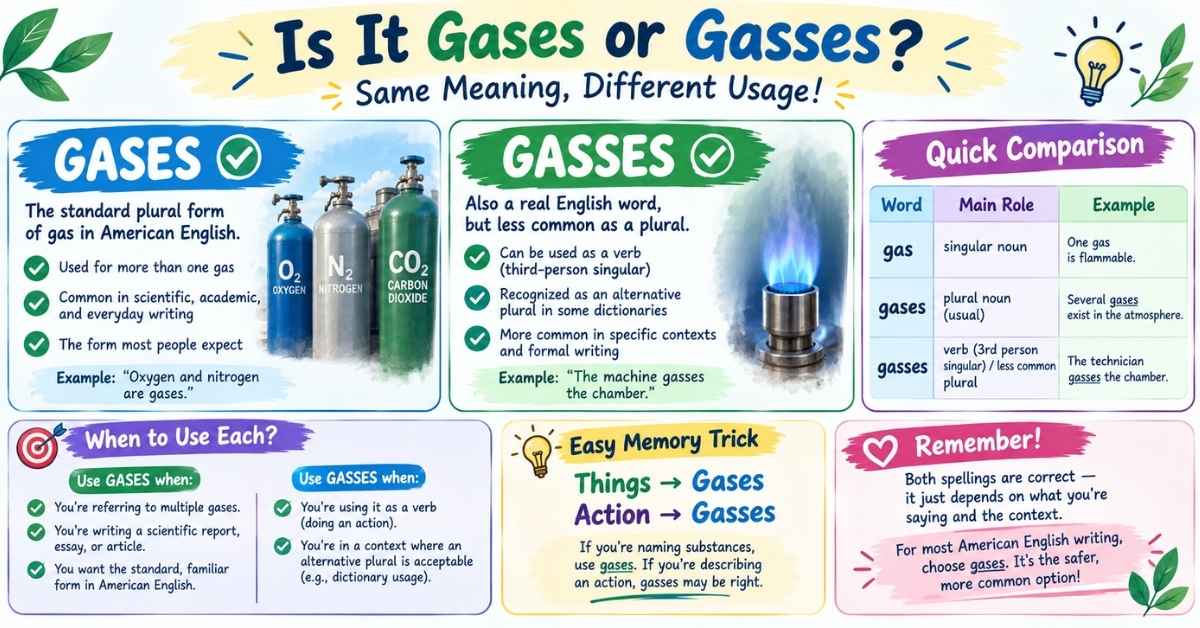
Is it gases or gasses? If you’re talking about more than one gas, gases is the standard and much more common spelling in American English. For example, “Oxygen and nitrogen are gases” is the normal form you’ll see in scientific, academic, professional, and everyday writing. However, gasses is also a real English form: dictionaries recognize it in certain uses, particularly as a verb and, less commonly, as an alternative plural.
That small extra s causes more confusion than you might expect. The two words look almost identical, and they can occur in related contexts. The key is to look at what the word is doing in the sentence, not simply how many s’s it contains.
Is It Gases or Gasses?
If you need the ordinary plural of gas, use:
gas → gases
For example:
The atmosphere contains several different gases.
Oxygen and carbon dioxide are gases.
Scientists studied the behavior of several gases.
This is the form readers will generally expect.
Gasses can also be a legitimate English form, but it is much less common as a plural noun. It also has a separate grammatical role as a verb. Dictionary.com lists both gases and gasses as plural forms but specifically notes that gases is much more commonly used.
So, if you’re writing a school assignment, scientific report, website, business document, or ordinary sentence, gases is normally the safest choice.
Gases vs. Gasses at a Glance
| Word | Main role | Meaning | Example |
|---|---|---|---|
| gas | singular noun | one gas | Oxygen is a gas. |
| gases | plural noun | more than one gas | Oxygen and nitrogen are gases. |
| gasses | verb | performs an action involving gas | The machine gasses the chamber. |
| gasses | less-common plural | more than one gas | This plural is recognized in some dictionary usage. |
The most useful rule is simple:
More than one gas → gases
An action involving gas → gasses
But don’t interpret that as meaning gasses can never be a plural noun. Some dictionaries recognize it as an alternative plural, which is why you may encounter it in published writing.
What Does “Gases” Mean?
Gases is the ordinary plural form of the noun gas.
A gas is a substance that exists in a gaseous state rather than as a solid or liquid. Common examples include:
- oxygen
- nitrogen
- hydrogen
- helium
- carbon dioxide
- methane
- natural gas
Cambridge Dictionary, for example, uses gases when discussing substances such as oxygen, hydrogen, and nitrogen.
Examples of “gases”
The laboratory tested several gases.
Different gases have different chemical properties.
The Earth’s atmosphere contains several important gases.
The experiment produced toxic gases.
Greenhouse gases affect Earth’s climate.
In each example, gases is a plural noun because the sentence refers to multiple gases or multiple types of gas.
What Does “Gasses” Mean?
This is where the spelling becomes more interesting.
Gasses can be the third-person singular present-tense form of the verb gas.
For example:
The technician gasses the chamber before testing.
Here, gasses describes an action. It isn’t naming multiple substances.
Another example is:
The machine gasses the containers.
Again, the word describes what the machine does.
Merriam-Webster’s material recognizes gasses as a present-tense verb form of gas.
Why this matters
Compare these sentences:
Several gases were detected.
and:
The equipment gasses the chamber.
The first word is a plural noun.
The second is a verb.
That grammatical distinction is the easiest way to understand why the extra s sometimes appears.
Is “Gasses” Ever Correct as a Plural?
Yes.
This is an important nuance that many simplified grammar articles overlook.
Dictionary.com explicitly lists gases and gasses as plural forms of gas, while explaining that gases is much more common.
Merriam-Webster also records gasses in its treatment of the word.
So calling gasses an outright spelling error in every context would be too strong.
However, there is an important practical distinction:
Recognized does not necessarily mean preferred.
If you are writing for a general American audience, gases is overwhelmingly the more familiar choice for the ordinary plural.
That’s especially true in established expressions such as:
- greenhouse gases
- noble gases
- atmospheric gases
- exhaust gases
- industrial gases
- toxic gases
Using gases in these expressions immediately looks natural to most readers.
Why Is the Plural “Gases” Instead of “Gasses”?
The spelling can seem strange because English has many words where a consonant is doubled before a suffix.
For example:
- stop → stopped
- plan → planned
- run → running
So someone seeing gas may naturally wonder why the plural isn’t gasses.
The answer is that English spelling doesn’t apply one single consonant-doubling rule to every word.
The conventional plural of gas is:
gas + es = gases
The spelling gases has become the normal form for the plural noun.
The fact that gasses exists elsewhere in English makes the situation look more complicated than it really is.
When Should You Use “Gases”?
For most American English writing, choose gases when you’re referring to multiple gases.
1. Scientific writing
The reaction produced several gases.
2. Chemistry
The container holds a mixture of different gases.
3. Environmental writing
Greenhouse gases contribute to atmospheric warming.
4. Academic writing
The study examined how different gases behaved under pressure.
5. General writing
Several gases were released from the container.
6. Technical writing
The system monitors hazardous gases.
In all of these situations, gases is the conventional choice.
When Can You Use “Gasses”?
Use gasses when the sentence calls for the relevant verb form.
For example:
The machine gasses the chamber before the experiment.
The technician gasses the material during processing.
The system gasses the container with a controlled substance.
The important point is that gasses is describing an action performed by a subject.
You can test the sentence by asking:
Who or what is doing something?
If gasses describes that action, the double-s spelling may be appropriate.
Gases or Gasses in American English
For a U.S. audience, the practical choice is straightforward:
Use gases as your default plural.
This is particularly appropriate for:
- school assignments
- essays
- scientific reports
- websites
- news writing
- business documents
- technical documentation
- educational material
- everyday communication
The fact that gasses exists doesn’t mean you should automatically replace gases with it.
In fact, established scientific terminology overwhelmingly uses gases.
Cambridge’s American English dictionary uses gases in its explanation of gaseous substances, while Dictionary.com identifies gases as the much more common plural.
read more >>> Armor or Armour
Greenhouse Gases or Greenhouse Gasses?
The standard expression is:
greenhouse gases
For example:
Carbon dioxide and methane are important greenhouse gases.
This is one of those phrases where conventional usage makes the answer particularly clear.
Although dictionaries can recognize gasses in certain contexts, greenhouse gases is the familiar scientific and environmental expression.
The same pattern applies to phrases such as:
noble gases
atmospheric gases
exhaust gases
industrial gases
toxic gases
If you’re writing about multiple gaseous substances, gases is generally the form your reader expects.
Gases vs. Gasses: Common Mistakes
Mistake 1: Assuming “gasses” is always wrong
It isn’t.
Gasses can be a legitimate word, particularly as a verb, and dictionaries also document it as an alternative plural in some usage.
The better rule is:
Use gases by default when you mean multiple gases.
Mistake 2: Assuming both forms are equally common
They’re not.
Dictionary.com specifically says gases is much more commonly used as a plural.
So although gasses can appear in legitimate English, that doesn’t make the two spellings equally natural for ordinary writing.
Mistake 3: Using “gasses” in scientific phrases
Consider:
The atmosphere contains several gasses.
A reader will understand the sentence, but gases is the conventional choice:
The atmosphere contains several gases.
Likewise:
greenhouse gases
noble gases
atmospheric gases
These forms are familiar and immediately recognizable.
Mistake 4: Confusing “gases” with “gasses” as a verb
Compare:
The laboratory detected several gases.
with:
The machine gasses the chamber.
The first answers “What substances were detected?”
The second answers “What does the machine do?”
That difference makes the spelling much easier to remember.
Gas, Gases, Gasses, and Gassed
These forms can be confusing when placed next to one another.
| Form | Function | Example |
|---|---|---|
| gas | singular noun | This is a gas. |
| gases | usual plural noun | These are gases. |
| gasses | verb form / less-common plural | The machine gasses the chamber. |
| gassed | past-tense verb | The chamber was gassed. |
| gassing | -ing verb form | The system is gassing the chamber. |
The distinction becomes much easier when you look at the role of the word in the sentence rather than simply counting letters.
How Do You Spell the Plural of Gas?
The usual spelling is:
gas → gases
Examples:
one gas
two gases
several gases
different gases
many gases
If you are writing an ordinary sentence about multiple gases, gases is the form to choose.
How Do You Remember Gases vs. Gasses?
Try this simple memory trick:
Things → gases
If you’re naming substances, use gases.
Oxygen and nitrogen are gases.
Action → gasses
If you’re describing something doing an action involving gas, gasses may be the verb form.
The machine gasses the chamber.
There is one caveat: because gasses can also occur as an alternative plural, this is a practical shortcut, not an absolute dictionary rule.
For ordinary U.S. writing, however, it works extremely well.
Gases or Gasses: Which One Should You Use in an Essay?
If your essay says:
Different gases behave differently under pressure.
Use gases.
If you’re writing a chemistry report:
The experiment released several gases.
Again, use gases.
If you’re writing a technical description:
The equipment gasses the chamber before the test.
Here, gasses can be appropriate because it is functioning as a verb.
For formal writing, the safest strategy is not to memorize an isolated spelling rule. Instead, identify the grammatical function first.
When in doubt in ordinary U.S. writing, gases is the form your readers will expect.
Frequently Asked Questions
Is it gases or gasses?
Gases is the usual plural spelling of gas. Gasses is also a recognized form, but it is much less common as a plural and has an important verb use.
What is the plural of gas?
The standard plural is gases.
one gas → two gases
Is “gasses” a word?
Yes. It can be a verb form and is also recognized as an alternative plural in some dictionary usage.
Is “gasses” a misspelling of “gases”?
Not necessarily. Context matters. If you mean the ordinary plural noun, gases is normally the better choice. But gasses can be legitimate in other grammatical contexts.
Is “greenhouse gasses” correct?
Greenhouse gases is the standard and familiar expression.
Is “noble gasses” correct?
The conventional scientific expression is noble gases.
How do you spell gas plural?
Spell it:
G-A-S-E-S
gas → gases
Is “gases” correct in scientific writing?
Yes. It is the conventional plural used in scientific and technical contexts.
Are gases and gasses pronounced differently?
They can be very similar in pronunciation, which is one reason the spelling confusion persists. The distinction is primarily visible in writing and grammatical function.
Which is better for American English: gases or gasses?
For the ordinary plural of gas, gases is the practical default for American English. It is considerably more familiar and common
Gases or Gasses: Final Answer
If you’re asking “Is it gases or gasses?” because you need the normal plural of gas, use gases.
Gas → gases
That’s the standard, familiar form for American English and the one you should normally choose in scientific, academic, professional, and everyday writing.
But gasses is not simply a nonexistent or universally incorrect spelling. It can function as a verb, and major dictionaries also recognize it as an alternative plural form in some usage. Dictionary.com specifically notes that gases is much more common.
So the practical rule is:
More than one gas? Use “gases.”
Describing an action with the verb “gas”? “Gasses” may be correct.
