

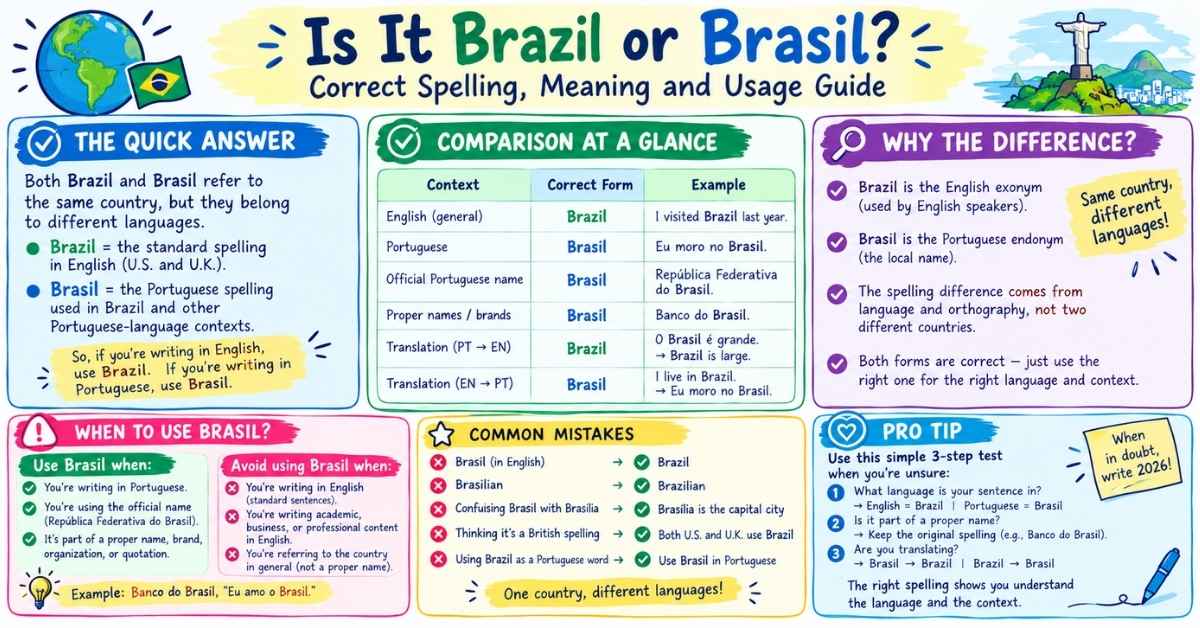
Is it Brazil or Brasil? Both forms refer to the same South American country, but they belong to different language contexts. Brazil is the standard spelling in English, including American and British English, while Brasil is the Portuguese spelling used in Brazil and other Portuguese-language contexts. The important exception is that you should preserve Brasil when it appears in an official Portuguese name, quotation, organization, brand, or other proper name.
So if you’re writing an ordinary sentence in English, choose Brazil. If you’re writing in Portuguese, choose Brasil.
Is It Brazil or Brasil? The Short Answer
Here is the easiest way to remember the difference:
| Context | Correct form |
|---|---|
| Standard English | Brazil |
| American English | Brazil |
| British English | Brazil |
| Portuguese | Brasil |
| Official Portuguese name | Brasil |
| Portuguese quotation | Brasil |
| English translation | Brazil |
| Brazilian adjective in English | Brazilian |
For example:
- I visited Brazil last year. ✓
- O Brasil é muito grande. ✓
- She studies Brazilian history. ✓
- Banco do Brasil ✓
The key point is that Brazil and Brasil are not two different countries. They are language-specific forms of the same country name.
The United Nations Group of Experts on Geographical Names lists Brazil as the English short name and Brasil as the Portuguese endonym.
Brazil vs. Brasil: What Is the Actual Difference?
The difference is primarily language and established spelling convention.
In English, the country is called Brazil.
In Portuguese, it is called Brasil.
That means neither word is inherently a “fake” version of the other. The correct choice depends on the language and context.
Think about similar examples:
- Germany → Deutschland in German
- Spain → España in Spanish
- Italy → Italia in Italian
- Brazil → Brasil in Portuguese
Different languages often have their own established names for countries and places.
In linguistic terminology, the local name used within a language or country can be called an endonym, while a name used by another language can be an exonym. In this case, Brasil is the Portuguese form, while Brazil is the established English form.
That is why seeing Brasil on a Brazilian website does not mean someone has made a spelling mistake.
Why Does Brazil Become Brasil in Portuguese?
The spelling difference developed through the history and orthography of the two languages.
Portuguese uses Brasil, while English standardized Brazil.
The Portuguese form is deeply established in Brazil itself. Brazil’s Constitution, for example, uses the official name República Federativa do Brasil. The same constitutional text identifies Portuguese as the official language of the country.
The important lesson is that English does not need to reproduce the Portuguese spelling every time it refers to the country.
If you are writing an English sentence, the conventional form is:
Brazil
If you’re reproducing the Portuguese name exactly, retain:
Brasil
This is the same principle editors use when handling foreign proper names: don’t alter a genuine name simply because another language spells it differently.
Which Spelling Should You Use in English?
If your entire sentence is written in English, Brazil should normally be your choice.
In American English
Use Brazil.
Examples:
- Brazil is the largest country in South America.
- My friend moved to Brazil.
- We are studying Brazil’s economy.
- Brazilian food is popular around the world.
In British English
Use Brazil as well.
This is important because some people assume Brasil might be a British English alternative to Brazil.
It isn’t.
The difference is not like:
- American color / British colour
- American center / British centre
Both American and British English use Brazil.
In academic writing
Use Brazil when writing an English-language essay, research paper, thesis, or report.
For example:
Brazil has played an important role in the history and economy of South America.
Writing Brasil in an ordinary English academic sentence can make the wording look inconsistent unless you are specifically discussing Portuguese terminology.
In business writing
Use Brazil in normal English emails, presentations, proposals, reports, and professional documents.
For example:
Our company plans to expand its operations into Brazil next year.
In travel writing
Use Brazil for English-speaking readers:
Brazil offers a huge variety of landscapes, from beaches to rainforests.
You can introduce Brasil when explaining local language or culture:
In Portuguese, the country is called Brasil.
That gives the reader both forms without confusing them.
When Is Brasil Correct in an English Text?
This is where many simplified spelling guides fall short.
Brasil can legitimately appear inside an English sentence.
The reason is simple: proper names are not automatically translated or respelled.
Consider:
Banco do Brasil
This is the name of a Brazilian financial institution.
You should not casually change it to:
Banco do Brazil
The Portuguese spelling is part of the name.
Similarly, Brazil’s official Portuguese name is:
República Federativa do Brasil
The English equivalent is:
Federative Republic of Brazil
Brazilian government material uses the Portuguese form in its constitutional and official contexts.
Portuguese quotations
If you quote a Portuguese sentence, keep the original spelling.
For example:
“Eu amo o Brasil.”
You would not change the quoted Portuguese word to Brazil simply because your surrounding article is in English.
Portuguese titles and names
A verified Portuguese title, organization name, slogan, or brand may retain Brasil.
The rule is therefore not:
“Never use Brasil in English.”
The better rule is:
Use Brazil for ordinary English prose, but preserve Brasil when it is part of authentic Portuguese wording or a proper name.
That distinction makes your writing much more accurate.
Is Brasil a British English Spelling?
No.
This is one of the most useful things to clarify for English learners.
Brasil is not the British spelling of Brazil.
Both American and British English normally use:
Brazil
The difference comes from English vs. Portuguese, not American vs. British English.
Compare:
| American English | British English |
|---|---|
| color | colour |
| center | centre |
| traveler | traveller |
| Brazil | Brazil |
So if you’re writing for a U.S. audience, Brazil is correct. If you’re writing for a U.K. audience, Brazil is also correct.
Brazil, Brasil, Brazilian and Brasília: Don’t Mix Them Up
The spelling question becomes easier when you separate the related words.
Brazil
Brazil is the standard English country name.
She wants to visit Brazil.
Brasil
Brasil is the Portuguese country name.
Eu moro no Brasil.
That sentence means:
I live in Brazil.
Brazilian
The standard English adjective and demonym is Brazilian.
Correct:
- Brazilian food
- Brazilian music
- Brazilian culture
- Brazilian Portuguese
- a Brazilian artist
- Brazilian people
Avoid:
- Brasilian food
- Brasilian music
- Brasil culture
Brasilian is not the standard English form.
Brazilians
The plural noun is:
Brazilians
For example:
Brazilians speak Portuguese.
Brazil’s
For possession, use:
Brazil’s
Example:
Brazil’s capital is Brasília.
Brasília
This is another word that can cause confusion.
Brasília is the capital city of Brazil.
So:
- Brazil = country in English
- Brasil = country in Portuguese
- Brasília = capital city
The Brazilian government’s constitutional text identifies Brasília as the Federal Capital.
Brazil vs. Brasil in Translation
Translation is one of the situations where the difference becomes especially obvious.
Portuguese → English
If you translate:
Brasil
into English, the standard country name is:
Brazil
For example:
O Brasil é enorme.
becomes:
Brazil is huge.
English → Portuguese
If you translate:
Brazil
into Portuguese, use:
Brasil
For example:
I live in Brazil.
becomes:
Eu moro no Brasil.
Don’t translate proper names automatically
Suppose an English article mentions:
Banco do Brasil
You generally preserve the organization’s established name rather than changing it to Banco do Brazil.
The same principle applies to official titles, quotations, and other names where the original Portuguese spelling matters.
This is why context is more useful than memorizing a rigid “right/wrong” rule.
read more >>> Is It 26′ or ’26?
Common Mistakes With Brazil and Brasil
Mistake 1: Thinking they are different countries
They aren’t.
Brazil and Brasil refer to the same country.
The spelling changes according to language.
Mistake 2: Calling Brasil a spelling mistake
This is inaccurate.
Brasil is correct Portuguese.
It is simply not the standard form for an ordinary English sentence.
Mistake 3: Using Brasil randomly in English
For example:
I am traveling to Brasil next summer.
If the sentence is ordinary English, use:
I am traveling to Brazil next summer.
Mistake 4: Assuming Brasil is British English
It isn’t.
Both U.S. and U.K. English use Brazil.
Mistake 5: Writing Brasilian
Use:
Brazilian
not:
Brasilian
Mistake 6: Changing proper names
If an organization’s established name contains Brasil, don’t automatically replace it with Brazil.
Mistake 7: Confusing Brasil and Brasília
Brasil is the Portuguese country name.
Brasília is the capital.
Brazil or Brasil? Real-World Examples
English school assignment
Correct:
Brazil is the largest country in South America.
English business email
Correct:
Our company is exploring opportunities in Brazil.
English travel article
Correct:
The best time to visit Brazil depends on which region you plan to explore.
Portuguese sentence
Correct:
O Brasil tem uma grande diversidade cultural.
English article discussing Portuguese
Correct:
In Portuguese, the country is called Brasil.
Official Portuguese name
Correct:
República Federativa do Brasil
English translation of that name
Correct:
Federative Republic of Brazil
Organization name
If the established name is Banco do Brasil, keep Brasil.
The important distinction is between ordinary English prose and a preserved original name.
A Simple 3-Step Test: Brazil or Brasil?
If you’re unsure, use this quick test.
Step 1: What language is your sentence in?
If it’s English, choose:
Brazil
If it’s Portuguese, choose:
Brasil
Step 2: Is it part of a proper name?
If Brasil appears in an official organization, brand, quotation, title, or other verified Portuguese name, preserve it.
Step 3: Are you translating?
When translating Portuguese into English:
Brasil → Brazil
When translating English into Portuguese:
Brazil → Brasil
This three-step method solves almost every ordinary usage question.
Is “Brazil or Brasil” a Spelling Difference?
Yes, but it is more accurate to call it a language-based naming difference rather than simply saying one spelling is wrong.
A normal English spelling mistake would be something like writing a word incorrectly within the same language.
Here, however, we have two established forms:
- Brazil in English
- Brasil in Portuguese
The distinction is therefore similar to the way different languages develop their own names for geographical places.
That is why saying “Brasil is wrong” without qualification is misleading.
A better explanation is:
Brasil is correct in Portuguese; Brazil is correct in standard English.
FAQs About Brazil or Brasil
Is it Brazil or Brasil?
Both are correct, but they belong to different language contexts. Brazil is the standard English spelling, while Brasil is the Portuguese spelling.
Are Brazil and Brasil the same country?
Yes. Brazil and Brasil refer to the same South American country.
Is Brasil wrong in English?
Usually, Brasil is not the normal choice for an ordinary English sentence. However, it can correctly remain in a Portuguese proper name, quotation, title, organization, or brand.
Is Brasil the British spelling?
No. Brasil is Portuguese, not British English. Both American and British English use Brazil.
Why do Brazilians write Brasil?
Because Brasil is the Portuguese name of the country. Brazil’s official constitutional name is República Federativa do Brasil.
Can I use Brasil in an English essay?
For ordinary English prose, use Brazil. You can use Brasil when discussing Portuguese terminology or preserving a Portuguese quotation or proper name.
Is Brazilian or Brasilian correct?
Brazilian is the standard English form.
Examples include Brazilian food, Brazilian culture, and Brazilian Portuguese.
What is Brazil called in Portuguese?
It is called Brasil in Portuguese.
Is Brasília the same as Brasil?
No. Brasília is the capital of Brazil, while Brasil is the Portuguese name of the country.
Does Brazil use Portuguese?
Yes. Brazil’s Constitution identifies Portuguese as the official language of the Federative Republic of Brazil.
Should I use Brazil for a U.S. audience?
Yes. For standard U.S. English, Brazil is the appropriate country name.
Should I use Brazil for British readers too?
Yes. Brazil is also the standard English form in British English.
Final Answer: Brazil or Brasil?
If you’re writing in English, use Brazil.
If you’re writing in Portuguese, use Brasil.
And If Brasil appears inside an authentic Portuguese proper name, quotation, organization, or official title, keep the original form.
The easiest rule is:
English → Brazil
Portuguese → Brasil
And remember the related English forms: Brazilian, Brazilians, and Brazil’s.
The distinction is not about two different countries, nor is it an American-versus-British spelling difference. It is primarily a difference between English and Portuguese naming conventions. The UN’s geographical-names data independently supports the English Brazil / Portuguese Brasil distinction, while Brazil’s own constitutional text uses Brasil in its official Portuguese name.
