

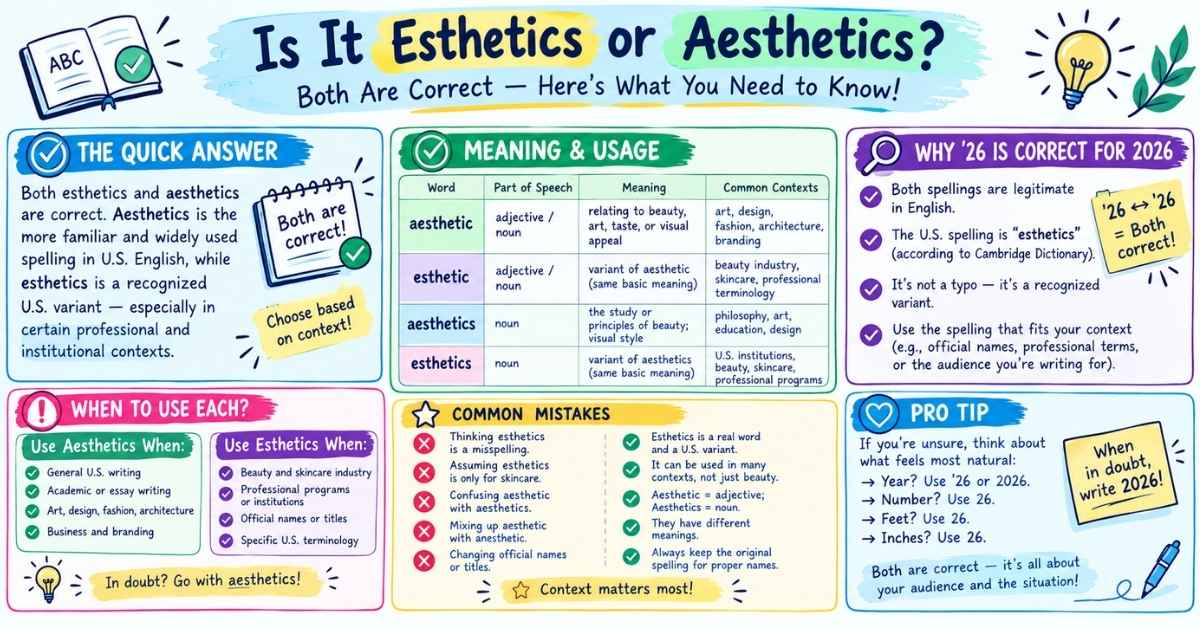
Is it esthetics or aesthetics? Both spellings are correct, but aesthetics is the safer general-purpose choice in U.S. English, while esthetics is a recognized U.S. variant that appears more often in certain professional and institutional contexts. Cambridge Dictionary explicitly identifies esthetics as the U.S. spelling of aesthetics, so it is not a spelling mistake.
The confusion happens because the two words look almost identical, sound essentially the same, and are sometimes used in overlapping contexts. If you are writing an essay, website, business description, article, or social media post, aesthetics will usually be the most familiar choice. But if you see esthetics in a legitimate professional name or established terminology, you should not automatically “correct” it.
Is It Esthetics or Aesthetics?
The short answer is:
Both are correct.
- Aesthetics is the more familiar general spelling.
- Esthetics is a recognized U.S. spelling variant.
- Both refer broadly to beauty, taste, appearance, artistic qualities, and the study of beauty.
- The difference is primarily spelling and usage preference, not a completely different definition.
Cambridge lists aesthetics as the study of beauty, particularly in art, and separately identifies esthetics as its U.S. spelling.
That means it would be inaccurate to say that one word is “correct” while the other is simply wrong.
The practical answer
If you’re unsure which one to type in ordinary American English, choose:
aesthetics
If you are copying the established spelling of a school, company, professional title, organization, or other official terminology, keep its original spelling.
That distinction is much more useful than memorizing a rigid “art versus beauty” rule.
What Does Aesthetics Mean?
Aesthetics is a noun associated with the study, perception, principles, and qualities of beauty and artistic expression.
It can refer to the philosophical study of beauty, artistic taste, or the visual qualities of something.
For example:
The course explores the aesthetics of modern art.
Here, aesthetics refers to ideas about beauty, art, taste, and artistic judgment.
The word also has a very common modern meaning: the overall visual style or look of something.
For example:
The restaurant has a minimalist aesthetic.
In this sentence, aesthetic describes the restaurant’s recognizable visual style.
That modern sense is especially common in:
- fashion
- photography
- interior design
- branding
- social media
- architecture
- graphic design
- lifestyle content
Dictionary.com likewise defines aesthetics in relation to beauty, art, taste, and judgments about artistic works.
Aesthetics is broader than simply “looking pretty”
Something can have a strong aesthetic without everyone considering it beautiful.
A brutalist building, for example, may have a deliberately severe aesthetic. A film may have a dark aesthetic. A brand may have a minimalist aesthetic.
So aesthetic quality is not necessarily the same thing as conventional beauty.
What Does Esthetics Mean?
Esthetics has essentially the same fundamental meaning as aesthetics.
The important point is that esthetics is a legitimate U.S. spelling, not a misspelling.
Cambridge directly describes esthetics as the U.S. spelling of aesthetics. Dictionary.com similarly lists esthetics as an American form and directs readers to aesthetics.
You may encounter esthetics in:
- beauty schools
- skincare terminology
- cosmetology
- professional training
- dentistry
- design
- discussions of appearance
- institutional terminology
However, it is important not to turn that tendency into an absolute rule.
It would be misleading to say:
aesthetics = art
esthetics = skincare
The real relationship is broader.
Esthetics can refer to the same general ideas of beauty, taste, artistic qualities, and appearance that aesthetics does.
The difference is primarily the established spelling and the context in which readers encounter it.
Aesthetics vs. Esthetics: What Is the Real Difference?
Here is the simplest comparison:
| Feature | Aesthetics | Esthetics |
|---|---|---|
| Correct spelling? | Yes | Yes |
| Used in U.S. English? | Yes | Yes |
| Basic meaning | Beauty, art, taste, appearance | Same basic meaning |
| General familiarity | Higher | Lower |
| Academic usage | Very common | Possible |
| Art/design usage | Very common | Possible |
| Beauty industry | Common | Also common |
| Professional terminology | Common | Established in some contexts |
| Best general default | Yes | Usually no |
| Pronunciation | Essentially the same | Essentially the same |
The key lesson is this:
A word can be correct without being the most natural choice in every situation.
That is exactly what happens here.
Which Spelling Should You Use in American English?
For most U.S. writing, aesthetics is the safest default.
Use aesthetics when writing about:
Art and philosophy
The professor discussed the aesthetics of classical sculpture.
Design
The new website has a clean and modern aesthetic.
Architecture
The building combines practical function with a distinctive aesthetic.
Fashion
Her personal aesthetic is simple and understated.
Photography
The photographer developed a consistent visual aesthetic.
Branding
The company is known for its minimalist aesthetic.
Social media
The account has a colorful vintage aesthetic.
These uses are natural and widely recognizable.
What about beauty and skincare?
This is where things become more complicated.
You may encounter both aesthetic and esthetic in beauty-related terminology.
For example:
- aesthetic treatment
- aesthetic medicine
- aesthetic dentistry
- esthetic treatment
- esthetic dentistry
- esthetics program
- esthetician
The presence of a beauty context does not automatically make esthetic the only correct spelling.
The terminology used by a particular school, clinic, organization, state licensing system, or professional publication may determine the preferred form.
Aesthetic, Esthetic, Aesthetics, and Esthetics
Another reason this topic becomes confusing is that there are four related forms.
Aesthetic
Usually an adjective, but it can also function as a noun.
Adjective:
The designer made several aesthetic changes.
Noun:
The brand has a distinctive aesthetic.
Esthetic
A variant spelling of aesthetic.
The treatment included several esthetic considerations.
Aesthetics
A noun referring to the study or principles of beauty, or to the overall visual qualities of something.
The course focuses on aesthetics and art theory.
Esthetics
A variant spelling of aesthetics.
The program includes courses in esthetics.
Understanding these four forms eliminates much of the confusion.
Aesthetician vs. Esthetician: Which Is Correct?
This is one of the most confusing parts of the entire word family.
Both aesthetician and esthetician exist.
Merriam-Webster lists aesthetician and identifies esthetician as a less common variant. It also gives aesthetician a professional meaning referring to someone who provides cosmetic skincare treatments and services.
In U.S. beauty terminology, esthetician is particularly familiar.
An esthetician may provide services such as:
- facials
- skincare treatments
- hair removal
- makeup-related services
- other cosmetic skincare services
That does not mean aesthetician is incorrect.
It means English has developed overlapping forms, and professional usage can favor one over another.
A useful distinction
If you are writing a general article, you can discuss both forms.
If you are referring to a specific professional’s title, use the spelling that person, employer, school, licensing authority, or organization officially uses.
That is a better editorial rule than trying to “fix” the spelling based on personal preference.
Are Esthetics and Aesthetics Pronounced the Same?
For most English speakers, aesthetics and esthetics are pronounced essentially the same way.
The spelling therefore does not provide a reliable clue when you hear the word spoken.
The same issue exists with:
- aesthetic
- esthetic
The initial a in aesthetic does not create a separate spoken syllable.
That is one reason people often become unsure about the written form: their ears cannot reliably tell them which spelling they should type.
The solution is to learn the spelling as a vocabulary item rather than trying to reconstruct it from pronunciation.
Why Are There Two Spellings?
The history is more complicated than simply saying “British spelling versus American spelling.”
The word has roots connected with Greek ideas of perception and sensation and developed through European intellectual traditions. The modern English word became established in discussions of beauty, art, perception, and taste.
Over time, esthetic developed as an alternative spelling.
The two forms survived rather than one completely replacing the other.
That is common in English. Languages frequently retain multiple accepted forms because of:
- regional preferences
- historical spelling patterns
- professional terminology
- institutional conventions
- editorial traditions
So there is no need to assume that one form must be a typo simply because another form looks more familiar.
Is Esthetics Only an American Spelling?
Esthetics is strongly associated with U.S. English, and major dictionaries recognize that relationship.
Cambridge specifically labels esthetics as a U.S. spelling of aesthetics.
But there is an important nuance:
American English does not require you to use esthetics.
Americans routinely use aesthetics as well.
In fact, aesthetics is extremely well established in U.S. writing involving:
- art
- philosophy
- architecture
- design
- fashion
- photography
- branding
- popular culture
So calling esthetics “the American spelling” can be misleading if readers interpret that to mean Americans normally replace aesthetics with esthetics.
A more accurate explanation is:
Esthetics is an accepted U.S. variant of aesthetics, while aesthetics remains a very common general form in American English.
read more >>> Is It Brazil or Brasil?
Common Mistakes With Esthetics and Aesthetics
Mistake 1: Calling esthetics a misspelling
This is the biggest mistake.
Esthetics is a legitimate word.
If a reputable organization uses it, there is no reason to automatically change it.
Mistake 2: Assuming esthetics is only for skincare
This is an overly strict rule.
Although esthetics is visible in beauty and skincare terminology, its dictionary meaning is not restricted to cosmetics. Cambridge’s examples include contexts involving product design and social concepts.
Mistake 3: Assuming aesthetics is only for art
That is equally restrictive.
People commonly use aesthetic to describe:
- a room
- a brand
- an outfit
- a website
- a photograph
- a social media account
- a building
Mistake 4: Confusing aesthetic with aesthetics
These forms are related but not interchangeable in every sentence.
The website has a modern aesthetic.
Here, aesthetic refers to the site’s visual style.
The course examines aesthetics.
Here, aesthetics refers to the broader field or principles concerning beauty and art.
Mistake 5: Confusing aesthetic with anesthetic
These are completely different words.
Aesthetic relates to beauty, appearance, artistic qualities, or taste.
Anesthetic relates to a substance or method used to reduce or eliminate sensation.
A dentist might discuss aesthetic dentistry and also use a local anesthetic. Those words should never be treated as spelling variants.
Mistake 6: “Correcting” an official name
Suppose a school is officially called:
ABC School of Esthetics
Do not change it to:
ABC School of Aesthetics
just because you prefer the longer spelling.
Proper names and official terminology should be preserved exactly.
Which One Should You Use? A Practical Decision Guide
| Situation | Best choice |
|---|---|
| General U.S. writing | Aesthetics |
| School essay | Aesthetics |
| Academic philosophy | Aesthetics |
| Art criticism | Aesthetics |
| Architecture | Aesthetics |
| Graphic design | Aesthetics |
| Fashion | Aesthetics |
| Social media | Aesthetic |
| General branding | Aesthetic |
| Beauty industry | Check the established terminology |
| Professional title | Follow the official title |
| Business name | Use the official spelling |
| Quotation | Preserve the original spelling |
| U.S. esthetics program | Use the program’s terminology |
The simplest rule is:
When you have no special reason to choose otherwise, use aesthetic/aesthetics.
Use esthetic/esthetics when the surrounding professional or institutional context clearly uses that form.
Examples of Aesthetics in Sentences
Here are natural examples of the more familiar form:
- The aesthetics of the building reflect its minimalist design.
- She has a strong sense of aesthetic style.
- The photographer created a distinctive visual aesthetic.
- The website needs a more consistent aesthetic.
- The professor teaches aesthetics and philosophy.
- The brand’s aesthetic appeal attracts younger customers.
- The designer considered both function and aesthetic value.
- The room has a warm, modern aesthetic.
Notice that aesthetic works comfortably across many subjects.
Examples of Esthetics in Sentences
The shorter spelling is also legitimate:
- The program offers courses in esthetics.
- The clinic uses the terminology esthetic treatment in its materials.
- The discussion considered the esthetic qualities of the design.
- Students enrolled in an esthetics program learned professional skincare techniques.
- The organization retained its established spelling of esthetic services.
These examples illustrate an important point: esthetics is valid even when aesthetics would also be understandable.
Why Spellcheck Cannot Fully Solve This Problem
Spellcheck is useful for detecting obvious misspellings, but aesthetic versus esthetic is not simply a right-versus-wrong spelling problem.
Both forms are recognized.
That means a spellchecker may accept either word while leaving you with a more important question:
Which form sounds most natural for my audience?
That is an editorial decision.
For general U.S. content, aesthetics is usually the safer choice because it is broadly recognizable.
But if an organization officially uses esthetics, replacing it with aesthetics could actually introduce an error.
The Easiest Way to Remember the Difference
Don’t memorize an artificial rule such as:
“Aesthetics is for art and esthetics is for beauty.”
That rule is too narrow.
Instead, remember:
Aesthetics is the general, familiar form. Esthetics is an accepted U.S. variant.
Then consider the context.
If you’re writing:
The room has a beautiful ______.
aesthetic is the natural default.
If you’re writing about a professional program that officially calls itself an:
Esthetics Program
keep esthetics.
This approach is more reliable because it considers usage, audience, and established terminology, not just the subject matter.
Is It Esthetics or Aesthetics? Final Answer
So, is it esthetics or aesthetics?
Both are correct.
Aesthetics is the safer and more familiar choice for most general U.S. writing. It works naturally in discussions of art, design, philosophy, beauty, architecture, fashion, branding, and visual style.
Esthetics is also correct. It is a recognized U.S. variant and appears especially often in certain professional, institutional, beauty, and skincare contexts.
The important thing is not to treat the difference as a strict meaning distinction.
Esthetics does not automatically mean skincare, and aesthetics does not automatically mean art.
When you’re unsure, use aesthetics. When an official name, professional terminology, or established style uses esthetics, keep that spelling.
That gives you a simple rule without turning a flexible feature of English into a false grammar rule.
Frequently Asked Questions
Is esthetics a correct spelling?
Yes. Esthetics is a legitimate English spelling and is recognized as a U.S. variant of aesthetics. Cambridge explicitly identifies it as the U.S. spelling.
Which is more common: aesthetics or esthetics?
Aesthetics is generally the more familiar general-purpose form. Esthetics remains a recognized variant and is more noticeable in some U.S. professional contexts.
Is esthetics an American spelling?
Yes. Major dictionary sources identify esthetics as a U.S. spelling of aesthetics.
Are aesthetics and esthetics the same?
They have the same core meaning. The main difference is spelling and usage preference.
Should I use aesthetics or esthetics in the U.S.?
For ordinary American English, aesthetics is the safest default. Use esthetics when a professional, institutional, organizational, or official context uses that spelling.
Is esthetic a word?
Yes. Esthetic is a legitimate variant of aesthetic.
Is aesthetician or esthetician correct?
Both exist. Merriam-Webster lists aesthetician and notes esthetician as a less common variant. In U.S. skincare terminology, esthetician is especially familiar.
Is esthetics only used for skincare?
No. Although it is strongly associated with beauty and skincare in some U.S. professional contexts, esthetics can refer to the same broader concepts of beauty, taste, and artistic qualities as aesthetics. Cambridge’s examples demonstrate that its use is not limited to skincare.
Are aesthetic and esthetic pronounced differently?
Generally, no meaningful pronunciation difference exists for most English speakers. The spelling difference is much more noticeable in writing than in speech.
Is aesthetic or esthetic better for an essay?
Aesthetic is usually the better choice for a general academic essay because it is the more familiar form. However, if you are quoting a source or discussing an institution that uses esthetic, preserve that established spelling.
Conclusion
The question “is it esthetics or aesthetics?” has a straightforward answer: both spellings are correct.
For most U.S. readers, aesthetics is the best general-purpose choice. Esthetics is an accepted U.S. variant, not a typo, and it has an established place in professional and institutional terminology.
When choosing between them, think about audience, context, and established usage—not simply whether the subject involves beauty.
If there is no special convention to follow, choose aesthetics. If an official title or professional source uses esthetics, respect that spelling.
That is the clearest and most accurate way to handle the difference.
