

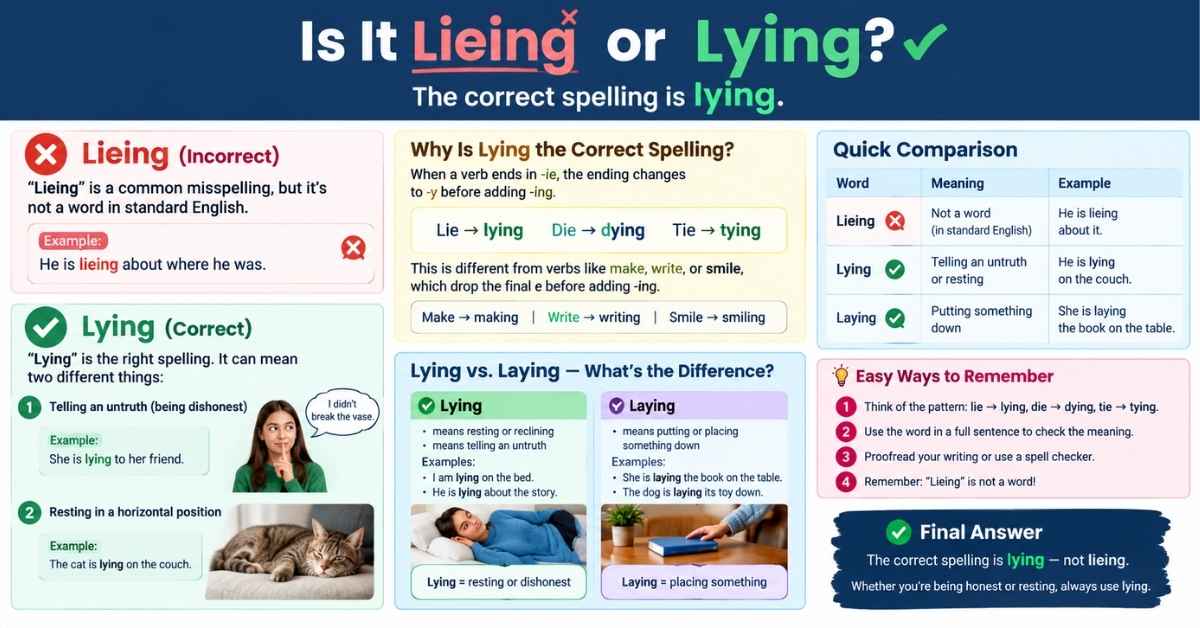
Is it lieing or lying? The correct spelling is lying. “Lieing” is a misspelling in standard English, whether you mean telling someone something untrue or resting in a horizontal position. The confusion happens because many English verbs drop their final e before adding -ing, but lie follows a different spelling pattern: its ending changes from -ie to -y.
Is Lieing or Lying Correct?
Lying is correct, and lieing is incorrect in standard modern English.
| Spelling | Correct? | Example |
|---|---|---|
| Lying | Yes | He is lying about what happened. |
| Lieing | No | He is lieing about what happened. |
If you are writing an email, school assignment, social media post, or professional document, always use lying.
The same spelling applies to both common meanings of lie. You do not need a different spelling when someone is being dishonest rather than lying down to rest.
Why Is Lying the Correct Spelling?
The answer comes from a common English spelling pattern: when a verb ends in -ie, the ending changes to -y before adding -ing.
Here is how the transformation works:
- Lie → lying
- Die → dying
- Tie → tying
Notice that the ie does not remain in the word. Instead, it becomes y, followed by -ing.
This differs from verbs such as make, write, and smile, where the final silent e is removed before adding -ing:
- Make → making
- Write → writing
- Smile → smiling
Because lie ends in -ie, applying only the usual silent-e rule leads to the incorrect form lieing. Remember the special pattern, and the spelling becomes much easier.
What Does Lying Mean?
The word lying has two common meanings. Understanding the context helps you use it correctly.
1. Lying means telling something untrue
When someone deliberately says something they know is false, they are lying.
Examples:
- He is lying about where he was last night.
- I knew she was lying when her story changed.
- Stop lying to your parents about your homework.
- The witness was accused of lying during the investigation.
In these examples, lying describes dishonesty or the act of not telling the truth.
2. Lying means resting or reclining
The word can also describe a person, animal, or object that is in a horizontal position or resting somewhere.
Examples:
- I am lying on the couch because I feel tired.
- The dog is lying beside the fireplace.
- She spent the afternoon lying on the beach.
- Your keys are lying on the kitchen counter.
Although the meanings differ, the spelling remains the same. Both forms use lying, never lieing.
Lying vs. Lieing: Examples in Sentences
The quickest way to learn the correct spelling is to see it in everyday situations.
| Incorrect sentence | Correct sentence |
|---|---|
| She is lieing to her friend. | She is lying to her friend. |
| I caught him lieing about his age. | I caught him lying about his age. |
| The cat is lieing on the sofa. | The cat is lying on the sofa. |
| He kept lieing about the missing money. | He kept lying about the missing money. |
| They were lieing in the grass. | They were lying in the grass. |
Examples in everyday American English
In a conversation:
“Why are you lying to me about what happened?”
In a school assignment:
“The character was lying because he wanted to avoid punishment.”
In a workplace email:
“I am not suggesting that anyone is lying, but the information in these reports does not match.”
In a description:
“The puppy was lying quietly on its blanket.”
These examples show that lying works naturally in informal and formal writing. The correct choice depends on the meaning of the sentence, not the setting.
read more >>> Stear vs Steer
Lying vs. Laying: What’s the Difference?
Although lying and laying look similar, they are different verb forms. This is a common source of confusion because both can describe situations involving people or objects in a horizontal position.
- Lying describes being in a resting position or telling something untrue.
- Laying describes putting or placing something down. It normally takes a direct object.
Consider these examples:
| Lying | Laying |
|---|---|
| She is lying on the bed. | She is laying a blanket on the bed. |
| The dog is lying on the floor. | The dog is laying its toy on the floor. |
| He is lying about his mistake. | He is laying the papers on the desk. |
A useful way to remember the difference is to ask whether someone is resting or placing something.
If someone is resting, use lying. If someone is placing an object somewhere, use laying. When the meaning is dishonesty, use lying as well.
Easy Ways to Remember the Correct Spelling
If you repeatedly confuse lieing and lying, try these simple methods.
Remember the -ie to -y rule
Memorize this pattern:
Lie → lying
Then connect it with two familiar words:
- Die → dying
- Tie → tying
All three change -ie to -y before adding -ing. This pattern is more reliable than trying to apply the silent-e rule to every verb.
Read the word in a complete sentence
Instead of memorizing the spelling alone, practice it in context:
- “You are lying.”
- “I am lying on the couch.”
- “He was lying about the results.”
Seeing the same spelling in different situations reinforces the rule and shows how one word can have more than one meaning.
Check your writing before submitting it
If you are proofreading an essay, email, or article, search for lieing and replace it with lying wherever appropriate. A spelling checker can help catch the mistake, but you should still review the sentence to ensure the word conveys the intended meaning.
Frequently Asked Questions
Is lieing ever correct?
No. In standard modern English, lying is the accepted spelling. Use lying in formal writing, everyday communication, and edited content.
How do you spell lying correctly?
Spell it L-Y-I-N-G. Start with lie, change ie to y, and add -ing.
Why is lying not spelled lieing?
Because verbs ending in -ie change that ending to -y before adding -ing. The correct form is lie → lying, just as die → dying and tie → tying.
Is lying a real word?
Yes. Lying is the present participle of lie and can function as a gerund. It describes telling an untruth or being in a resting position.
What is the difference between lying and lied?
Lying describes an ongoing action, while lied is the simple past tense of lie when it means telling an untruth.
Examples:
- Present: He is lying to me.
- Past: He lied to me yesterday.
Is lying down or lieing down correct?
Lying down is correct.
Example: “I am lying down because I have a headache.”
The spelling does not change when lie refers to resting rather than dishonesty.
What is the difference between lying and laying down?
Use lying down when someone is reclining. Use laying something down when someone is placing an object somewhere.
- Correct: “I am lying down.”
- Correct: “I am laying my jacket down.”
Final Answer: Is It Lieing or Lying?
The correct spelling is lying, not lieing. The word can mean telling an untruth or resting in a horizontal position, and both meanings use the same spelling.
Remember the simple rule: lie → lying, die → dying, tie → tying. Once you learn this pattern, you can avoid the mistake in everyday conversations, schoolwork, emails, and professional writing.
