

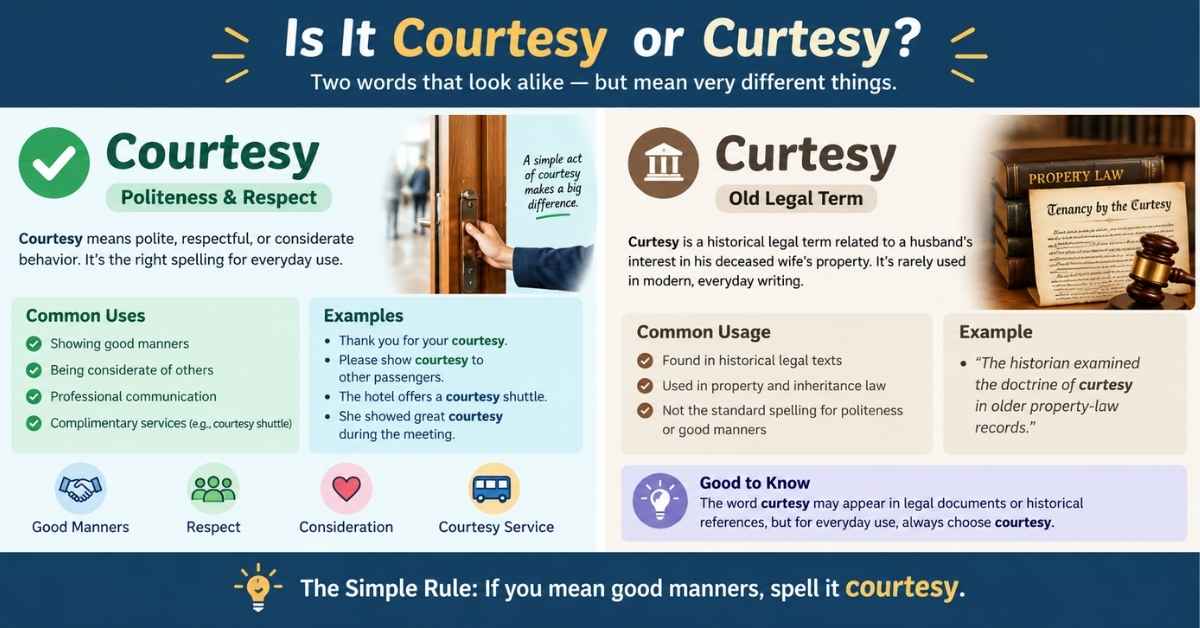
Is it courtesy or curtesy? The correct spelling for everyday English is courtesy when you mean politeness, respect, good manners, or a considerate act. For example, holding a door open for someone is a simple act of courtesy. The word curtesy also exists in historical legal terminology, but it is not the standard spelling for ordinary polite behavior. If you are writing an email, school assignment, business document, or social media post, courtesy is almost always the word you need.
Courtesy vs. Curtesy: The Main Difference
The main difference between courtesy and curtesy is their usage.
Courtesy is the standard modern English word for polite behavior, consideration, and respectful actions. It is common in everyday conversations, professional communication, customer service, and formal writing.
Curtesy is an old legal term associated with certain historical property and inheritance rights. It is rarely needed in ordinary modern writing.
| Word | Meaning | Common usage |
|---|---|---|
| Courtesy | Politeness, respect, or a considerate action | Everyday English, business, and social situations |
| Curtesy | A historical legal right involving a surviving husband’s interest in his deceased wife’s property | Historical legal texts and specialized discussions |
For example:
- Correct: Thank you for your courtesy and support.
- Incorrect for the intended meaning: Thank you for your curtesy and support.
The second sentence uses the wrong word if the writer wants to express appreciation for someone’s politeness.
However, it would be inaccurate to say that curtesy has never been a real English word. Historical dictionaries document its specialized usage, and Cornell Law School’s Legal Information Institute explains its meaning in older property law.
Quick rule: If you mean kindness, respect, or good manners, choose courtesy.
What Does Courtesy Mean?
Courtesy is a noun that describes polite, respectful, or considerate behavior toward other people. It can also refer to a thoughtful action, a formal gesture of respect, or something provided as a favor.
Courtesy is important in everyday relationships because small, respectful actions can make communication more pleasant and help people feel valued.
Examples of courtesy
- Holding a door open for someone carrying groceries.
- Saying “please” when making a request.
- Thanking a colleague for helping with a difficult task.
- Listening patiently while another person explains a problem.
- Giving a neighbor advance notice about a noisy event.
These actions demonstrate consideration for other people’s time, comfort, and feelings.
Courtesy in professional communication
Courtesy is particularly valuable in workplaces, where respectful communication helps maintain productive relationships.
For example:
“Thank you for your courtesy and assistance during the meeting.”
This sentence expresses appreciation for someone’s respectful behavior or helpful actions.
Another example is:
“As a professional courtesy, I contacted the client before making the change.”
Here, professional courtesy means taking a considerate step because it is appropriate in a business relationship.
Courtesy does not mean agreeing with everyone. A person can disagree with a colleague, decline a request, or establish a boundary while still speaking respectfully.
Courtesy as a free service or favor
The word also appears in expressions describing services offered without charge.
For example:
“The hotel provides a courtesy shuttle to the airport.”
In this sentence, courtesy shuttle refers to transportation provided as a complimentary service.
Similarly:
“The company offered a courtesy replacement while the original product was being repaired.”
The replacement is described as a courtesy because it is offered as a helpful gesture rather than necessarily as a paid service.
What Does Curtesy Mean?
Curtesy is a historical legal term associated with a husband’s interest in certain property owned by his deceased wife. It belongs to older property and inheritance law rather than ordinary discussions about manners.
In historical legal systems, curtesy could refer to a surviving husband’s right to a life interest in qualifying property, subject to specific legal conditions. The precise requirements depended on the applicable legal system.
The related legal concept of dower historically concerned a wife’s rights in her deceased husband’s property. These terms reflected older rules that treated spouses differently according to gender.
Modern inheritance and marital-property rules have changed considerably, and current rights depend on the relevant jurisdiction. Cornell’s Legal Information Institute describes curtesy as an outdated legal term and discusses the historical distinction between dower and curtesy.
Example of curtesy in legal writing
“ The historian examined the doctrine of curtesy in older property-law records.”
This sentence uses the word in a historical legal context, not to describe politeness.
The term may still appear in legal scholarship, historical documents, or discussions of inheritance law. However, most readers will not need it when writing about everyday behavior.
Important distinction: Curtesy is not the correct alternative spelling of courtesy when the intended meaning is politeness.
Courtesy vs. Curtesy: Examples in Sentences
Examples make the difference easier to remember.
| Sentence | Correct word | Why |
|---|---|---|
| She treated every customer with courtesy. | Courtesy | Describes respectful behavior. |
| Please show courtesy to other passengers. | Courtesy | Refers to consideration for others. |
| Thank you for your courtesy during the interview. | Courtesy | Expresses appreciation for politeness. |
| The hotel offers a courtesy shuttle. | Courtesy | Describes a complimentary service. |
| The researcher studied curtesy in historical inheritance law. | Curtesy | Refers to a specialized legal concept. |
| The legal historian explained the doctrine of curtesy. | Curtesy | Refers to historical property law. |
Common spelling mistakes to avoid
Mistake 1: Using curtesy to mean politeness
Incorrect: “The manager showed great curtesy to the visitors.”
Correct: “The manager showed great courtesy to the visitors.”
Mistake 2: Misspelling courtesy in an email
Incorrect: “Thank you for your curtesy and cooperation.”
Correct: “Thank you for your courtesy and cooperation.”
Mistake 3: Assuming the rare word is always meaningless
Although curtesy is not the standard everyday spelling for politeness, it does have a historical legal meaning. Context determines whether it is appropriate.
Common Expressions Using Courtesy
Learning common expressions is another practical way to remember the correct spelling.
Common courtesy
Common courtesy means the basic level of politeness and consideration people generally expect from one another.
Example: “It is common courtesy to let your host know if you will arrive late.”
As a courtesy
This expression describes something done as a polite or helpful gesture.
Example: “The receptionist called ahead as a courtesy.”
By courtesy of
By courtesy of means that something is provided, permitted, or made available by a person or organization, often as a favor.
Example: “The photographs were reproduced by courtesy of the museum.”
It can also be used more broadly to identify the source of something.
Example: “The complimentary tickets were provided courtesy of the event sponsor.”
Professional courtesy
Professional courtesy refers to respectful or considerate behavior within a professional relationship.
Example: “She informed her colleague about the schedule change as a matter of professional courtesy.”
Courtesy call
A courtesy call is a call made as a polite gesture, to maintain a relationship, or to communicate information considerately.
Example: “The representative made a courtesy call to confirm the appointment.”
In each of these expressions, courtesy is the correct spelling.
Courtesy, Courteous, and Curtsy: Related Words Explained
These words look or sound similar, but they serve different purposes.
| Word | Meaning | Example |
|---|---|---|
| Courtesy | Politeness or a considerate action | “Her courtesy impressed the guests.” |
| Courteous | Showing politeness and respect | “The staff were courteous and helpful.” |
| Courteously | In a polite or respectful manner | “He responded courteously to the question.” |
| Curtsy | A traditional gesture of respect involving a slight bending of the knees | “The performer gave a curtsy after the show.” |
| Curtesy | A historical legal term; also an obsolete spelling associated with older usage | “The document discussed curtesy rights.” |
One particularly important distinction is between courtesy and curtsy.
Courtesy generally describes behavior or a considerate action. A curtsy is a physical gesture. The word curtesy has also appeared historically as a spelling associated with this gesture, but curtsy is the usual modern spelling.
For example:
- “She thanked the host with courtesy.” This describes polite behavior.
- “She performed a curtsy before leaving the stage.” This describes a gesture.
Choosing the right word makes the sentence clearer and prevents confusion.
read more >>> Bareable or Bearable?
How to Remember the Correct Spelling
If you regularly confuse courtesy and curtesy, use these simple techniques.
1. Remember the letters “our”
The standard spelling is c-o-u-r-t-e-s-y.
A useful memory aid is to associate courtesy with the idea of making room for our fellow people through respect and consideration. This is a mnemonic rather than the word’s actual historical origin.
2. Connect courtesy with courteous
The words courtesy and courteous belong to the same word family.
For example:
- “Thank you for your courtesy.”
- “Thank you for being courteous.”
Both sentences express appreciation for respectful behavior.
Remembering this connection can make the correct spelling easier to recall.
3. Check the meaning before choosing the word
Ask yourself what you are trying to describe.
If you mean politeness, kindness, respect, a helpful gesture, or a complimentary service, use courtesy.
If you are discussing an old legal right involving property and inheritance, curtesy may be appropriate.
4. Use spellcheck as a final check, not the only check
Spellcheck tools can catch many spelling errors, but they do not always explain whether a word fits its context.
Reading the sentence again and checking the intended meaning is especially helpful when two words look similar.
Frequently Asked Questions
Is it courtesy or curtesy?
Courtesy is correct when referring to politeness, respect, or a considerate act. Curtesy is a historical legal term and is not the normal spelling for this meaning.
Is curtesy a real word?
Yes. Curtesy appears in historical legal terminology, particularly in discussions of property and inheritance rights. It is not the standard modern spelling of the everyday word for politeness.
What does courtesy mean?
Courtesy means polite, respectful, or considerate behavior. It can also refer to a helpful gesture or a service offered as a favor.
What is an example of courtesy?
Holding a door open for someone, thanking a person for their help, or listening respectfully during a conversation are examples of courtesy.
What is the difference between courtesy and curtesy?
Courtesy refers to politeness, respect, and considerate actions. Curtesy is a historical legal term connected with certain inheritance rights.
Is courtesy the same as kindness?
They are related, but not identical. Courtesy emphasizes polite and respectful behavior, while kindness emphasizes goodwill and concern for others. An action can demonstrate both.
What does “courtesy of” mean?
“Courtesy of” identifies something provided by someone, often as a favor or complimentary service. For example, “The tickets were provided courtesy of the sponsor.”
What is the plural of courtesy?
The plural of courtesy is courtesies. For example: “The guests exchanged the usual courtesies before the meeting.”
Is courtesy a noun or an adjective?
Courtesy is primarily a noun, as in “She showed courtesy.” It can also function as a modifier in expressions such as courtesy call and courtesy shuttle.
Is curtsy the same as courtesy?
No. Courtesy means politeness or a considerate act. A curtsy is a traditional gesture in which someone bends the knees slightly as a sign of respect. Curtesy is also found in historical legal usage and older spelling traditions.
Conclusion
When deciding between courtesy or curtesy, choose courtesy for everyday English. It is the correct spelling for politeness, good manners, respectful behavior, and considerate actions.
Reserve curtesy for a relevant historical or legal context, and use curtsy when referring to the traditional gesture of respect.
The easiest rule to remember is simple: If you mean good manners, spell it courtesy.
