

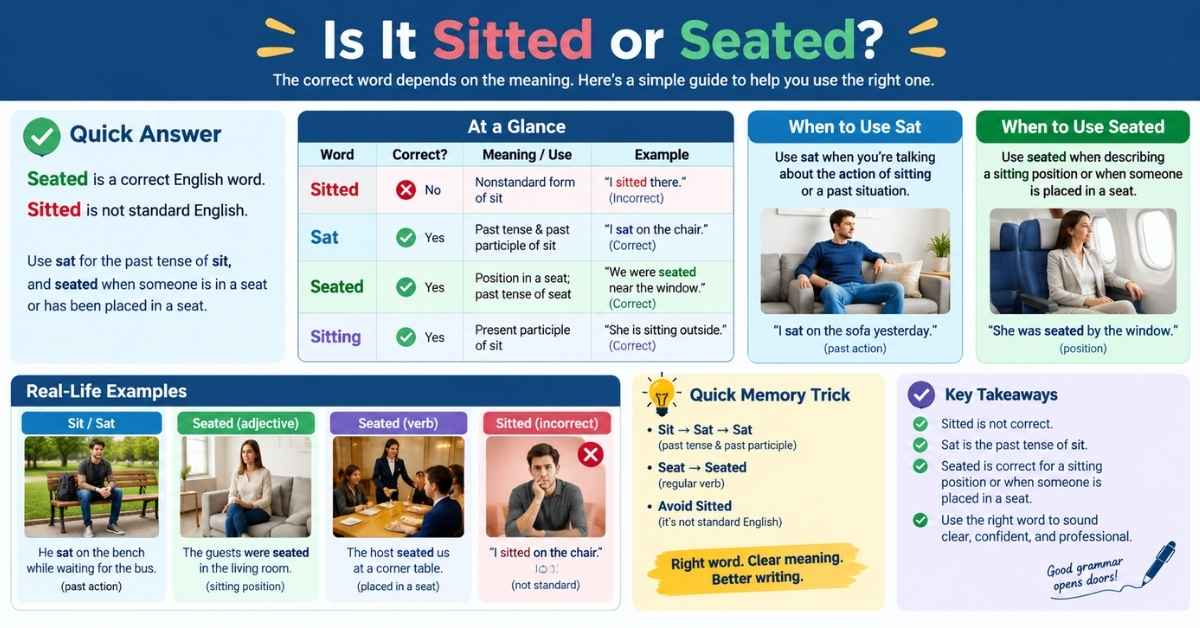
Is it sitted or seated? The correct choice is usually seated when describing someone who is in a sitting position, but sat is the correct past tense of the verb sit. The word sitted is nonstandard in modern English and should generally be avoided in formal writing. For example, write “I sat on the couch yesterday” or “I was seated near the window,” depending on what you mean. Understanding the difference between sit, sat, and seated will help you write more naturally and avoid common grammar mistakes.
Is It Sitted or Seated? The Quick Answer
Seated is a correct English word, while sitted is not standard English. However, seated and sat are not interchangeable in every sentence.
The verb sit is irregular, which means it does not form its past tense by simply adding -ed. Its standard forms are sit, sat, and sat. Meanwhile, seated comes from the verb seat, which means to place someone in a seat or position.
Here is a quick comparison:
| Word | Correct? | Meaning or use | Example |
|---|---|---|---|
| Sitted | No, in standard English | Nonstandard form of sit | Avoid “I sitted there.” |
| Sat | Yes | Past tense and past participle of sit | “I sat near the door.” |
| Seated | Yes | Positioned in a seat; form of seat | “We were seated near the door.” |
| Sitting | Yes | Present participle of sit | “She is sitting outside.” |
Cambridge Dictionary confirms that sat is both the past simple and past participle of sit, while seated is an established adjective meaning sitting. These definitions support the distinction between the two correct forms.
What Does Sitted Mean?
Sitted is a nonstandard form that people sometimes create by applying the regular English past-tense rule to the verb sit. Although the spelling may seem logical, it is not the accepted form in standard contemporary English.
Many English verbs form their past tense by adding -ed. For example:
- Walk → walked
- Talk → talked
- Open → opened
- Sit → sat, not sitted
Because sit is an irregular verb, its past form changes rather than following the usual pattern.
Why Do People Write Sitted?
The confusion is understandable, especially for people learning English. When someone learns that walk becomes walked and play becomes played, it seems reasonable to assume that sit should become sitted.
However, English contains many irregular verbs that must be learned individually. The same principle applies to go → went, eat → ate, and write → wrote.
If you encounter sitted in an informal conversation or online text, the intended meaning may still be clear. Nevertheless, in school assignments, professional emails, business documents, and other standard writing, choose sat or seated according to the sentence.
Incorrect: We sitted together during the meeting.
Correct: We sat together during the meeting.
Also correct: We were seated together during the meeting.
The last two sentences are both grammatical, but they emphasize slightly different things.
What Does Seated Mean?
Seated is a correct English word derived from the verb seat. It generally describes someone who is sitting or has been placed in a seat.
It can function as an adjective or as a verb form in a passive construction.
1. Seated as an Adjective
When seated describes a person’s position, it works as an adjective.
Examples:
- The seated guests waited for dinner.
- Please remain seated until the vehicle stops.
- A woman seated near the entrance waved to us.
- Everyone was seated comfortably in the conference room.
In these sentences, seated describes a state or position rather than simply reporting the action of sitting down.
2. Seated as a Verb Form
The verb seat can mean to place someone in a particular seat. Its past tense and past participle are seated.
Examples:
- The host seated us near the window.
- The usher seated the visitors in the front row.
- The restaurant staff seated our group promptly.
Notice that the subject performs an action on someone else. The host seats the guests, and the usher seats the visitors.
This is an important difference between sit and seat: in ordinary physical-position usage, sit describes someone taking or occupying a sitting position, while seat can describe placing someone in that position.
Sat vs. Seated: What’s the Difference?
The difference between sat and seated depends on the meaning and structure of your sentence.
Sat is the past tense of sit. Use it when describing an action that happened in the past or a past state of sitting.
Seated commonly describes a person’s position or the act of placing someone in a seat.
Compare these examples:
| Sentence | Explanation |
|---|---|
| She sat by the window. | Describes where she sat. |
| She was seated by the window. | Describes her position, using a passive construction. |
| The manager seated the guests. | The manager placed the guests in their seats. |
| The guests were seated by the manager. | The guests received seats from the manager. |
| I have sat here before. | Uses the past participle of sit. |
| I have been seated here before. | Uses a passive construction with seat. |
Both sat and seated can be correct, but the sentence structure matters.
For instance, “She seated by the window” is generally incorrect if you simply mean that she sat there. Write “She sat by the window” or “She was seated by the window.”
The distinction is particularly useful in professional writing. A meeting organizer might say, “The attendees were seated in alphabetical order,” while a participant might say, “I sat beside my colleague.”
Sit, Sat, and Seated: Grammar Rules Explained
Learning the main verb forms makes this spelling question much easier.
The Forms of Sit
| Verb form | Correct word | Example |
|---|---|---|
| Base form | Sit | Please sit here. |
| Third-person singular | Sits | He sits near the front. |
| Present participle | Sitting | She is sitting outside. |
| Simple past | Sat | They sat together yesterday. |
| Past participle | Sat | We have sat here before. |
The standard pattern is sit → sat → sat.
The past participle appears in perfect constructions with helping verbs such as have, has, and had.
Examples:
- I have sat in this chair before.
- She has sat through several meetings today.
- They had sat together before the show began.
Do not substitute sitted for sat in these constructions.
The Forms of Seat
The verb seat follows the regular pattern:
- Base form: seat
- Simple past: seated
- Past participle: seated
- Present participle: seating
Examples:
- Please seat the guests near the stage.
- The attendant seated the passengers.
- The guests have been seated.
- The staff is seating customers now.
This explains why seated is correct even though sitted is not. The two forms come from different verbs.
Correct and Incorrect Sentence Examples
The easiest way to understand the difference is to compare common sentences.
Everyday Conversations
Incorrect: I sitted on the sofa after work.
Correct: I sat on the sofa after work.
Why: Sat is the simple past of sit.
School or College Writing
Incorrect: The students were sitted in the classroom.
Correct: The students were seated in the classroom.
Also correct: The students sat in the classroom.
Why: Use were seated to describe their position or sat to report the action.
Workplace Meetings
Incorrect: We sitted around the conference table.
Correct: We sat around the conference table.
Also correct: We were seated around the conference table.
Why: Both correct versions are natural, but the second emphasizes the arrangement of the participants.
Restaurants and Events
Incorrect: The host sitted us near the entrance.
Correct: The host seated us near the entrance.
Why: The host placed the guests in their seats, so the verb is seat, whose past tense is seated.
Formal Instructions
Incorrect: Please remain sitted until the presentation ends.
Correct: Please remain seated until the presentation ends.
Why: Remain seated is an established expression meaning to stay in a sitting position.
Talking About a Past Experience
Incorrect: I have sitted in the front row before.
Correct: I have sat in the front row before.
Why: The past participle of sit is sat, not sitted.
These examples show why it is not enough to replace every instance of sitted with seated. Sometimes the right correction is sat.
When Should You Use Sat Instead of Seated?
Choose sat when you are talking about the action of sitting or describing a past situation without emphasizing that someone was placed in a seat.
Use seated when you want to describe a sitting position, a formal arrangement, or the action of providing someone with a seat.
Consider these situations:
- A past action: “I sat on the bench while waiting for the bus.”
- A person’s position: “My friend was seated beside me.”
- An organized event: “The guests were seated according to their assigned tables.”
- A direct action by someone else: “The receptionist seated the visitors in the waiting area.”
- A formal instruction: “Please be seated.”
A useful test is to ask yourself what you are trying to communicate. If you mean that someone sat down or spent time sitting, sat will often be the most straightforward choice. If you mean that someone is in a seat or has been placed there, seated may be more appropriate.
read more >>> Is It Shiney or Shiny?
Common Mistakes to Avoid
Even after learning that sitted is nonstandard, writers can still confuse related verb forms.
Mistake 1: Treating Seated as the Past Tense of Sit
The simple past of sit is sat, not seated.
Incorrect: “Yesterday, I seated on the couch.”
Correct: “Yesterday, I sat on the couch.”
Mistake 2: Using Seated Without a Necessary Verb
Incorrect: “The guests seated near the stage.”
If you mean that the guests were sitting there, write:
Correct: “The guests were seated near the stage.”
Or simply:
Correct: “The guests sat near the stage.”
Mistake 3: Confusing Sit and Seat
These verbs have related meanings but different grammatical patterns.
- Sit down: “Please sit down.”
- Seat someone: “Please seat the visitor.”
- Be seated: “Please be seated.”
Remember that seat can take a direct object when it means to place someone in a seat.
Mistake 4: Using Sitted in Formal Writing
Although readers may understand what you mean, sitted is not the standard form expected in formal American English. Use the established verb forms instead.
Mistake 5: Assuming Every Sentence Has Only One Correct Version
Some sentences can be rewritten in multiple ways without changing their essential meaning.
For example:
- I sat near the door.
- I was seated near the door.
Both are correct. The best option depends on whether you want to emphasize the action or the position.
Easy Ways to Remember the Difference
You do not need to memorize a long list of grammar rules to avoid this mistake.
Remember these three patterns:
- Sit → Sat → Sat: Use sat for both the simple past and past participle of sit.
- Seat → Seated: Use seated when describing someone placed in a seat or occupying a sitting position.
- Avoid Sitted: Do not add -ed to sit to form its standard past tense.
You can also remember the distinction through a simple example:
- You sit in a chair.
- You sat in a chair yesterday.
- You are seated in a chair now.
- Someone seated you in that chair.
Once you connect each word with its verb and meaning, the correct choice becomes much easier.
Frequently Asked Questions
Is it sitted or seated?
Seated is the standard word when describing someone in a sitting position, but sat is the correct past tense of sit. Sitted is nonstandard in modern English.
Is sitted a real English word?
Sitted appears in some references as a nonstandard form, but it is not the accepted standard past tense of sit. In ordinary formal writing, use sat or seated, depending on the sentence.
What is the past tense of sit?
The past tense of sit is sat. For example, “I sat beside my friend yesterday.”
Is seated the past tense of sit?
No. Seated comes from the verb seat. The past tense of sit is sat, while seated can function as an adjective or as the past tense and past participle of seat.
Can I say I was seated?
Yes. “I was seated” is grammatically correct. It describes your position or uses a passive construction of the verb seat. For example, “I was seated near the front of the room.”
Is it correct to say I sitted down?
No. The standard expression is “I sat down.” The verb sit changes to sat in the simple past.
Is seated formal English?
Yes. Seated is common in formal and everyday English. Expressions such as “Please be seated” and “The guests were seated at their tables” are grammatically correct.
Is there a difference between American and British English?
There is no standard American-versus-British spelling distinction between sat and seated. Both varieties use these established forms, while sitted is nonstandard in ordinary formal writing.
Which is correct: sat on the chair or seated on the chair?
Both can be correct in suitable sentence structures. “She sat on the chair” is a complete sentence. “She was seated on the chair” is also correct. And “She seated on the chair” is generally incorrect if you mean that she sat there.
How can I remember the correct form?
Remember sit, sat, sat for the verb sit and seat, seated, seated for the verb seat. This simple distinction will help you avoid the common mistake of writing sitted.
Final Verdict
When deciding between sitted and seated, remember that the correct choice depends on your intended meaning. Sitted is nonstandard; sat is the past tense of sit, and seated is a correct form of seat.
Write “I sat on the sofa” when describing a past action, “I was seated on the sofa” when describing your position, and “The host seated us” when someone places people in their seats. These simple rules will help you choose the right word confidently in everyday conversations, academic assignments, and professional writing.
