

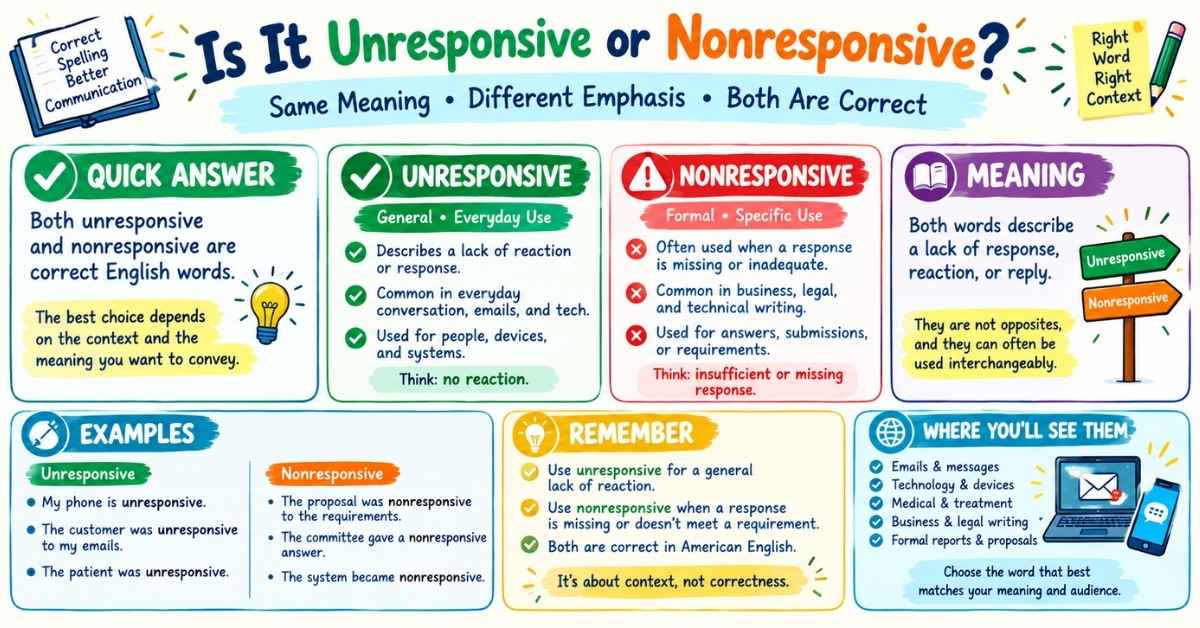
Is it unresponsive or nonresponsive? Both spellings are correct, and both describe a lack of response or reaction. However, unresponsive is a natural choice for everyday situations involving people, devices, and reactions, while nonresponsive can be particularly useful in formal, technical, or administrative contexts where a response is missing or fails to meet a requirement. The words often overlap, so the best choice depends on what you want to communicate.
Is It Unresponsive or Nonresponsive?
The answer is that both words are correct English adjectives. Neither is a misspelling of the other, and neither is universally better in every situation.
Use unresponsive when describing someone or something that fails to react as expected. For example, you might say, “My phone became unresponsive,” or “The customer was unresponsive to my emails.”
Use nonresponsive when you want to emphasize a missing, inadequate, or irrelevant response, particularly in formal or specialized writing. For example, “The proposal was deemed nonresponsive because it failed to meet the submission requirements.”
These are tendencies, not strict grammatical rules. A person who ignores an email can be described as either unresponsive or nonresponsive, depending on the intended emphasis.
Quick rule: Choose unresponsive for a general lack of reaction and consider nonresponsive when evaluating whether an expected response was provided or met specific requirements.
What Does Unresponsive Mean?
Unresponsive is an adjective that describes someone or something that does not react, reply, or respond in the expected way.
It can describe a person who does not answer a question, a device that does not react to commands, or a treatment that fails to produce the expected effect.
Examples of unresponsive
- Everyday communication: “I’ve sent her three messages, but she remains unresponsive.”
- Technology: “The laptop became unresponsive after I opened several applications.”
- Medical context: “The patient was unresponsive when emergency personnel arrived.”
- Treatment: “The condition was unresponsive to the initial treatment.”
- Customer service: “The company has been unresponsive to repeated requests for assistance.”
In each example, the emphasis is on a lack of the reaction or response that someone would normally expect.
The word can describe an inability to respond, a failure to react, or a lack of engagement. It does not automatically mean that someone is deliberately ignoring another person.
For instance, a customer who has not answered your email might be busy, unavailable, or simply unaware of the message. Calling the customer unresponsive describes the communication problem without necessarily explaining its cause.
What Does Nonresponsive Mean?
Nonresponsive is also an adjective meaning not responding or failing to provide an appropriate response. In some contexts, it specifically describes an answer, submission, or action that does not address what was requested.
This makes the word useful in business, legal, administrative, and technical writing.
Examples of nonresponsive
- Business: “The vendor submitted a nonresponsive proposal that omitted the required documentation.”
- Communication: “The committee considered the explanation nonresponsive because it did not answer the question.”
- Customer service: “The department was nonresponsive to the customer’s formal complaint.”
- Technology: “The application became nonresponsive after the update.”
- Research: “The report excluded nonresponsive answers from the relevant analysis.”
Notice that a nonresponsive answer can exist without actually answering the question. This is an important distinction in formal contexts: the issue may not be the complete absence of a reply, but the failure of that reply to address what was asked.
However, nonresponsive is not limited to formal writing. It is also used in everyday English, and its meaning frequently overlaps with unresponsive.
Unresponsive vs. Nonresponsive: Key Differences
The main difference concerns emphasis rather than correctness.
| Feature | Unresponsive | Nonresponsive |
|---|---|---|
| Basic meaning | Not reacting or responding as expected | Not responding or failing to provide an adequate response |
| Everyday English | Very natural | Also correct |
| People and communication | Common | Common, especially in formal contexts |
| Devices and systems | Common | Also appropriate |
| Formal submissions | Possible | Often especially precise |
| Answers that miss the question | Correct in many contexts | Particularly useful |
| Medical contexts | Common | Also used in specialized contexts |
| Correct spelling | Yes | Yes |
Compare the words in similar sentences
Example 1: Email communication
- Unresponsive: “The manager was unresponsive to my emails.”
- Nonresponsive: “The manager was nonresponsive to my emails.”
Both sentences are correct. The first sounds natural in ordinary conversation, while the second can sound more formal or evaluative.
Example 2: A computer
- Unresponsive: “My computer became unresponsive.”
- Nonresponsive: “My computer became nonresponsive.”
Both communicate that the computer stopped reacting properly. The first is a straightforward, familiar choice.
Example 3: A formal proposal
- Unresponsive: “The proposal was unresponsive to the stated requirements.”
- Nonresponsive: “The proposal was nonresponsive to the stated requirements.”
Both can work, but nonresponsive is especially suitable when assessing whether a submission satisfies specified requirements.
Example 4: A medical situation
- Unresponsive: “The patient was unresponsive.”
- Nonresponsive: “The patient was nonresponsive.”
Both forms occur in medical language. The precise meaning depends on the clinical context, so neither word should be used to make a diagnosis on its own.
These examples demonstrate why it is misleading to say that one word always refers to an inability to respond while the other always refers to an unwillingness to respond. Neither word reliably communicates that distinction.
When Should You Use Each Word?
1. Everyday conversation and messages
Choose unresponsive when describing someone who has not replied or reacted.
For example:
“My friend has been unresponsive since yesterday.”
This sentence communicates that your friend has not been responding. It does not establish why.
You could also say, “My friend has been nonresponsive since yesterday.” That is grammatically acceptable, although the wording may sound more formal or clinical.
If you simply want to describe an unanswered message, an even more natural option may be: “My friend hasn’t replied since yesterday.”
2. Technology and devices
Both words can describe a device or application that fails to react to user input.
Examples:
- “The touchscreen is unresponsive.”
- “The application became unresponsive after the update.”
- “The system was nonresponsive to commands.”
- “The interface remained nonresponsive despite several attempts to restart it.”
In ordinary technology troubleshooting, unresponsive is usually a clear, natural choice.
When writing a technical report, follow the terminology used in the relevant documentation or style guide. Consistency and precision matter more than forcing a distinction between the two adjectives.
3. Medical and treatment contexts
Both unresponsive and nonresponsive appear in medical language.
For example:
- “The patient was unresponsive to verbal stimulation.”
- “The condition was nonresponsive to the initial treatment.”
The first describes a lack of response to stimulation. The second describes a treatment response that was not achieved.
Medical terminology is context-dependent. A person described as unresponsive may have a serious medical problem; the word should not be casually equated with sleeping, ignoring someone, or simply being distracted.
Important: If someone suddenly becomes unresponsive and cannot be awakened, call 911 in the United States and follow the emergency dispatcher’s instructions.
4. Business, legal, and formal writing
Nonresponsive can be particularly useful when an answer, bid, application, or submission is judged against specific requirements.
For example:
“The procurement team rejected the bid because it was nonresponsive to the mandatory specifications.”
Here, the problem is not merely that the bid failed to elicit a reaction. It failed to satisfy the requirements against which it was evaluated.
Similarly:
“The witness gave a nonresponsive answer.”
This suggests that the answer did not address the question being asked.
In legal or procurement settings, however, the precise meaning may depend on applicable rules and established terminology. Use the relevant governing standard rather than relying solely on the general distinction between the words.
Unresponsive vs. Nonresponsive: Examples in Sentences
The following examples show how both words work in practical situations.
Unresponsive in a sentence
- The customer support team was unresponsive to my request for a refund.
- My phone became unresponsive after the software update.
- The patient was unresponsive, so emergency personnel assessed the situation.
- The company appeared unresponsive to feedback from its customers.
- The treatment proved unresponsive to the initial intervention.
Nonresponsive in a sentence
- The application was classified as nonresponsive because it omitted required information.
- The committee received a nonresponsive answer to its main question.
- The website became nonresponsive when the server experienced problems.
- The vendor submitted a nonresponsive bid.
- The department was criticized for being nonresponsive to public concerns.
Which word fits better?
Consider this sentence:
“The applicant gave a _____ answer to the interviewer’s question.”
Both unresponsive and nonresponsive can be grammatically correct. If the answer failed to address the question, nonresponsive may communicate the intended meaning more precisely.
Now consider:
“The laptop became _____ when I clicked the button.”
Unresponsive is a natural everyday choice because the emphasis is on the laptop’s failure to react.
These are usage preferences, not rules that make the alternative incorrect.
read more >>> Is It Costumer or Customer?
Is It Nonresponsive or Non-Responsive?
Both nonresponsive and non-responsive appear in established English usage.
For American English, nonresponsive is a practical default when no specific style guide requires otherwise. The hyphenated form is also documented; for example, Cambridge Dictionary lists non-responsive as an entry.
The important point is to avoid treating the hyphen as a difference in meaning. In ordinary usage, the two forms generally communicate the same idea.
For a website, business report, or academic paper:
- Choose a spelling convention and use it consistently.
- Follow your organization’s style guide if it specifies one.
- Retain the spelling used in official terminology when quoting or discussing a formal standard.
- Do not assume that non-responsive is automatically more formal or more correct.
If you are writing a general American English article and have no other requirement to consider, nonresponsive is a sensible default.
Common Mistakes to Avoid
Mistake 1: Assuming one word is incorrect
Both unresponsive and nonresponsive are legitimate words. The choice is about meaning, emphasis, and context—not a right-versus-wrong spelling test.
Mistake 2: Treating the words as exact opposites
They are not opposites. Both express a lack of response, and their meanings overlap considerably.
Mistake 3: Assuming nonresponsive always means unwilling
A nonresponsive person or system is not necessarily refusing to respond deliberately. The adjective describes the lack of response, not always its cause.
Mistake 4: Using unresponsive when a more precise description is available
If a formal answer fails to address a specific question, nonresponsive may be the clearer choice. In other situations, a direct statement such as “The answer did not address the question” may be clearer still.
Mistake 5: Treating hyphenation as a universal rule
The closed and hyphenated forms both appear in published English references. Follow your chosen dictionary or style guide rather than inventing a strict rule that applies everywhere.
Frequently Asked Questions
Is it unresponsive or nonresponsive?
Both are correct. Unresponsive is a natural general-purpose choice for something that does not react, while nonresponsive can be especially useful when a response is missing or fails to meet a requirement.
Is nonresponsive a real word?
Yes. Nonresponsive is an established English adjective, not a misspelling of unresponsive.
Are unresponsive and nonresponsive interchangeable?
They are interchangeable in many sentences, especially those describing people, devices, and communication. However, nonresponsive can be more precise when an answer or submission fails to address a particular requirement.
Is unresponsive more common than nonresponsive?
Unresponsive is a familiar general-purpose choice in everyday English. However, determining which word is more frequent across all American English writing requires a defined corpus and a consistent method of counting. It is better to choose the word that fits the sentence than to rely on an unsupported numerical claim.
Should nonresponsive have a hyphen?
Both nonresponsive and non-responsive are documented. In general American English, use nonresponsive as your default unless your preferred dictionary, style guide, or organization specifies the hyphenated form.
Is an unresponsive phone correct English?
Yes. “My phone is unresponsive” is natural English when the phone fails to react to touch, button presses, or other input.
Which word is better for formal writing?
Both can be appropriate. Nonresponsive is particularly useful when evaluating answers, bids, or submissions against stated requirements. Unresponsive remains appropriate in formal writing when describing a lack of reaction or response.
Does unresponsive mean unconscious?
Not always. It can describe a person who does not react to attempts to communicate, but its meaning depends on context. In a medical emergency, sudden unresponsiveness should be treated seriously.
Final Verdict
When deciding whether to write unresponsive or nonresponsive, remember that both words are correct and their meanings overlap.
Use unresponsive for a straightforward description of a person, device, or system that fails to react as expected. Use nonresponsive when you want to emphasize a missing or inadequate response, particularly in formal, technical, business, or administrative contexts.
Neither word is universally superior. The clearest choice is the one that communicates your intended meaning accurately and naturally.
