

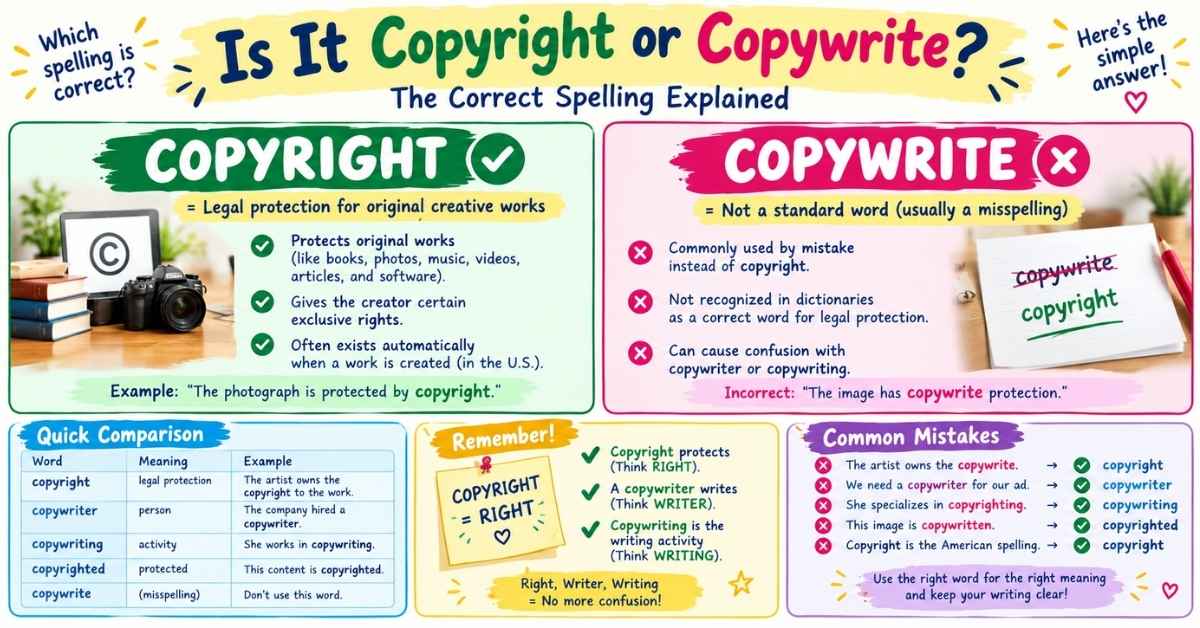
Is it copyright or copywrite? If you mean the legal protection given to an original creative work, the correct spelling is copyright. Copywrite is commonly used as a misspelling of copyright, often because people confuse it with copywriter or copywriting. The three terms are related to words and content, but they have very different meanings.
The easiest way to remember the difference is simple: copyright protects, a copywriter writes, and copywriting is the process of writing promotional or marketing content.
Is It Copyright or Copywrite?
The correct spelling is copyright when you are talking about legal rights over an original creative work.
| Word | Meaning | Example |
|---|---|---|
| Copyright | Legal protection for original creative works | The photographer owns the copyright to the image. |
| Copywrite | Usually a misspelling of copyright | ❌ The photo has copywrite protection. |
| Copywriter | A person who writes marketing or advertising copy | The company hired a copywriter. |
| Copywriting | The activity of writing marketing or advertising copy | She works in copywriting. |
| Copyrighted | Protected by copyright | The photograph is copyrighted. |
So if you are writing about intellectual property, ownership, creative rights, or protection from unauthorized use, use copyright.
If you are talking about someone who creates advertising or promotional text, use copywriter.
If you mean the work or profession of creating that text, use copywriting.
Copyright vs Copywrite: What Is the Difference?
Copyright and copywrite are easily confused because they look and sound similar. However, they should not be treated as interchangeable terms.
Copyright
Copyright refers to a form of intellectual property protection for original works of authorship.
The U.S. Copyright Office explains that copyright protects original works once they are created and fixed in a tangible form of expression. Examples include books, photographs, music, movies, software, illustrations, and blog posts.
For example:
- The author owns the copyright to the book.
- The photographer owns the copyright to the photograph.
- This website contains copyrighted material.
- The company registered its copyright.
Copywrite
When someone writes copywrite while referring to intellectual property, they generally mean copyright.
For example:
❌ The artist owns the copywrite to the painting.
✅ The artist owns the copyright to the painting.
The confusion is understandable because the word write is associated with writing. It is also easy to mentally combine copy with writer or copywriting.
But when the subject is legal protection, the standard word is copyright.
What Does Copyright Mean?
Copyright is a legal concept associated with original creative works.
The U.S. Copyright Office describes copyright as a type of intellectual property that protects original works of authorship when they are fixed in a tangible form.
That can include works such as:
- Books
- Blog posts
- Photographs
- Illustrations
- Songs
- Sound recordings
- Movies
- Software
- Poems
- Architectural works
- Other qualifying creative works
Copyright gives copyright owners certain exclusive rights concerning their works.
A useful point for U.S. readers is that copyright protection generally exists automatically when an original work is created and fixed in a tangible form. Registration is not what creates the underlying copyright. However, registration can provide important legal benefits, and the U.S. Copyright Office notes that registration or refusal is required for a U.S. work before bringing an infringement lawsuit in federal court.
That is why copyright is a legal and intellectual property term, not simply another spelling of “copywriting.”
What Is a Copywriter?
A copywriter is a person who writes copy for advertising, marketing, sales, or other promotional purposes.
For example, a copywriter might create:
- Website landing-page text
- Product descriptions
- Advertisements
- Email campaigns
- Sales pages
- Social media advertising copy
- Brochures
- Marketing headlines
- Promotional scripts
Consider this sentence:
The company hired a copywriter to rewrite its homepage.
Here, copywriter refers to the person doing the writing.
It has nothing to do with whether the homepage is legally protected by copyright.
That distinction is important because one piece of content can involve both concepts.
For example, a copywriter might write an advertisement, while copyright may apply to the resulting original work.
What Is Copywriting?
Copywriting is the process or practice of writing persuasive content intended to communicate with or influence an audience, especially in marketing and advertising.
For example:
She specializes in copywriting for small businesses.
The person is a copywriter.
The activity is copywriting.
The legal protection associated with an original qualifying work is copyright.
This gives you a simple three-part distinction:
Copyright = legal rights
Copywriter = person
Copywriting = writing activity
That distinction solves most of the confusion surrounding these words.
Copyright, Copywriter, and Copywriting at a Glance
| Term | What it describes | Simple way to remember |
|---|---|---|
| Copyright | Legal protection and rights | Think right |
| Copywriter | Person who writes copy | Think writer |
| Copywriting | Writing marketing or advertising copy | Think writing |
| Copyrighted | Something protected by copyright | Think protected |
| Copywrite | Commonly confused/misspelled form | Don’t use it for copyright |
This is one of the most useful distinctions to remember:
Copyright protects.
A copywriter writes.
Copywriting sells or persuades.
Why Do People Spell Copyright as Copywrite?
The mistake makes sense once you look at the words.
People already know words such as:
- write
- writer
- writing
- copywriter
- copywriting
So copywrite can look perfectly logical at first glance.
There is another reason: copyright and copywrite sound alike in ordinary speech. When someone hears the word rather than sees it written, the difference between right and write disappears.
English has many similar sound-based spelling problems, including:
- right / write
- there / their / they’re
- your / you’re
- brake / break
In this case, the confusion is made even stronger by the legitimate words copywriter and copywriting.
The result is an easy mental mix-up:
copy + right → copyright
versus
copy + writer → copywriter
Once you understand what each word describes, the spelling becomes much easier.
read more >>> Is It Gluing or Glueing?
Is Copyright Different in American and British English?
No. Copyright is spelled the same in American and British English.
It is not a situation like:
- color / colour
- center / centre
- organize / organise
For the legal term, both American and British English use copyright.
Cambridge Dictionary lists copyright as a noun and verb and provides both U.S. and U.K. pronunciation information.
So you should not use copywrite because you think it is an American or British spelling variation.
It isn’t a regional spelling difference.
Copyrighted or Copywritten: Which Is Correct?
This is another common question caused by the same confusion.
When you mean that something is protected by copyright, the standard form is copyrighted.
For example:
Photograph is copyrighted.✅
The article is copyrighted.✅
The software is copyrighted.✅
The photograph is copywritten.❌
Cambridge identifies copyrighted as the past tense and past participle of the verb copyright.
So the useful sequence is:
copyright → copyrighted
Not:
copywrite → copywritten
Common Copyright vs Copywrite Mistakes
Here are some mistakes you may encounter in everyday writing.
Mistake 1: Using copywrite for legal protection
❌ The photographer owns the copywrite.
✅ The photographer owns the copyright.
Mistake 2: Confusing a copywriter with copyright
❌ We need to hire someone for copyright to write our advertisement.
✅ We need to hire a copywriter to write our advertisement.
Mistake 3: Calling marketing work copyright
❌ She specializes in copyright for online businesses.
✅ She specializes in copywriting for online businesses.
Mistake 4: Writing copywritten
❌ This image is copywritten.
✅ This image is copyrighted.
Mistake 5: Assuming copywrite is a U.S. spelling
❌ Copywrite is the American spelling.
✅ Copyright is the standard spelling in American English.
How to Use Copyright Correctly in a Sentence
Here are several natural examples:
- The author owns the copyright to the novel.
- The photograph is protected by copyright.
- The company registered its copyright.
- The website contains copyrighted images.
- Unauthorized use may raise copyright concerns.
- The copyright holder gave permission to use the photograph.
- The publisher owns the copyright to the book.
- The artist retained copyright in the original work.
Cambridge also lists common combinations such as copyright owner, copyright information, copyright clearance, and copyright infringement.
These collocations are useful because they show how the word naturally appears in professional English.
How to Use Copywriter Correctly in a Sentence
Use copywriter when referring to a person.
Examples:
- The company hired a freelance copywriter.
- Our copywriter created the new sales page.
- She works as a copywriter for a marketing agency.
- The copywriter wrote the product description.
Remember:
-writer = the person who writes.
That same pattern appears in other words such as:
- songwriter
- screenwriter
- ghostwriter
- playwright
How to Use Copywriting Correctly in a Sentence
Use copywriting when talking about the activity or profession.
Examples:
- He has five years of copywriting experience.
- She learned copywriting for digital marketing.
- Good copywriting can make a complicated offer easier to understand.
- The agency provides copywriting services.
- Email copywriting requires concise and persuasive language.
The important distinction is:
A copywriter does copywriting.
Neither term means copyright.
Is “Copywrite” Ever Used?
You may encounter copywrite online, but that does not mean it should automatically replace copyright or copywriting in professional writing.
The safest approach is to choose the established term that matches your meaning:
- Talking about legal protection → copyright
- Talking about a person who writes promotional copy → copywriter
- Talking about promotional writing as an activity → copywriting
- Talking about something protected → copyrighted
This approach avoids ambiguity and matches standard professional terminology.
Does Copyright Apply Automatically in the United States?
For U.S. readers, this is an important distinction between copyright as a legal concept and copyright registration.
The U.S. Copyright Office states that copyright protection exists when an original work is created and fixed in a tangible form. Registration is generally voluntary for the existence of copyright itself.
However, registration can be important if an owner needs to enforce rights in court. The Copyright Office specifically explains that registration, or refusal of registration, is required before an owner of a U.S. work can bring an infringement lawsuit.
So avoid the oversimplified statement:
“You have no copyright until you register.”
For U.S. copyright law, that is not accurate.
A Simple Memory Trick for Copyright vs Copywrite
If you keep forgetting the spelling, remember this:
Copyright → RIGHT
Think:
legal rights
Copyright is about rights associated with an original creative work.
Copywriter → WRITER
Think:
a person who writes
A copywriter creates advertising or marketing copy.
Copywriting → WRITING
Think:
the activity
Copywriting is the process of creating promotional or persuasive copy.
The complete memory rule
Copyright protects.
A copywriter writes.
Copywriting is writing copy.
Once you remember those three relationships, copyright vs copywrite becomes much easier.
FAQs About Copyright or Copywrite
Is it copyright or copywrite?
Copyright is the correct spelling when you mean legal rights or protection for an original creative work. Copywrite is commonly used as a misspelling or confusion with copywriting.
Is copywrite a correct spelling of copyright?
No. If you mean the legal protection of an original work, use copyright.
Is copywrite the same as copywriting?
No. Copywriting is the activity of writing marketing or advertising copy. Copyright concerns legal rights in qualifying creative works.
What is a copywriter?
A copywriter is a person who writes copy, especially for advertising, marketing, websites, sales materials, and promotional communications.
Is copyright one word?
Yes. Copyright is normally written as one word.
Is it copyrighted or copywritten?
The standard form is copyrighted when you mean protected by copyright. Cambridge lists copyrighted as the past tense and past participle of copyright.
Is copyright the same in American and British English?
Yes. Copyright is spelled the same in American and British English.
Does copyright apply to blog posts?
Original blog posts can be protected by copyright when they meet the applicable requirements. The U.S. Copyright Office specifically lists blog posts among examples of works that can receive copyright protection.
What does the © symbol mean?
The © symbol is commonly used to indicate a copyright claim or copyright information. Cambridge identifies © as the symbol associated with copyright protection.
How can I remember copyright?
Think RIGHT. Copyright is about legal rights. A copywriter is a person who writes, while copywriting is the writing activity.
Final Answer: Copyright or Copywrite?
If you are asking “Is it copyright or copywrite?”, use copyright when you mean legal protection or rights associated with an original creative work.
Copywrite is the form people commonly type when they confuse copyright with copywriter or copywriting.
The easiest rule is:
Copyright = legal rights
Copywriter = person
Copywriting = activity
Copyrighted = protected work
Once you separate those four terms, the spelling is straightforward—and you can avoid one of the most common word-choice mistakes involving writing, marketing, and intellectual property.
