

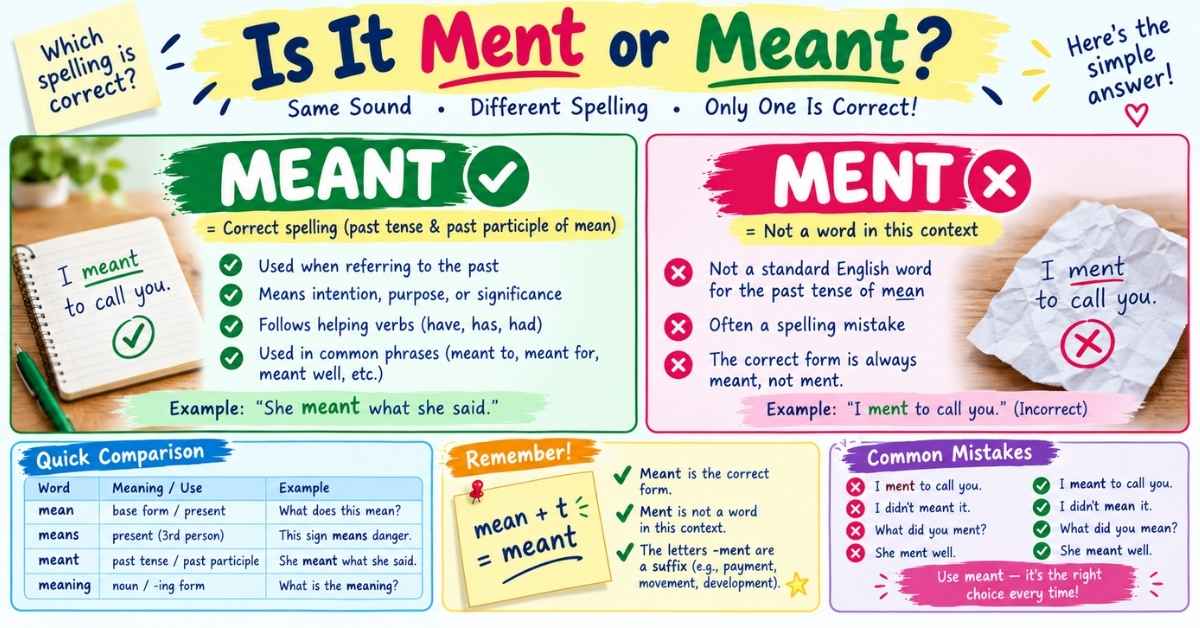
Is it ment or meant? The correct spelling is meant when you are using the past tense or past participle of mean. For example, “I meant to call you yesterday” is correct, while “I ment to call you yesterday” is incorrect in standard English. The confusion happens mainly because meant is pronounced /mɛnt/, which makes the missing “a” in ment easy to imagine when spelling the word from sound.
Is It Ment or Meant?
The correct form is meant.
| Word | Correct as the past form of mean? | Use |
|---|---|---|
| meant | ✅ Yes | Past tense and past participle of mean |
| ment | ❌ No | Usually a spelling mistake in this context |
For example:
- Correct: I meant to call you.
- Incorrect: I ment to call you.
- Correct: She meant what she said.
- Incorrect: She ment what she said.
Cambridge defines meant as the past simple and past participle of mean. Oxford gives the same grammatical classification, and Collins likewise identifies meant as the past tense and past participle of mean.
So if your sentence needs the past form of mean, choose meant.
What Does Meant Mean?
Meant is the past form of the verb mean. Depending on the sentence, it can communicate several related ideas.
1. Meant can show past intention
When someone intended to do something, use meant.
I meant to send the email yesterday.
This says the person intended to send the email, even though the action may not have happened.
Another example:
She meant to arrive early.
The intention existed in the past.
2. Meant can describe significance
It can also tell us that something had a particular importance.
Her message meant a lot to me.
Here, meant does not mean “intended.” It describes the importance or emotional significance of the message.
3. Meant can describe what something signified
The red warning light meant that the machine needed attention.
In this sentence, meant means that the warning light indicated or signified something.
4. Meant can describe intended purpose
The room was meant for meetings.
Here, meant for communicates intended purpose or use. Collins also documents meant to and meant for as established uses of the word.
Is Meant the Past Tense of Mean?
Yes.
The basic verb pattern is:
mean → meant → meant
| Verb form | Word | Example |
|---|---|---|
| Base form | mean | I mean what I say. |
| Simple past | meant | I meant what I said. |
| Past participle | meant | I have meant to call. |
This is an irregular verb because the past form is not made by simply adding the usual -ed ending.
You do not normally write:
❌ meaned
Instead:
✅ meant
Dictionary references consistently identify meant as both the simple past and past participle of mean.
Why Do People Spell Meant as Ment?
The main reason is pronunciation.
The word meant is pronounced /mɛnt/. The spelling does not sound as transparent as it looks. When someone hears the word in conversation, especially in fast speech, the a is not pronounced as a separate sound.
That can create this mental sequence:
sound: “ment”
assumed spelling: ment
standard spelling: meant
This is a classic example of why English spelling cannot always be reconstructed perfectly from pronunciation.
For comparison:
- mean has a long vowel sound.
- meant has a short vowel sound.
- meant still retains the spelling connection to mean.
Dictionary.com and Oxford both give the pronunciation of meant with the short /ɛ/ vowel.
So if you have ever thought, “Why isn’t it spelled ment if that’s how it sounds?” that is exactly where the confusion comes from.
Mean vs. Meant: When Should You Use Each?
The easiest distinction is present vs. past, although sentence structure also matters.
Present: Mean
Use mean for the base or present form.
What does this word mean?
I mean what I say.
I mean to finish this today.
Past: Meant
Use meant when the verb is referring to the past.
What did she mean by that?
Notice something important here: after did, we use the base form mean, not meant.
Compare:
❌ What did she meant?
✅ What did she mean?
But without did:
She meant something different.
This is an important grammar distinction that is easy to miss.
Why “I Didn’t Meant” Is Wrong
One of the most common mistakes is:
❌ I didn’t meant to hurt you.
The correct version is:
✅ I didn’t mean to hurt you.
Why?
Because did already carries the past-tense information. After did or didn’t, English normally uses the base form of the verb.
Compare:
- I meant to call.
- I did mean to call.
- I didn’t mean to call.
The same pattern appears with many other verbs:
- I went.
- I did go.
- I didn’t go.
Not:
- ❌ I didn’t went.
So the rule is:
Past tense without did → meant
After did/didn’t → mean
This is one of the most useful distinctions to remember.
How to Use Meant in Common Expressions
“Meant to”
Meant to commonly describes an intention, purpose, or expected action.
I meant to call you.
We meant to leave earlier.
She was meant to arrive at noon.
The first example describes a person’s past intention. The third can describe an expected or intended arrangement.
“Meant for”
THE Meant for describes intended use, purpose, or an intended recipient.
This book was meant for beginners.
The gift was meant for my sister.
This tool was meant for outdoor use.
“Meant well”
The Meant well means that someone had good intentions.
He meant well, but his advice wasn’t helpful.
The important idea is intention, not necessarily the result.
“Meant no harm”
This expression is commonly used when someone wants to clarify that they did not intend to cause harm.
I meant no harm by the comment.
“Meant a lot”
This describes importance or emotional significance.
Your support meant a lot to me.
Here, meant is about significance, not simply an intention.
“Meant what I said”
This expression emphasizes sincerity.
I meant what I said.
In other words, the speaker genuinely intended the meaning expressed.
“Meant to be”
The phrase meant to be can describe something regarded as intended, destined, or expected.
The meeting was meant to be informal.
They believed the opportunity was meant to be.
The exact interpretation depends on context.
What About the “-Ment” Suffix?
This is where the spelling ment really does appear in English but that does not make ment the past tense of mean.
-ment is a suffix.
Cambridge defines -ment as a suffix used to form nouns referring to an action, process, or result. Examples include words such as achievement, management, and disappointment.
Consider:
- pay → payment
- agree → agreement
- develop → development
- move → movement
- achieve → achievement
- improve → improvement
In these words, -ment is part of a larger word.
That is completely different from writing:
❌ I ment to call you.
The correct form is:
✅ I meant to call you.
The key distinction
meant = a complete word and the past form of mean
-ment = a suffix that appears at the end of many nouns
This distinction explains why ment can look familiar even though it is normally incorrect as a standalone replacement for meant.
Common Mistakes With Ment and Meant
Mistake 1: “I ment to call.”
❌ Incorrect:
I ment to call you.
✅ Correct:
I meant to call you.
Mistake 2: “She ment well.”
❌ Incorrect:
She ment well.
✅ Correct:
She meant well.
Mistake 3: “What did you meant?”
❌ Incorrect:
What did you meant?
✅ Correct:
What did you mean?
Remember: did + base verb.
Mistake 4: “I didn’t meant it.”
❌ Incorrect:
I didn’t meant it.
✅ Correct:
I didn’t mean it.
Again, didn’t already marks the past.
Mistake 5: Confusing meant with meaning
These forms have different jobs.
What does this mean?
What did this mean?
What was the meaning of the sentence?
She meant something different.
Mean, meant, and meaning are related, but they are not interchangeable.
Meant vs. Mean vs. Meaning
| Word | Main grammatical role | Example |
|---|---|---|
| mean | Base/present verb | What does this mean? |
| means | Present tense, third-person singular | This sign means danger. |
| meant | Past tense/past participle | She meant what she said. |
| meaning | Noun / -ing form | What is the meaning? |
This table is often enough to resolve the confusion.
If the sentence asks about something happening now, mean may be appropriate.
If it refers to something that already happened, meant may be appropriate.
AND If you are naming the sense or significance of something, meaning may be the correct noun.
read more >>> Is It Copyright or Copywrite?
Is There a Difference in American and British English?
Not on this spelling question.
Both American English and British English use:
mean → meant
There is no standard American spelling ment that replaces meant.
Collins provides American and British entries for meant, while both dictionary treatments identify it as the past tense and past participle of mean.
So if you’re writing for a U.S. audience, the answer is straightforward:
Use meant.
The same spelling applies in British English.
Is “Ment” Ever Correct?
There is an important qualification.
Ment is not normally the correct standalone spelling when you mean the past form of mean.
However, the letters -ment are extremely common as part of other English words.
For example:
- payment
- agreement
- development
- movement
- treatment
- achievement
- improvement
- statement
So saying “you will never see ment” would be misleading.
The better rule is:
Do not use “ment” as the standalone past tense of “mean.” Use “meant.”
The suffix -ment is a legitimate word-forming element, but it serves a different grammatical function.
An Easy Memory Trick for Meant
The simplest memory trick is:
mean + t = meant
Look at the relationship:
mean → meant
The spelling keeps mean visible and adds t.
Another useful sentence is:
What I mean today, I meant yesterday.
For example:
Today:
I mean what I say.
Yesterday:
I meant what I said.
This connects the two forms instead of asking you to memorize meant as an isolated spelling.
A Fast Test: Should You Write Mean or Meant?
When you’re unsure, look at the sentence structure.
If the sentence uses “did”:
Use mean.
What did you mean?
I didn’t mean that.
If the sentence directly describes a past action:
Use meant.
I meant to call.
She meant what she said.
If it follows have, has, or had:
Use meant.
I have meant to ask you.
She has meant well.
We had meant to leave earlier.
This gives you a practical three-part test:
did/didn’t → mean
simple past → meant
have/has/had → meant
Quick Comparison: Ment vs. Meant
| Question | Answer |
|---|---|
| Is meant a real English word? | Yes |
| Is meant the past tense of mean? | Yes |
| Is meant the past participle of mean? | Yes |
| Is ment normally the past tense of mean? | No |
| Is -ment a real English suffix? | Yes |
| Why does “ment” look plausible? | It reflects the pronunciation of meant |
| Is the spelling different in U.S. English? | No |
| Correct: “I ment to call”? | No |
| Correct: “I meant to call”? | Yes |
| Correct: “I didn’t mean to call”? | Yes |
Frequently Asked Questions
Is it “ment” or “meant”?
Meant is correct when you need the past tense or past participle of mean.
I meant to call you.
Is “ment” a word?
Ment is not normally used as a standalone standard-English replacement for meant. The sequence -ment, however, is a legitimate suffix used in words such as payment and development.
What is the past tense of mean?
The past tense of mean is meant.
mean → meant
What is the past participle of mean?
The past participle is also meant.
She has meant well.
Why is meant spelled with an “a”?
The spelling preserves the established form of the irregular verb mean. Its pronunciation does not separately reveal the a, which contributes to the common spelling confusion.
Is “I ment to call you” correct?
No. The standard spelling is:
I meant to call you.
Is “I didn’t meant to” correct?
No.
Use:
I didn’t mean to.
After didn’t, use the base verb mean.
What is the difference between mean and meant?
Mean is the base/present form, while meant is the past tense and past participle.
What do you mean?
What did you mean?
I meant what I said.
Is meant a verb?
Yes. Meant is a verb form: specifically, the past tense and past participle of mean.
Can I use meant after “have”?
Yes.
I have meant to ask you about that.
Here, meant functions as the past participle.
Is “meant for” correct?
Yes.
This guide was meant for beginners.
It can describe intended purpose or an intended recipient.
Is “meant well” correct?
Yes.
She meant well, even though the advice didn’t help.
It means she had good intentions.
Is the spelling “meant” the same in American and British English?
Yes. Both varieties use meant as the past form of mean.
Final Answer: Ment or Meant?
If you’re choosing between ment and meant because you need the past form of mean, choose meant.
The essential pattern is:
mean → meant → meant
Use mean as the base/present form, meant as the simple past, and meant as the past participle.
And remember the important grammar exception:
I meant to call.
I didn’t mean to call.
The letters -ment do occur in English, but as a suffix in words such as payment, movement, and development. That is a different use from the word meant.
So when you are writing “I meant,” “she meant,” “they meant,” or “it meant,” keep the a:
✅ meant
❌ ment
