

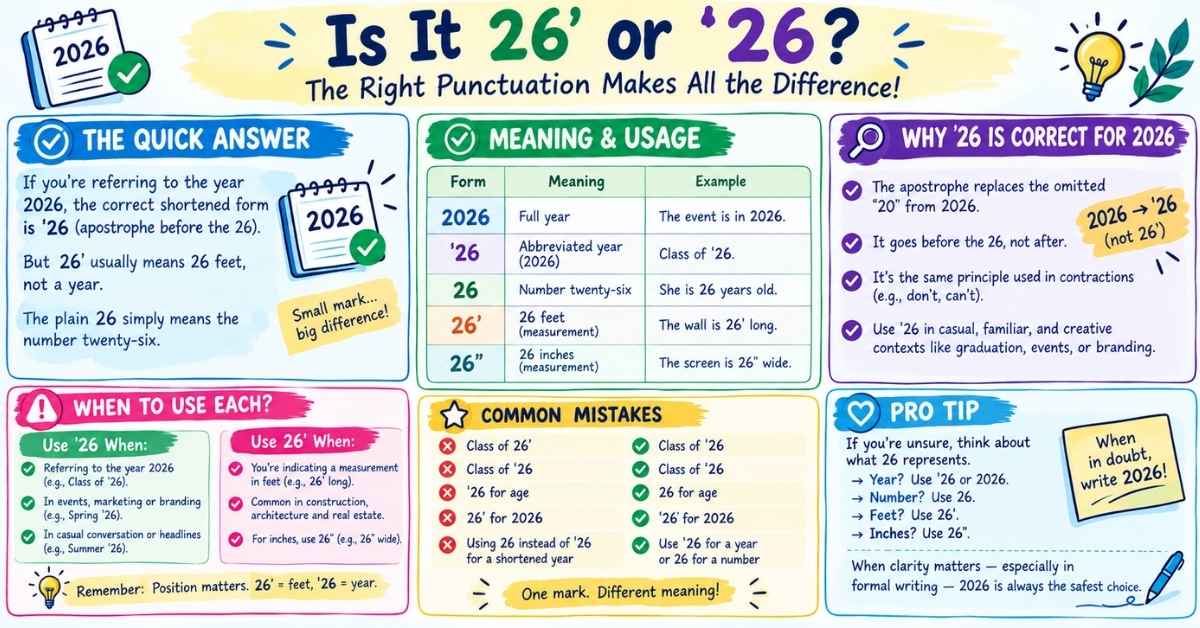
Is it 26′ or ’26? If you are trying to shorten the year 2026, the correct abbreviated form is ’26, with the apostrophe before the 26. By contrast, 26′ normally means 26 feet, not the year 2026. The plain 26 simply means the number twenty-six. That small punctuation mark changes the meaning, so knowing where it belongs matters in professional, academic, graduation, marketing, and everyday writing.
The Quick Answer: ’26 vs. 26′
The easiest way to remember the difference is to look at what the symbol is doing.
| Form | Meaning | Example |
|---|---|---|
| 2026 | Full calendar year | The conference is in 2026. |
| ’26 | Shortened form of a year | Class of ’26 |
| 26 | The number twenty-six | She is 26 years old. |
| 26′ | 26 feet | The room is 26′ wide. |
| 26″ | 26 inches | The table is 26″ wide. |
So, if you are asking how to abbreviate 2026, use ’26, not 26′.
The distinction is important because the mark after the number has a completely different function from the apostrophe before a shortened year. A prime mark after a numeral is commonly used for feet, while a leading apostrophe indicates omitted digits in an abbreviated year.
Why ’26 Is the Correct Shortened Form of 2026
When writers abbreviate 2026 to ’26, the first two digits 20 have been removed.
Think of it this way:
2026 → ’26
The apostrophe tells the reader that something has been omitted. In this case, the missing information is the beginning of the year.
This is the same basic punctuation principle used when letters are omitted from contractions. The apostrophe isn’t there merely to make the abbreviation look attractive; it communicates that part of the original form has been left out.
Editorial style guidance supports this usage. The Chicago Manual of Style, for example, uses “the class of ’06” as an example of a correctly abbreviated year. Calvin University’s editorial guide likewise specifically says to use the apostrophe indicating the omitted portion of a graduation year.
Therefore:
2026 → ’26
not:
2026 → 26′
and not:
2026 → ‘26
Why Does the Apostrophe Go Before 26?
The position follows the omission.
The digits 20 have disappeared from the beginning of 2026, so the apostrophe goes at the beginning of the shortened form:
’26
It does not go after the number:
26′
That difference is not merely stylistic.
’26 = shortened year
26′ = commonly 26 feet
This is why writing the symbol in the wrong position can change the meaning of an otherwise simple expression.
’26 vs. ‘26: The Direction of the Mark Matters
There is another easy mistake: using ‘26 instead of ’26.
These marks may look almost identical in some fonts, but they perform different typographic functions.
- ’ = apostrophe / closing single quotation mark shape
- ‘ = opening single quotation mark
When digits are omitted from the beginning of a year, the preferred mark is the apostrophe:
Class of ’26
not:
Class of ‘26
Editorial guidance from Calvin University explicitly distinguishes these two forms and says the correct abbreviated-year mark should be ’, not ‘. Smarter Balanced style guidance makes the same distinction, specifying an apostrophe rather than an opening single quotation mark when abbreviating years.
This matters particularly when you are creating a graduation announcement, website heading, poster, logo, social media graphic, or printed invitation, because typography is highly visible in those contexts.
What Does 26′ Mean?
If you see 26′, do not automatically read it as a shortened year.
In measurement notation, ′ is the prime symbol commonly used for feet.
For example:
26′ = 26 feet
A construction drawing might say:
The wall is 26′ long.
An architectural plan might show:
26′ × 12′
That means the dimensions are 26 feet by 12 feet.
For inches, the corresponding symbol is the double prime:
26″ = 26 inches
So:
26′ 5″ = 26 feet 5 inches
This distinction is particularly important in architecture, construction, interior design, engineering, real estate and technical documentation.
The easiest visual rule
Mark before number → abbreviated year
Mark after number → measurement context
Context still matters, but this rule resolves most everyday confusion.
When Should You Use 26 Without an Apostrophe?
Use 26 when you mean the ordinary number twenty-six rather than an abbreviated year.
Examples include:
- She is 26 years old.
- We ordered 26 chairs.
- The team scored 26 points.
- There are 26 students in the class.
- Turn to page 26.
- The package weighs 26 pounds.
- The building has 26 floors.
Nothing has been omitted from the number in these examples, so there is no reason to insert an apostrophe.
Compare:
She is 26 years old.
Here, 26 is an age.
She graduated in ’26.
Here, ’26 represents a year.
The digits are similar, but their grammatical roles are different.
When Is ’26 Appropriate?
The shortened year is particularly common where brevity, familiarity, or visual style matters.
Graduation
One of the clearest examples is:
Class of ’26
A graduation year is already understood from context, so shortening 2026 to ’26 is natural.
Events
You might see:
Summer ’26
or:
Conference ’26
Marketing
A brand might use:
Spring ’26 Collection
or:
Fall ’26 Preview
The abbreviated year can make a headline or campaign name shorter and visually cleaner.
Fiscal or academic references
Abbreviated years can also appear in contexts such as:
FY ’26
or:
’25–’26
However, organizations may establish their own editorial conventions. That is why professional writers should follow the relevant house style rather than assuming every publication handles abbreviated years identically.
Should You Write 2026 Instead of ’26?
Often, yes—especially when clarity is more important than brevity.
The shortened form is useful, but it isn’t mandatory.
In formal writing, consider using the complete year:
The policy will take effect in 2026.
That is usually clearer than:
The policy will take effect in ’26.
This is particularly sensible in:
- academic papers
- legal documents
- contracts
- official reports
- historical writing
- financial documents
- technical documentation
- records that may be read years later
A shortened year can become ambiguous when the surrounding context does not establish the century.
For example, ’26 could potentially refer to 1926, 2026, or another year ending in 26. The Chicago Manual of Style’s discussion of abbreviated class years illustrates how historical context can affect interpretation.
So the better editorial rule isn’t simply “always abbreviate.”
It is:
Use ’26 when the shortened form is clear and appropriate; use 2026 when precision matters more.
Common Mistakes Writers Make
1. Writing 26′ when they mean 2026
Incorrect for a shortened year:
Class of 26′
The mark is in the wrong position and can be interpreted as a feet symbol.
Correct:
Class of ’26
2. Writing ‘26 instead of ’26
The opening quotation mark is not the preferred mark for an omitted year.
Incorrect:
Class of ‘26
Correct:
Class of ’26
3. Adding an apostrophe to an ordinary age
Incorrect:
She is ’26 years old.
Correct:
She is 26 years old.
The person is twenty-six; the number isn’t an abbreviated year.
4. Assuming every shortened year must be abbreviated
You don’t have to shorten 2026.
In a formal report, 2026 may be much clearer than ’26.
5. Using an apostrophe merely because it looks stylish
Punctuation should communicate meaning. It shouldn’t be added simply because a design looks better with a mark.
An apostrophe before a year indicates omission. It should have a grammatical reason for being there.
Examples You Can Use
Here are practical examples showing the difference.
Referring to a year
Correct:
The new program begins in 2026.
Also correct in an appropriate informal context:
The new program begins in ’26.
Graduation
Correct:
She is a member of the Class of ’26.
Age
Correct:
My brother is 26 years old.
Quantity
Correct:
The company hired 26 employees.
Measurement
Correct:
The room is 26′ long.
Here, the mark after 26 indicates feet.
Inches
Correct:
The screen is 26″ wide.
A year range
A shortened range may appear as:
’25–’26
But some organizations use different conventions for abbreviated year ranges. Follow the applicable editorial style when writing professionally. Style preferences are not perfectly uniform across institutions.
read more >>> is it leafs or leaves
A 5-Second Test for Choosing the Right Form
When you’re unsure, ask yourself one question:
What does 26 represent?
If it represents the year 2026, you can write:
2026
or, where abbreviation is appropriate:
’26
If it represents the number twenty-six, write:
26
If it represents 26 feet, write:
26′
If it represents 26 inches, write:
26″
That simple classification prevents nearly every common error.
What About “Class of 26”?
This is a common point of confusion.
If you mean students graduating in 2026, the clearest formal version is:
Class of 2026
A conventional shortened version is:
Class of ’26
Writing:
Class of 26
may be understood from context, but it removes the punctuation that signals that the year has been shortened.
For graduation merchandise, banners, announcements, websites and social graphics, Class of ’26 is a familiar and readable form.
What Does ’26 Mean Without Context?
This is where caution is necessary.
By itself:
’26
does not mathematically prove which century you mean.
It could refer to a year ending in 26. The surrounding text supplies the missing context.
For example:
Class of ’26
in a modern school context will normally be understood as the graduating class of 2026.
But a historical sentence such as:
The events of ’26 changed the country.
could require additional context to establish whether the writer means 1926, 1826, 2026, or another year.
If there is any realistic possibility of confusion, write the full year.
Is the Apostrophe the Same as a Feet Mark?
Not exactly.
This distinction is frequently overlooked.
The symbol used in ’26 is functioning as an apostrophe marking omitted digits.
The symbol in 26′ is a prime mark, conventionally used to indicate feet in measurements.
They may look similar in ordinary fonts, but their position and function are different.
That is why the following expressions should not be treated as equivalent:
’26 → abbreviated year
26′ → 26 feet
This is one of the most important distinctions missing from many simplified explanations of the query.
What Style Guides Tell Us
The general principle is well established, but professional style can vary.
The Chicago Manual of Style provides an example of a properly abbreviated class year using a leading apostrophe.
Calvin University’s editorial style guide specifically instructs writers to use the apostrophe that indicates the omitted portion of the year and warns against the opening quotation mark.
Smarter Balanced similarly advises replacing the first two numbers with an apostrophe when a year is abbreviated.
At the same time, institutional style systems can differ on exactly when abbreviated years should be used, particularly in ranges and formal documents. NYU Law, for example, has its own convention for abbreviated years in ranges.
The practical lesson is simple:
The punctuation principle is stable, but your publication’s style guide determines when abbreviation is preferred.
Frequently Asked Questions
Is it ’26 or 26 for the year 2026?
Use ’26 when you intentionally abbreviate 2026. In formal or potentially ambiguous writing, 2026 is usually clearer.
Is it 26′ or ’26?
If you mean a shortened year, it is ’26. 26′ commonly means 26 feet.
Does the apostrophe go before or after 26?
For an abbreviated year, it goes before 26:
’26
Is “Class of ’26” correct?
Yes. Class of ’26 is a conventional shortened form of Class of 2026.
Is “Class of ‘26” correct?
The preferred typographic form is Class of ’26, using the apostrophe that indicates omitted digits rather than an opening single quotation mark.
Can ’26 mean 1926?
Yes. Without context, a shortened year can be ambiguous. The surrounding text determines which year is intended.
Should I use 2026 instead of ’26?
For formal, legal, academic, technical, or potentially ambiguous writing, 2026 is often the better choice because it eliminates uncertainty.
What does 26′ mean?
In measurement notation, 26′ commonly means 26 feet.
What does 26″ mean?
26″ commonly means 26 inches.
How do you abbreviate 2026?
When abbreviation is appropriate, write ’26, with the apostrophe before the final two digits.
Is 26 an abbreviation for 2026?
No. 26 is simply the number twenty-six. If you want to signal that digits have been omitted from 2026, use ’26.
The Bottom Line
If you’re referring to 2026, the shortened form is:
’26
If you’re referring to the ordinary number:
26
If you’re referring to a measurement of feet:
26′
And if clarity matters more than brevity, simply write:
2026
The key is to remember that the apostrophe in ’26 replaces the omitted 20. It belongs before the 26, not after it. Meanwhile, 26′ belongs to an entirely different notation system and commonly means 26 feet.
When in doubt, choose the form that makes the meaning unmistakable. In formal writing, that will often be 2026; in familiar contexts such as graduation or branding, ’26 is concise and conventional.
