

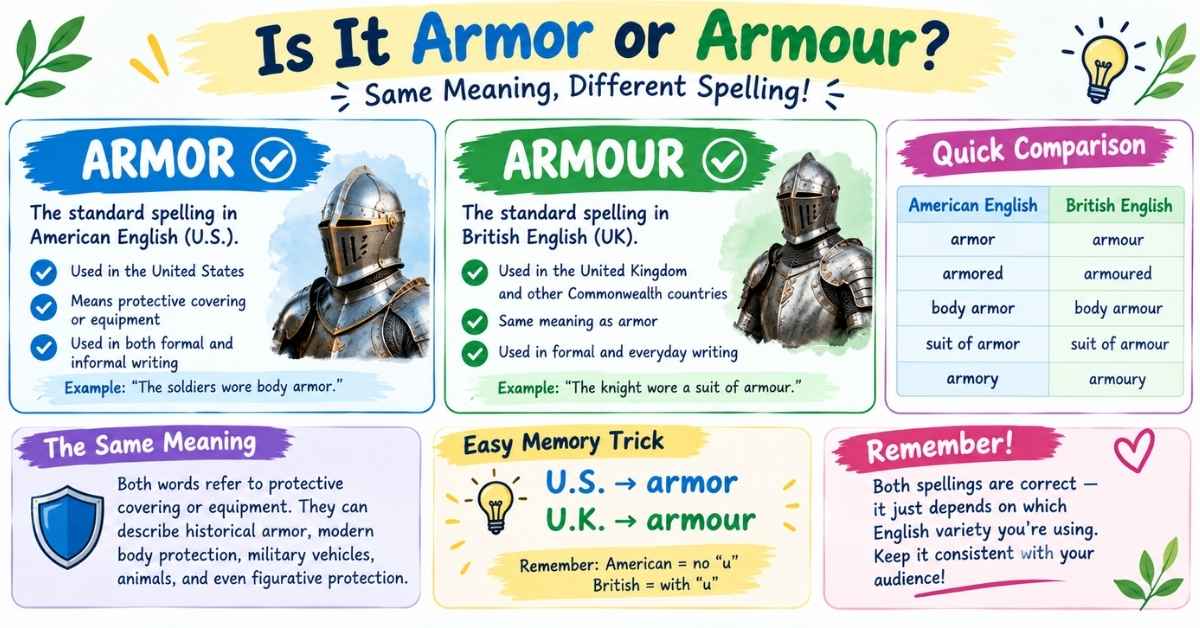
Is it armor or armour? Both spellings are correct, but if you are writing for a U.S. audience, use “armor.” Armour is the standard British spelling of the same word. The meaning does not change; the difference is mainly a matter of regional English spelling.
So if you’re writing an American article, school assignment, business document, or website, armor is the form you want.
| American English | British English |
|---|---|
| armor | armour |
| armored | armoured |
| body armor | body armour |
| suit of armor | suit of armour |
| armory | armoury |
The easiest way to remember it is simple: American English uses armor; British English uses armour.
Armor vs. Armour: The Quick Answer
Armor is the standard spelling in American English.
Armour is the standard spelling in British English.
Both words refer to protective covering or equipment. They can describe historical protection worn by knights, modern protective equipment, military vehicles, animal protection, and even figurative emotional defenses.
For example:
- American: The knight wore a suit of armor.
- British: The knight wore a suit of armour.
The knight, the equipment, and the meaning are the same. Only the spelling changes.
What Does “Armor” Mean?
Armor is a protective covering designed to protect a person, animal, vehicle, structure, or other object from damage.
Historically, the word commonly brings to mind medieval armor worn by knights and soldiers. Today, its meaning is much broader.
You can use armor when talking about:
- Protective clothing
- Military vehicles
- Body protection
- Protective plating
- Animal defenses
- Historical equipment
- Figurative protection
For example:
The museum has an impressive collection of medieval armor.
Or:
The officers wore body armor during the operation.
The word can also be used figuratively:
Her confidence became a kind of emotional armor.
Here, armor does not mean metal equipment. It describes something that provides psychological or emotional protection.
What Does “Armour” Mean?
Armour has the same basic meaning as armor. The difference is that armour is the British English spelling.
For example:
The museum contains several suits of medieval armour.
A British writer could also write:
The soldiers wore body armour.
The American equivalents would normally be:
The museum contains several suits of medieval armor.
and:
The soldiers wore body armor.
Again, the meaning stays the same.
Armor vs. Armour: What Is the Actual Difference?
The difference is primarily the spelling of the final part of the word.
American English
armor
British English
armour
The British form contains an additional u.
This is part of a broader spelling pattern found in many British and American English words:
| British English | American English |
|---|---|
| colour | color |
| honour | honor |
| favour | favor |
| labour | labor |
| neighbour | neighbor |
| rumour | rumor |
| armour | armor |
This pattern is useful as a memory aid, but it should not be treated as a rule that applies mechanically to every English word.
Why Does Armour Have a “U”?
The difference developed as British and American spelling conventions evolved separately.
The word has a long history in English and ultimately traces through French to Latin. Historical forms included spellings such as armure and armour before the modern regional forms became established.
British English retained the -our spelling in this group of words, while American English standardized the shorter -or form in many cases.
That is why you see:
British: armour
American: armor
The same broader pattern explains familiar pairs such as colour/color and honour/honor.
Importantly, this does not mean that “armour” is an outdated version of “armor.” It remains a normal modern spelling in British English.
Is Armor American or British?
Armor is American English.
If you are writing for readers in the United States, armor is normally the spelling you should choose.
For example:
The soldier wore protective armor.
The vehicle has reinforced armor.
The museum displays medieval armor.
The game character upgraded his armor.
All of these use the standard American spelling.
Is Armour British English?
Yes. Armour is the standard British spelling.
For example:
The soldier wore protective armour.
The museum displays medieval armour.
The vehicle was fitted with additional armour.
The knight’s armour was heavily decorated.
The spelling is not more formal or more sophisticated. It simply follows the British spelling convention.
Armor vs. Armour in American and British Writing
If you’re unsure which version belongs in your sentence, look at the rest of your writing.
If your article uses:
- color
- honor
- favor
- labor
- neighbor
then armor will normally fit the same American English style.
If your article uses:
- colour
- honour
- favour
- labour
- neighbour
then armour will normally fit the British style.
American English example
The knight wore a suit of armor and carried a shield.
British English example
The knight wore a suit of armour and carried a shield.
Neither sentence is inherently better. The important thing is that the spelling matches the English variety you are using.
Body Armor or Body Armour?
This is one of the most common related questions.
Both forms are correct.
American English
body armor
The officers wore body armor.
British English
body armour
The officers wore body armour.
If your content is written for a U.S. audience, use body armor.
This same regional difference appears in other related phrases.
| American English | British English |
|---|---|
| body armor | body armour |
| suit of armor | suit of armour |
| armor plate | armour plate |
| armored vehicle | armoured vehicle |
| armored forces | armoured forces |
| armor-piercing | armour-piercing |
| knight in shining armor | knight in shining armour |
Armored or Armoured?
The same spelling distinction continues into related adjectives.
American English: armored
The army deployed armored vehicles.
British English: armoured
The army deployed armoured vehicles.
This is important because writers sometimes remember armor but accidentally mix it with armoured.
For consistent American English, use:
- armor
- armored
- armoring
- armor-plated
- body armor
For consistent British English, use:
- armour
- armoured
- armouring
- armour-plated
- body armour
Armor as a Noun
Armor is commonly used as a noun for protective covering or equipment.
Examples:
The knight’s armor was made from metal.
The soldiers received new body armor.
The tank has additional armor around the crew compartment.
The animal has a natural protective covering that functions as armor.
The noun can also have a figurative meaning:
Humor became his armor against criticism.
In this sentence, armor means a form of emotional or psychological protection.
Armor as a Verb
Armor can also function as a verb.
As a verb, it means to equip or cover something with protective material, or to protect something.
For example:
Engineers armored the vehicle against attack.
The vehicle was armored for additional protection.
The British spelling follows the same regional pattern:
Engineers armoured the vehicle.
So the spelling difference applies to the word’s related forms, not just the basic noun.
Armor in Historical Writing
When writing about medieval history, you may see either spelling depending on the source.
An American history article may say:
Medieval knights wore armor made from metal plates.
A British publication may write:
Medieval knights wore armour made from metal plates.
If you are quoting a historical source, preserve the source’s spelling when appropriate.
If you’re writing your own article for American readers, use armor consistently.
Armor in Modern Military Writing
The word is not limited to knights and medieval warfare.
Modern usage can refer to protective material on military vehicles, protective equipment, or military forces associated with armored vehicles.
For example:
The vehicle was designed with additional armor.
The soldiers were issued body armor.
The armored vehicles moved toward the training area.
This modern use is one reason it is inaccurate to think of armour as merely an old-fashioned word for medieval equipment.
Both regional forms remain useful in modern English.
Armor in Figurative Expressions
Armor is also used metaphorically.
One familiar expression is:
a chink in someone’s armor
A “chink” in armor represents a weak or vulnerable point.
For example:
The opposing lawyer found a chink in his argument’s armor.
British English would normally use:
The opposing lawyer found a chink in his argument’s armour.
Another familiar expression is:
a knight in shining armor
It describes someone who arrives to rescue or help another person.
British English uses:
a knight in shining armour
Again, the spelling changes according to the English variety, while the underlying expression remains recognizable.
Armor or Armour in Gaming
This spelling difference can be especially noticeable in video games, fantasy writing, and online communities.
An American game guide might say:
Upgrade your armor before entering the next level.
A British-oriented guide might say:
Upgrade your armour before entering the next level.
The same distinction applies to related terminology such as armor rating, armor set, armored character, and similar expressions.
If you’re creating content for U.S. gamers, armor will normally be the natural choice.
Is Armour an Old-Fashioned Spelling?
No.
Armour can look unusual to an American reader because U.S. English normally uses armor, but that does not make armour archaic.
It is the standard British spelling and continues to be used in modern British English.
Likewise, armor is not an incorrect or informal version of the word. It is the normal American form.
The key is regional spelling, not age or formality.
read more >>> Is It Impatient or Inpatient?
Common Mistakes With Armor and Armour
Mistake 1: Thinking one spelling is wrong
Both are established spellings.
The mistake is usually choosing a spelling that does not match the English variety you’re trying to use.
Mistake 2: Assuming armour means medieval armor
It doesn’t.
British English can use armour for historical equipment, modern body protection, vehicle protection, and figurative meanings.
Mistake 3: Mixing armor and armour
For example:
The soldier wore body armor and traveled in an armoured vehicle.
This mixes American and British forms.
For American English:
The soldier wore body armor and traveled in an armored vehicle.
For British English:
The soldier wore body armour and traveled in an armoured vehicle.
Mistake 4: Thinking armour is more formal
The extra u does not make the word more formal.
It indicates a different spelling convention.
Mistake 5: Changing the spelling according to the subject
You do not use armor for vehicles and armour for knights.
The choice is based on the variety of English, not the subject.
American English can use armor for:
- knights
- police
- soldiers
- tanks
- animals
- figurative protection
British English can use armour for the same categories.
A Simple Memory Trick
Use this shortcut:
U.S. → armor
U.K. → armour
The British form contains the extra u, just as you see in:
- colour
- honour
- favour
- labour
So if your article is written in American English, remember to drop the u:
armour → armor
That’s all you need to remember.
Armor vs. Armour: Side-by-Side
| Feature | Armor | Armour |
|---|---|---|
| Main variety | American English | British English |
| Meaning | Protective covering | Protective covering |
| Spelling | No “u” | Includes “u” |
| Body form | body armor | body armour |
| Adjective | armored | armoured |
| Historical use | Yes | Yes |
| Modern use | Yes | Yes |
| Figurative use | Yes | Yes |
| Verb | armor | armour |
| Correct? | Yes in American English | Yes in British English |
What Should You Use in the United States?
If your audience is American, the practical answer is simple:
Use “armor.”
That includes:
- armor
- body armor
- suit of armor
- armored vehicle
- armor-plated
- armor-piercing
For example:
The police officers wore body armor.
The museum displays medieval armor.
The military uses heavily armored vehicles.
The character’s armor provides additional protection.
Using armour in a U.S.-focused piece is generally understandable, but it can make the text look inconsistent with standard American spelling.
What Should You Use in the UK?
If you’re writing according to British English conventions, use:
armour
and related forms such as:
- body armour
- suit of armour
- armoured vehicle
- armour-plated
- armour-piercing
For example:
The museum contains a collection of medieval armour.
What About Canada and Australia?
English spelling varies across countries, so it is better not to reduce every country to a simple “American versus British” rule.
British-influenced varieties commonly retain -our spellings, while American English uses -or in this word.
For Canadian, Australian, New Zealand, or other international writing, follow the style guide, publication standard, or institutional preference that applies to your audience.
The safest professional rule is:
Identify your target English variety, then stay consistent.
Pronunciation: Is Armor Pronounced Differently From Armour?
The spelling difference does not create a completely different word or an extra syllable.
The exact pronunciation can vary with accent. U.S. and UK dictionaries give different phonetic representations reflecting broader American and British pronunciation patterns.
So don’t assume that the extra u means the word should be pronounced as though it contained an additional “oo” sound.
The important distinction for this query is spelling:
armor = American spelling
armour = British spelling
Do Armor and Armour Mean the Same Thing?
Yes.
They are regional spellings of the same word.
Both can refer to:
- protective clothing
- protective equipment
- military vehicle protection
- protective coverings
- animal protection
- figurative protection
The difference is primarily regional spelling, not definition.
Is “Armor” More Correct Than “Armour”?
Not universally.
For American English, armor is the expected spelling.
For British English, armour is the expected spelling.
So the best answer depends on the English variety you’re writing.
If your target audience is in the United States, choose armor.
Final Answer: Is It Armor or Armour?
If you are writing for a U.S. audience, use “armor.”
Armour is the standard British spelling.
Both forms have the same basic meaning and can describe protective equipment, historical armor, body protection, military vehicle protection, animal defenses, and figurative protection.
The most useful rule is:
American English → armor
British English → armour
The same distinction carries into related forms:
American: armored, body armor, suit of armor
British: armoured, body armour, suit of armour
So if you’re writing an American English article, school assignment, website, or professional document, armor is the spelling to use. The important thing is not deciding which spelling is “better,” but matching the spelling to your intended English variety and keeping it consistent.
