

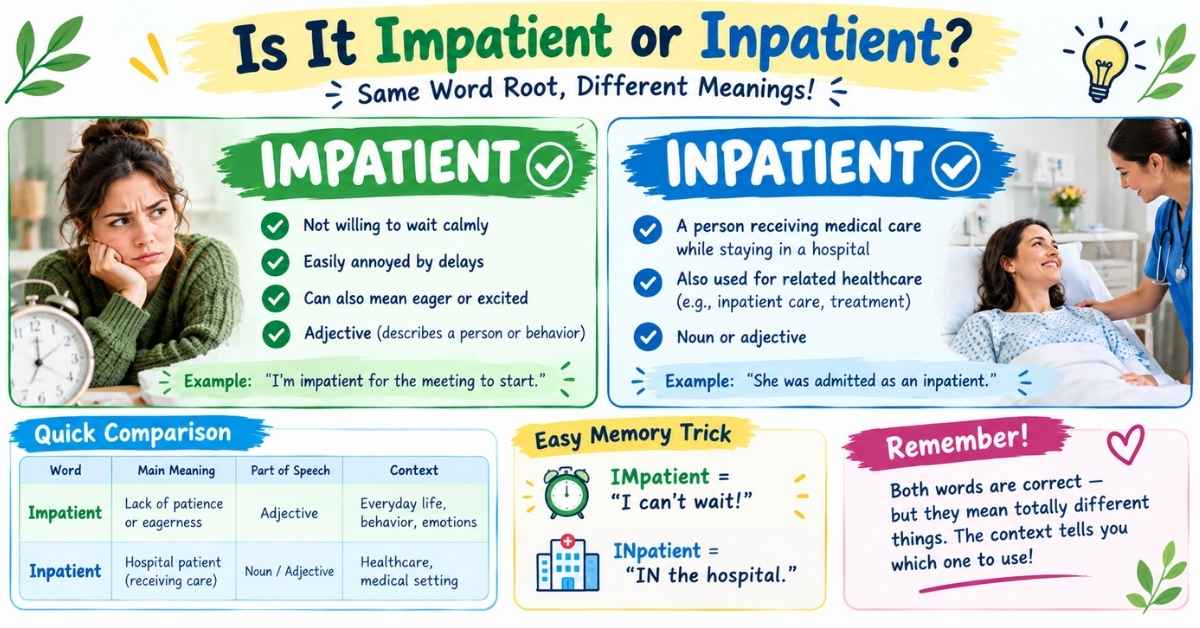
Is it impatient or inpatient? Both impatient and inpatient are correct English words, but they have completely different meanings. Use impatient when you mean someone is unwilling to wait calmly, easily annoyed by delays, or eager for something to happen. Use inpatient when you mean a person receiving medical care while staying in a hospital, or when describing healthcare such as inpatient treatment or inpatient care.
The confusion is understandable: both words contain patient, and their spellings differ by only one letter. But they belong to very different contexts. Once you connect impatient with waiting and inpatient with hospital care, the distinction becomes much easier to remember.
Impatient vs. Inpatient: The Quick Difference
| Word | Meaning | Part of Speech | Typical Context | Example |
|---|---|---|---|---|
| impatient | Not willing to wait calmly; annoyed by delay; eager | Adjective | Everyday behavior or emotions | She became impatient in the long line. |
| inpatient | A person receiving treatment while staying in a hospital; also related to such care | Noun / adjective | Healthcare | He was admitted as an inpatient. |
The simplest rule is:
Waiting or frustration → impatient
Hospital treatment or admission → inpatient
Cambridge defines impatient as someone who becomes annoyed because they have to wait, while also recognizing its meaning of wanting something to happen soon.
Cambridge defines an inpatient as someone who enters a hospital for medical care and stays there for one or more nights while being treated.
What Does “Impatient” Mean?
Impatient is an adjective describing a person, reaction, attitude, or behavior associated with a lack of patience.
You can be impatient because you are:
- waiting too long;
- annoyed by a delay;
- frustrated by someone’s slow response;
- eager for something to happen;
- unwilling to tolerate a particular situation.
For example:
I became impatient while waiting for the bus.
Here, the person is frustrated because the bus has not arrived. Nothing about the sentence involves medical care, so impatient is the correct word.
Oxford gives similar uses, including being impatient with someone, impatient at something, impatient to do something, and impatient for something.
Examples of “impatient”
- The children became impatient after waiting for an hour.
- He was impatient with the slow service.
- She is impatient to start her new job.
- They were impatient for the results.
- The driver became impatient in heavy traffic.
- Don’t be impatient; your turn is coming.
Notice that impatient does not always mean angry. It can also describe someone who is simply eager for something to happen.
For example:
She was impatient to begin the project.
Here, impatient means eager and ready to begin, rather than necessarily angry.
What Does “Inpatient” Mean?
Inpatient is primarily a healthcare term.
As a noun, an inpatient is a person who stays in a hospital while receiving medical treatment. Oxford gives this meaning and contrasts it with outpatient.
For example:
The patient was admitted as an inpatient for surgery.
Here, inpatient identifies the patient’s healthcare status.
The word can also work as an adjective:
- inpatient care
- inpatient treatment
- inpatient unit
- inpatient rehabilitation
- inpatient program
- inpatient services
Oxford specifically lists collocations including inpatient care, inpatient programme, and inpatient treatment.
Examples of “inpatient”
- The hospital admitted him as an inpatient.
- She received inpatient treatment after surgery.
- The facility has a specialized inpatient unit.
- His doctor recommended inpatient rehabilitation.
- The hospital provides both inpatient and outpatient services.
These examples have nothing to do with impatience or waiting.
Patient, Impatient, and Inpatient Explained
The word patient is where much of the confusion begins because it has two important meanings.
Patient as an adjective
If someone is patient, they can wait calmly and tolerate delays.
Maria is patient with young children.
Add the prefix im-, and you get:
impatient
That describes someone who is not patient, particularly when dealing with waiting, delays, or frustration.
Patient as a healthcare noun
A patient is also a person receiving medical care.
From this healthcare meaning, inpatient refers to a patient who receives care while staying in a hospital.
So you can think of the relationship this way:
patient → impatient
The adjective concerns patience and waiting.
patient → inpatient
The healthcare term concerns hospital-based treatment and admission.
This is more useful than simply trying to memorize two spellings.
Is “I Am Inpatient” Correct?
Usually, no, if you are trying to say that you are tired of waiting.
For example:
❌ I am inpatient for my food.
That is incorrect if you mean you are getting tired of waiting.
The correct sentence is:
✅ I am impatient for my food.
An even more natural sentence would be:
✅ I am getting impatient waiting for my food.
However, inpatient can correctly describe you in a medical context when used as a noun:
✅ I am an inpatient at the hospital.
This means you are a patient receiving hospital care.
The article an is important in this construction because inpatient is functioning as a countable noun.
Compare:
- I am impatient. → adjective describing your behavior or feeling.
- I am an inpatient. → noun identifying your healthcare status.
That grammatical distinction is one of the easiest ways to avoid the mistake.
Impatient vs. Inpatient Examples
Seeing the two words side by side makes the difference much clearer.
Everyday situations
Correct:
I became impatient when the restaurant took too long.
Incorrect:
I became inpatient when the restaurant took too long.
The sentence describes frustration with waiting, so impatient is required.
Medical situation
Correct:
The patient was admitted as an inpatient.
Incorrect:
The patient was admitted as an impatient.
The sentence describes hospital status, so inpatient is correct.
Another everyday example
She was impatient to hear the results.
She is eager and does not want to wait.
Another healthcare example
The hospital provides inpatient rehabilitation.
The phrase refers to rehabilitation provided in an inpatient setting.
Inpatient vs. Outpatient
If you are writing about healthcare, inpatient is often contrasted with outpatient, not impatient.
An inpatient receives care as a formally admitted hospital patient.
An outpatient receives medical services without being formally admitted as an inpatient.
This distinction matters in the United States because hospital status can affect billing and coverage.
Medicare explains that a patient becomes an inpatient when they are formally admitted to the hospital with a doctor’s order. It also notes that a person can receive hospital services as an outpatient, including observation services, even if they spend the night in the hospital.
That means this shortcut is useful but incomplete:
Inpatient = hospital overnight
A better rule is:
Inpatient = formally admitted for inpatient hospital care.
Simply staying in a hospital bed overnight does not automatically establish inpatient status under Medicare.
CMS also distinguishes inpatient hospital services from outpatient hospital services in its place-of-service terminology.
For everyday grammar purposes, however, you usually don’t need to understand billing rules. You only need to recognize that inpatient belongs to the medical-care vocabulary.
Why Are “Impatient” and “Inpatient” So Easy to Confuse?
There are several reasons.
1. They share “patient”
Both words contain:
patient
That makes them visually similar.
2. Only one letter changes
Compare:
impatient
inpatient
The m and n are easy to overlook when typing quickly.
3. Both words relate to “patient”
This makes the distinction even more confusing. But they developed into separate vocabulary items with different meanings.
4. Context determines the correct word
Consider:
The patient became impatient.
Here, patient means a person receiving medical care, while impatient describes the person’s behavior.
Now compare:
The patient became an inpatient.
Here, inpatient describes the person’s healthcare status.
Both sentences can be grammatically correct, but they communicate different information.
read more >>> Is It Impatient or Inpatient?
A Simple Memory Trick for Impatient vs. Inpatient
Use this two-question test:
Are you talking about waiting?
Choose impatient.
I’m impatient because the delivery is late.
Are you talking about hospital care?
Choose inpatient.
He is an inpatient receiving treatment.
You can also remember:
IMpatient → “I can’t wait.”
INpatient → “IN the hospital.”
The second is a memory aid rather than a complete explanation of the word’s linguistic history, but it works well for everyday writing.
read more >>> Is It Flutist or Flautist?
Common Mistakes With Impatient and Inpatient
Mistake 1: Using “inpatient” for frustration
❌ I am inpatient because the line is too long.
✅ I am impatient because the line is too long.
The sentence describes frustration caused by waiting.
Mistake 2: Using “impatient” for hospital care
❌ He was admitted as an impatient.
✅ He was admitted as an inpatient.
The person is receiving admitted medical care.
Mistake 3: Writing “impatient care”
❌ The hospital provides impatient care.
✅ The hospital provides inpatient care.
The intended term is a healthcare service provided to patients receiving inpatient care.
Mistake 4: Confusing inpatient and outpatient
❌ Assuming that every person who spends a night in a hospital is automatically an inpatient.
In U.S. Medicare terminology, formal admission matters; observation status can remain outpatient even when the patient stays overnight.
Can “Impatient” and “Inpatient” Appear in the Same Sentence?
Absolutely.
In fact, using both words together can make their meanings especially clear:
The inpatient became impatient while waiting for the doctor.
Here:
- inpatient = the person’s medical status;
- impatient = the person’s reaction to waiting.
Another example:
The impatient visitor asked when the inpatient would be discharged.
Again, the words perform completely different grammatical and semantic jobs.
This is an important point: neither spelling is inherently “wrong.” The correct choice depends on what you mean.
Is “Inpatient” One Word or Two?
In modern standard usage, inpatient is normally written as one word.
Examples include:
- inpatient care
- inpatient treatment
- inpatient unit
- inpatient rehabilitation
- inpatient services
Some references also discuss in-patient as an alternative form, but inpatient is the standard form you’ll commonly encounter in contemporary U.S. healthcare writing. Oxford lists inpatient as a single word.
Which Word Should You Use in Professional Writing?
Use the context test before submitting a document.
If you’re describing:
- frustration;
- impatience;
- waiting;
- eagerness;
- irritation;
use impatient.
If you’re describing:
- hospital admission;
- medical treatment;
- hospital care;
- rehabilitation;
- an admitted patient;
use inpatient.
This distinction is particularly important in healthcare documentation because medical terminology needs to be precise. In U.S. healthcare, inpatient and outpatient status can have practical implications for coverage and costs, so the words are not interchangeable. Medicare explicitly states that hospital status can affect what a beneficiary pays and what services may be covered.
Quick Decision Test
When you’re unsure, replace the word mentally.
If you could replace it with:
“unable to wait calmly”
→ use impatient.
If you could replace it with:
“hospital patient receiving admitted care”
→ use inpatient.
For example:
She was ___ for the meeting to begin.
“Unable to wait calmly” works.
✅ She was impatient for the meeting to begin.
Now:
He was admitted as an ___.
“Hospital patient receiving admitted care” works.
✅ He was admitted as an inpatient.
Frequently Asked Questions
Is it impatient or inpatient?
Both are correct words. Use impatient for a lack of patience, frustration with waiting, or eagerness. Use inpatient for a person receiving medical care while formally admitted to a hospital or for related healthcare services.
What is the main difference between impatient and inpatient?
Impatient describes behavior or a feeling; inpatient describes a medical status or healthcare setting.
Is impatient an adjective?
Yes. Impatient is an adjective.
She is impatient.
It can describe someone who dislikes waiting or someone who is eager for something to happen.
Is inpatient a noun?
Yes. Inpatient can be a noun.
He is an inpatient.
It can also function as an adjective:
He received inpatient treatment.
Oxford documents both the noun meaning and healthcare collocations.
What does inpatient mean in medical terms?
An inpatient is a person who stays in a hospital while receiving treatment. In U.S. healthcare, formal admission is important when determining inpatient status; simply spending the night in a hospital does not necessarily make someone an inpatient.
What is the opposite of inpatient?
In ordinary healthcare terminology, the contrasting term is outpatient.
An outpatient receives medical services without being formally admitted as an inpatient. Medicare notes that observation services can be provided on an outpatient basis, including situations in which a patient spends the night in the hospital.
What is the noun form of impatient?
The noun is impatience.
Her impatience was obvious.
Cambridge lists impatience as the noun associated with impatient.
Is “I am inpatient” correct?
It can be correct in a medical context if you mean:
I am an inpatient.
If you mean you are tired of waiting, use:
I am impatient.
Can impatient and inpatient be used in the same sentence?
Yes.
The inpatient became impatient while waiting for the doctor.
The first word describes medical status; the second describes behavior.
How can I remember the difference?
Think:
impatient = can’t wait
inpatient = medical care
That simple association will resolve most everyday spelling decisions.
Final Answer: Impatient or Inpatient?
The answer depends entirely on meaning.
Use impatient when someone is not willing to wait, easily annoyed by delay, or eager for something to happen. Cambridge and Oxford both document these meanings.
Use inpatient when referring to a person receiving medical care while staying in a hospital or to related healthcare such as inpatient care and inpatient treatment.
The fastest rule is:
Waiting or frustration = impatient.
Hospital care or admission = inpatient.
Once you focus on meaning rather than the single-letter spelling difference, the choice becomes straightforward.
