

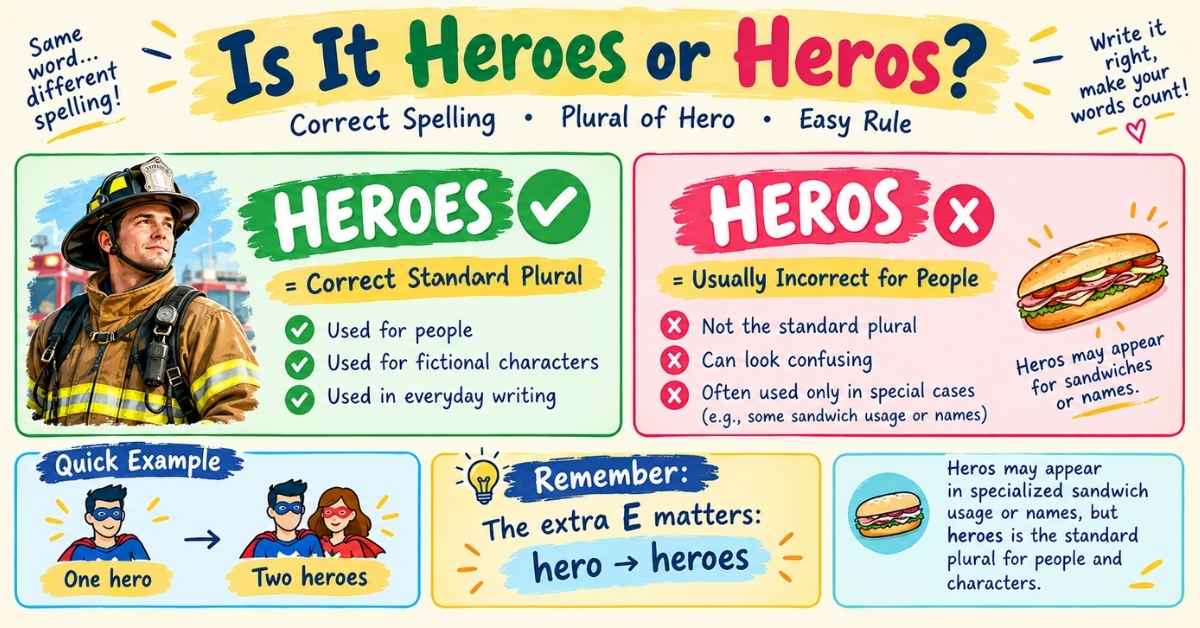
Is it heroes or heros? The correct spelling is heroes when you mean more than one heroic person, admired person, or fictional character. The singular is hero, and its standard plural is heroes. The spelling heros is not the normal plural of hero, although it can appear in a few specialized contexts, including some U.S. usage for a type of sandwich.
The extra e is easy to miss because many English nouns simply take -s when they become plural. That is why heros can look perfectly reasonable at first glance.
Heroes or Heros: Which Spelling Is Correct?
Here is the simplest way to remember the difference:
| Form | Use | Example |
|---|---|---|
| hero | One person or character | He is a hero. |
| heroes | More than one hero | They are heroes. |
| heros | Specialized usage, not the normal plural | Some U.S. sources use it for sandwiches. |
| hero’s | Possession by one hero | The hero’s shield broke. |
| heroes’ | Possession by multiple heroes | The heroes’ uniforms were ready. |
So if you are writing about firefighters, soldiers, teachers, parents, athletes, fictional characters, superheroes, or other admired people, use heroes.
Correct
The firefighters were celebrated as heroes.
Incorrect for this meaning
The firefighters were celebrated as heros.
The important point is that heroes is not an optional spelling variant of heros when you are talking about multiple heroes.
Why Is the Plural of Hero “Heroes”?
The confusion comes from the fact that English has more than one way to pluralize nouns ending in -o.
Some words use -es:
- hero → heroes
- potato → potatoes
- tomato → tomatoes
- echo → echoes
But other words simply take -s:
- photo → photos
- piano → pianos
- radio → radios
- studio → studios
That means you cannot reliably use a rule such as “every word ending in o takes -s” or “every word ending in o takes -es.”
For hero, the established standard plural is:
hero → heroes
The extra e is part of the spelling. It is not something you add only in formal writing.
Why “heros” looks so believable
English learners—and native speakers typing quickly—already know many straightforward plurals:
- book → books
- car → cars
- teacher → teachers
- student → students
It is therefore natural to think:
hero + s = heros
But English contains many irregular or historically established plural patterns. The safest approach is to learn the word as a pair:
hero → heroes
rather than trying to construct the plural from the spelling each time.
What Does “Heroes” Mean?
Heroes is the plural of hero.
A hero can be a person admired for courage, achievement, kindness, or another admirable quality. The word can also refer to a central character in a story, movie, novel, play, or other fictional work.
For example:
- The firefighters became heroes after the rescue.
- The novel follows three unlikely heroes.
- Her parents are her biggest heroes.
- The movie’s heroes must work together.
- The volunteers were praised as community heroes.
- Many children look up to sports heroes.
The word does not have to describe someone who performs a dramatic rescue. A person can be called a hero because of courage, achievement, sacrifice, character, or another quality that people admire.
Is “Heros” Ever a Correct Word?
This is where the answer becomes more interesting.
For the ordinary meaning of multiple heroes, heros is not the standard spelling.
However, heros can appear in specialized contexts.
1. Hero sandwiches
In U.S. English, hero can also mean a long sandwich, similar to a sub or hoagie. Some dictionary sources record heros as a plural for this particular food sense.
For example, a menu might use a form such as:
The deli sells meatball heros.
This is a specialized food usage. It does not change the ordinary plural:
The firefighters are heroes.
If you want maximum clarity, hero sandwiches or hero subs can avoid the spelling issue altogether.
2. “Heros” as a scientific name
Heros can also appear as a scientific genus name for cichlid fishes. In that context, it is a proper scientific name, not an alternative spelling of the plural noun hero.
For example, Heros severus is a recognized fish species.
That distinction is important: seeing Heros in a scientific database does not mean that heros is the normal plural of hero.
The practical rule
If you are writing about people or fictional characters:
Use heroes.
If you encounter Heros in a scientific context or a specialized name, do not automatically “correct” it to heroes. Context determines the meaning.
Hero’s, Heroes, or Heroes’?
Another common source of confusion is the apostrophe.
These three forms have different grammatical jobs.
Hero
Hero is singular.
The hero saved the child.
You are talking about one hero.
Heroes
Heroes is plural.
The heroes saved the child.
You are talking about more than one hero.
Hero’s
Hero’s is the singular possessive form.
The hero’s costume was damaged.
The costume belongs to or is associated with one hero.
Heroes’
Heroes’ is the plural possessive form.
The heroes’ costumes were damaged.
The costumes belong to or are associated with multiple heroes.
A useful way to remember this is:
hero = one
heroes = many
hero’s = one + possession
heroes’ = many + possession
So hero’s is not the plural of hero.
Is It “Superheros” or “Superheroes”?
The standard spelling is superheroes.
Because the word superhero contains hero, its plural keeps the same spelling pattern:
superhero → superheroes
Examples:
- The movie features several superheroes.
- Children dressed as superheroes.
- The comic book introduces new superheroes.
- These fictional superheroes have different abilities.
The same principle applies to antihero:
antihero → antiheroes
So these forms should generally be avoided when you mean multiple characters:
- ❌ superheros
- ❌ antiheros
Use:
- ✅ superheroes
- ✅ antiheroes
Is “Heroes” the Same in American and British English?
Yes. The ordinary plural is heroes in both American and British English.
There is no normal American-vs-British spelling change where heros replaces heroes when referring to multiple heroic people.
For U.S. writing, use heroes in:
- school assignments
- emails
- articles
- business writing
- social media posts
- stories
- captions
- professional documents
The spelling does not become heros simply because the writing is informal.
Common Examples of “Heroes”
Seeing the word in different contexts can make the rule easier to remember.
Real people
The rescue workers were praised as heroes.
The firefighters became local heroes.
The volunteers were recognized as community heroes.
People you admire
My parents are my heroes.
The athletes were childhood heroes to many fans.
She considers her teachers her heroes.
Fictional characters
The novel has two main heroes.
The film’s heroes face a difficult decision.
Comic-book heroes often have distinctive abilities.
Historical or cultural figures
The museum honors national heroes.
The story remembers the heroes who protected the village.
The common thread is simple: more than one person or character who is being described as a hero = heroes.
Why Do People Search “Heros or Heroes”?
The mistake is understandable.
English has a mixture of plural patterns, and many common nouns ending in -o take only -s. Seeing photos, pianos, radios, and studios can make heros look logical.
There is also no pronunciation clue that reliably fixes the spelling for you. In ordinary speech, the difference can be difficult to hear, so the problem mainly appears when you have to write the word.
That is why a spelling check is useful even when the sentence sounds completely natural.
A Simple Memory Trick for “Heroes”
Use this:
One hero, many heroes.
Or think of it visually:
hero → heroes
The extra e belongs to the standard plural.
You can also remember that heroes, potatoes, tomatoes, and echoes share the -es ending, while words such as photos and pianos show why you should not assume every noun ending in -o behaves identically.
The goal is not to memorize a universal rule. It is to remember the established spelling of this particular word.
read more >>> Is It Honey or Hunny?
Quick Decision: Which Form Should You Use?
Ask yourself what hero means in your sentence.
Are you talking about more than one brave, admired, or fictional person?
→ Use heroes.
Are you talking about one person?
→ Use hero.
Does something belong to one hero?
→ Use hero’s.
Does something belong to multiple heroes?
→ Use heroes’.
Are you talking about a specialized sandwich usage?
→ You may encounter heros in some U.S. sources, although hero sandwiches is often clearer.
Are you looking at a scientific name such as Heros?
→ Keep the scientific name as written; it is a separate use.
Frequently Asked Questions
Is it heroes or heros?
Heroes is correct when you mean more than one hero. Heros is not the standard plural spelling for people or fictional characters.
What is the plural of hero?
The plural of hero is heroes.
One hero
Two heroes
Is heros a word?
Heros can occur in specialized contexts, including some U.S. usage for the plural of the sandwich sense of hero. Heros is also used as a scientific genus name. It is not, however, the standard plural of hero when referring to heroic people or characters.
Why is the plural of hero heroes?
The established English plural of hero is heroes. English nouns ending in -o do not all follow one universal plural rule, which is why hero → heroes must be learned as the standard form.
Is “heros” correct for superheroes?
No. The standard plural is superheroes.
one superhero → several superheroes
Is hero’s the plural of hero?
No. Hero’s is the singular possessive form.
The hero’s cape was torn.
The ordinary plural is heroes.
What is the plural possessive of hero?
The plural possessive is heroes’.
The heroes’ costumes were damaged.
Are heroes and heros pronounced differently?
The spelling difference is primarily a written-language distinction. In ordinary speech, they may not provide a useful pronunciation clue for someone trying to determine which spelling to write.
Is heroes correct in American English?
Yes. Heroes is the standard plural form in American English.
What is the singular of heroes?
The singular is hero.
One hero
Several heroes
Final Answer: Heroes or Heros?
If you’re writing about multiple heroes, admired people, or fictional characters, use heroes.
The core spelling is:
hero → heroes
Not:
hero → heros
Remember the four forms:
hero = one
heroes = more than one
hero’s = one hero + possession
heroes’ = multiple heroes + possession
The spelling heros does have specialized uses, particularly in some U.S. sandwich terminology and in separate proper/scientific names, but it is not the standard plural of hero when you mean people or characters.
So if you’re writing a sentence such as “They are my heroes,” the extra e is exactly what you need.
