

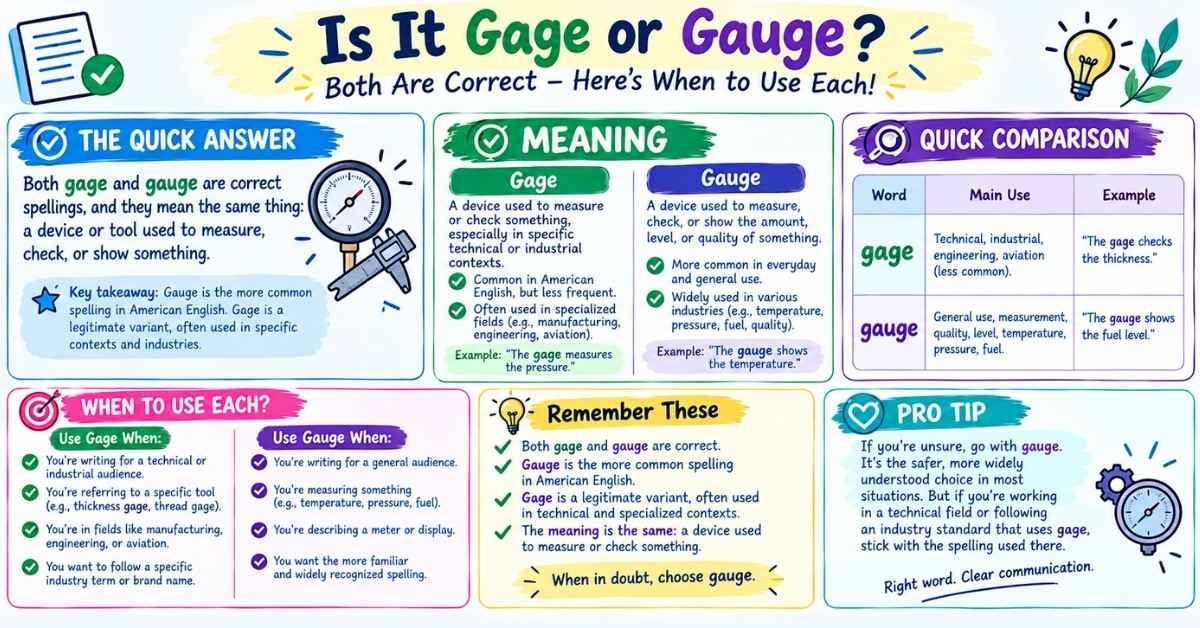
Is it gage or gauge? In most modern American English, gauge is the spelling you should use when you mean to measure, estimate, assess, or refer to a measuring instrument. Gage is also a real word, however, and it can appear as a variant spelling in specialized technical contexts or with older meanings. Cambridge specifically lists gage as a U.S. form of gauge, while Dictionary.com notes that gage can have both technical and historical uses.
So if you’re writing an email, essay, report, website, or everyday message, gauge is normally the safest choice. But don’t automatically assume that every instance of gage is a spelling mistake. The context matters.
Is It Gage or Gauge?
The simplest answer is:
| Word | General use | Best choice? |
|---|---|---|
| gauge | Measure, estimate, assess, measuring device | Yes |
| gage | Technical variant or historical meaning | Sometimes |
| gauging | Standard present participle of gauge | Yes |
| gaging | Variant derived from gage | Specialized use |
For example:
- Use: “We need to gauge customer interest.”
- Use: “Check the fuel gauge before leaving.”
- Use: “The engineer measured the pressure with a pressure gauge.”
- Specialized: An organization may deliberately use gage in its technical terminology.
The important point is that gage is not simply a misspelling of gauge in every circumstance.
What Does “Gauge” Mean?
Gauge has several meanings, but most are connected to measurement, estimation, or judgment.
Gauge as a noun
A gauge can be a device used to measure something.
Common examples include:
- fuel gauge
- pressure gauge
- temperature gauge
- tire gauge
- rain gauge
- depth gauge
Cambridge defines gauge as a device for measuring the amount or size of something and also gives specialized meanings involving railway distance and other measurements.
The word can also mean a standard or indicator.
For example:
Customer satisfaction is a useful gauge of how well the service is performing.
Here, gauge does not refer to a physical instrument. It means something used as a way of judging or evaluating.
Gauge as a verb
As a verb, gauge means to measure, estimate, assess, or judge.
Examples:
We used a thermometer to gauge the temperature.
It was difficult to gauge his reaction.
The company conducted a survey to gauge customer interest.
This is one of the most important distinctions for writers: when you mean “assess” or “estimate,” use gauge in normal English.
What Does “Gage” Mean?
Gage is a legitimate English word, but it has a narrower role in modern general writing.
One use is as a variant spelling of gauge, particularly in U.S. technical contexts. Dictionary.com identifies a technical sense of gage meaning gauge.
But gage also has older meanings that are separate from ordinary measurement.
Historically, gage could refer to a pledge, security, or an object offered as a challenge. Dictionary.com records this older sense and also identifies gage as a technical variant of gauge.
That means the sentence’s context can genuinely matter.
Gage vs. Gauge: What’s the Difference?
| Feature | Gauge | Gage |
|---|---|---|
| Standard general spelling | Yes | No |
| Measuring instrument | Yes | Variant in some technical contexts |
| Meaning “assess” | Yes | Less common |
| American English | Standard | U.S. variant |
| Technical terminology | Common | Sometimes established |
| Historical meaning | — | Pledge/challenge |
| General writing | Preferred | Usually avoid |
| Pronunciation | /ɡeɪdʒ/ | /ɡeɪdʒ/ |
The two forms are pronounced the same in their common modern uses. Cambridge gives the pronunciation as /ɡeɪdʒ/ for both.
The main difference is therefore spelling, frequency, convention, and context—not pronunciation.
When Should You Use “Gauge”?
For almost all ordinary writing, gauge is the form to choose.
Use the “gauge” when you mean measure
The technician used a pressure gauge.
Use the “gauge” when you mean assess
We need to gauge the team’s response.
or Use “gauge” when you mean estimate
It is difficult to gauge how much time remains.
and Use “gauge” for common measuring devices
Check the tire gauge before driving.
The fuel gauge is almost empty.
The temperature gauge showed a sudden increase.
Use “gauge” with interest
The company surveyed customers to gauge interest in the new service.
This last expression is especially important because “gauge interest” is the standard form most readers expect.
Gauge Interest or Gage Interest?
The preferred expression is:
gauge interest
For example:
The organizer created a survey to gauge interest in the event.
Here, gauge means assess or estimate.
You may encounter gage in some texts, but using gauge interest is the safest choice in general American English. Cambridge defines gauge as making a judgment about something, including people’s feelings and attitudes.
Other common expressions include:
- gauge public opinion
- gauge consumer demand
- gauge someone’s reaction
- gauge the situation
- gauge the risk
- gauge the temperature
- gauge the pressure
- gauge the distance
When Can “Gage” Be Correct?
This is where a simple spelling article often becomes misleading.
There are situations where gage is intentional and correct.
1. Established technical terminology
Some technical organizations use gage as their established spelling.
The clearest U.S. example is the U.S. Geological Survey (USGS).
The USGS explains that it has used the spelling gage for more than 100 years. Its terminology includes things such as stream gages and streamflow measurements.
In that environment, changing gage to gauge simply because gauge is more common would actually make the terminology less faithful to the organization’s established usage.
2. Historical writing
If you’re reproducing or discussing older language, gage may be appropriate because the word has historical meanings involving a pledge, security, or challenge.
3. Specialized industry usage
A technical specification, organization, database, or industry may have its own terminology.
The best rule is:
Follow the established spelling of the technical standard or organization you’re writing for.
Don’t “correct” a specialized term without checking the convention behind it.
Why Does the USGS Use “Gage” Instead of “Gauge”?
This is one of the most interesting details behind the spelling debate.
The U.S. Geological Survey says that gage is part of its institutional history and that the spelling has been used for more than a century.
The history goes back to the early development of systematic streamflow measurement in the United States.
According to the USGS, Frederick Haynes Newell was involved in developing early water-measurement methods, and he is credited with the adoption of the spelling gage within the agency’s terminology. The USGS notes that Newell believed gage represented an older Saxon spelling before the Norman influence associated with the added “u.”
That explains why you can encounter stream gage on official U.S. Geological Survey material even though stream gauge is also familiar in general English.
This is an important lesson in technical writing:
A less common spelling isn’t necessarily an error when it is an established institutional convention.
Stream Gauge or Stream Gage?
For general writing, stream gauge is a familiar form.
However, stream gage is also correct within the USGS’s established terminology.
The USGS continues to use gage extensively in its water-monitoring terminology, including stream gage locations and related data.
So the answer depends on your purpose:
- General audience → stream gauge
- Following USGS terminology → stream gage
Neither should automatically be labeled a typo.
Pressure Gauge or Pressure Gage?
For normal American English, use:
pressure gauge
For example:
The mechanic checked the pressure gauge.
Although gage can occur as a technical variant, pressure gauge is the much more recognizable general form.
The same principle applies to:
- temperature gauge
- fuel gauge
- tire gauge
- depth gauge
- vacuum gauge
If you’re not required to follow a specialized style guide, gauge is the safer spelling.
Gauging or Gaging?
This is another spelling that causes confusion.
The standard general-English form is:
gauging
For example:
We are gauging customer reactions.
The scientist is gauging the water level.
She is gauging the team’s response.
Cambridge identifies gauging as the present participle of gauge.
Gaging can appear when gage is intentionally being used as the base spelling, especially in specialized terminology.
So:
General English → gauging
Established technical convention → follow the convention
read more >>> Is it Payer or Payor
Gauges or Gages?
The same principle applies to the plural.
For ordinary writing:
gauges
Examples:
The dashboard has several gauges.
The technician inspected the pressure gauges.
The factory uses precision gauges.
Gages may appear where the organization or technical field deliberately uses gage.
Again, don’t assume that a technical document using gages contains a spelling error.
Common Examples of “Gauge”
Here are some of the most useful everyday examples:
| Context | Preferred sentence |
|---|---|
| Fuel | Check the fuel gauge. |
| Pressure | The pressure gauge is damaged. |
| Temperature | Watch the temperature gauge. |
| Tire | I bought a digital tire gauge. |
| Interest | We need to gauge interest first. |
| Reaction | She tried to gauge his reaction. |
| Opinion | The survey helps gauge public opinion. |
| Risk | We need to gauge the risk. |
| Distance | He tried to gauge the distance. |
| Situation | It’s difficult to gauge the situation. |
These examples show why gauge is the better default: it works naturally across both physical measurement and figurative assessment.
Common Mistakes to Avoid
Mistake 1: Calling “gage” always wrong
That’s too simplistic.
Gage is a legitimate word and a recognized variant in certain contexts.
Mistake 2: Using “gage” in ordinary prose
If you mean measure or assess and you’re writing for a general audience, gauge is normally the better choice.
Mistake 3: Changing technical terminology automatically
If a respected organization deliberately uses gage, preserve its terminology.
The USGS is the obvious example.
Mistake 4: Assuming different spellings mean different pronunciation
In ordinary modern usage, both are pronounced /ɡeɪdʒ/.
Mistake 5: Writing “gaugeing”
The standard spelling is:
gauging
Not gaugeing. Cambridge lists gauging as the present participle.
The Easy Rule to Remember
If you’re stuck between gage or gauge, use this rule:
General English → gauge.
Established technical terminology → follow the field’s convention.
For example:
- gauge interest ✓
- pressure gauge ✓
- fuel gauge ✓
- gauge someone’s reaction ✓
- gauging public opinion ✓
- USGS stream gage ✓ when following USGS terminology
That rule handles most situations without requiring you to memorize every exception.
Frequently Asked Questions
Is “gage” a real word?
Yes. Gage is a legitimate English word. It can function as a variant of gauge in certain U.S. and technical contexts and also has older meanings involving a pledge or challenge.
Is “gauge” the correct spelling?
Yes, in most modern general-English contexts. Use gauge for a measuring instrument and for the verb meaning to measure, estimate, assess, or judge.
Is gage or gauge preferred in American English?
Gauge is preferred for general American English. Gage remains a recognized U.S. variant, particularly in certain technical contexts.
Is it “gauge interest” or “gage interest”?
Use gauge interest in ordinary writing. Here, gauge means to assess or estimate interest.
Is it “pressure gauge” or “pressure gage”?
Pressure gauge is the standard general-English choice. Gage may appear in specialized technical usage.
Why does USGS use “gage”?
The USGS says the spelling is part of its history and has been used by the agency for more than 100 years.
Is it “gauging” or “gaging”?
Gauging is the standard general-English form. Gaging can occur where gage is intentionally used as the base spelling.
Is “gage” a misspelling of “gauge”?
Not necessarily. In ordinary writing, gauge is generally preferable, but gage has legitimate technical and historical uses.
Which should I use in an essay or email?
Use gauge. It is the familiar standard spelling for general American English.
Final Answer: Gage or Gauge?
If you’re writing for a general U.S. audience, choose “gauge.”
Use gauge for measuring instruments, measurements, estimates, judgments, and expressions such as “gauge interest” or “gauge someone’s reaction.”
Gage is not simply wrong, though. It remains a legitimate variant in some technical contexts and has separate historical meanings. The USGS’s use of “gage” is a particularly strong example of an established institutional convention.
So when you’re unsure, remember:
Gauge = the standard everyday choice.
Gage = legitimate in specific technical or historical contexts.
That distinction gives you the accurate answer without oversimplifying the English language.
